Category: Communication

  • Ethics/ Communication

    https://padlet.com/lmesag02/cuerpo-undefined-2-s024nn8v4vyyca71cz5m

    https://padlet.com/cuerpoundefined/collage-el-cuerpo-undefined-s023lvc2f36el4vh3xuh

    I guess this post can go into both categories. Still, to get my interventions out there, it was important for me to ask people to participate and share it with friends from Latino backgrounds to get diverse opinions from women in Latin America, so I started. Hence, I sent it to some of my friends who had completed a previous one and who were willing to help me and send it out, and I gu. I thought this was important in my communication since I needed to be careful about who I sent this to and make sure that I was not triggering people who were already going through a tough time, as well as making sure that I was sending the right message to get people to want to engage with the content. I also had to ensure I followed ethical guidelines by making sure people participating and reacting to this artifact knew it would be used in my research and that a certain public would read it. Since it was done in a Padlet, people also had the option to participate in it without including their names, which I thought was important. I also made sure the ethics and consent were clear and readable because I never want to be in a position where people can’t find it or it’s hidden. So, before people started the activity, they needed to review it and make sure they understood what they were signing up for. This is something that I did on both of the Padlets.

  • Bouncing of ideas with a friend

    Earlier this week, I felt a little stuck, and I started a conversation with one of my friends in Colombia, who I also consider one of my stakeholders. She is one of the people who responded to my last intervention. I felt a little defeated and like I didn’t know what to do, so I shared one of my other interventions from before I finished the master’s, and she gave me a couple of ideas I found important to include here. It started with an idea of getting people to speak more vulnerably about their body-image issues and giving them information about where some of those issues might come from. This started as an idea for a card game in the format of “We’re Really Not Strangers” to spark deeper conversations, and this could be an interesting idea to explore. Secondly, she talked about making an artifact in the form of a body and getting different people to interact with it and share how they felt about their bodies, and I also thought this could be something I could implement further as well; these were two of her ideas. These conversations are really helpful because hearing people’s perspectives on what this could end up looking like is really interesting to me. I am going to keep on trying to see what this might end up looking like because I have found this process really hard and also not something I am used to because the expectations and what things have to look like have always been very clear, and having them look in different ways has been very interesting but at the same time challenging for me. 

  • Meeting with Dr. Sabrina Springs

    I have had one of what I would consider a great breakthrough or a great step towards my project, having contacted Dr. Sabrina Springs a couple of weeks ago. Dr. Sabrina Springs is one of the central people I have been researching throughout my entire investigation. Several contacts have told me it would be very important to look at her work. I was able to secure a meeting, which will take place on August 17th. I will start preparing for that conversation this week because I want to make sure I am as prepared as possible. If she is giving me her time, it is important that I am as prepared as possible and can keep working on everything that I want moving forward. I think this will be a crucial step because one of the main things I want to accomplish is to shed light on all the information she has already created. After all, only a select number of people have read her work, and it is very important and has been central to my investigation, which makes it incredible that I will actually get to meet with her. 

  • Social Media Detox Impact – Ezgi Biçer

    I met Ezgi through one of my peers in the master’s program, Defne, who is one of her friends. She told me how she changed her view of life by doing this experiment, and I asked her to share her experience; she was happy to, which shows me the effect social media might have on young girls. This girl decided to delete all of her social media for a month, except for Snapchat,e to keep in contact with her close friends because this was her form of communication. She started doing it specifically because she was addicted to social media and was always doomscrolling, which led to a large amount of procrastination and left her without time to do anything else. She spent all of her time on social media, and that is why she deleted it to be more present because she started to develop body dysmorphia. After moving to London, she noticed some changes in her body. Now everyone is on Ozempic, which led to her seeing a lot of unrealistic bodies, and the more she gained weight, the more she saw people getting skinnier. She started to consume this type of media; this led to her feeling depressed because she felt everyone had the perfect body and she was fat. Still, she started thinking that skinny fat was the new fat, and she was not even this, but this is how she felt, and as if she should see a doctor, and felt as if she was overweight when she was actually of normal weight, and she was worried. Every time she would like herself in an outfits and she would look at her phone and this girls with their bodies she would look at the mirror and feel as if she was larger and that was why clothing did not look good on her which lead to her stoping wearing the outfits she wanted to wear because she presided herself as fat and after deleting social media she had more time to be taking care of her body and dealing with the addiction to scrolling. She realized that she stopped snacking and would eat even if she knew she was full, and she had issues with bingeing. Maybe it was because she was determined to lose weight that she started to restrict herself, but she did not crave anything, which was weird for her. The best thing is that now that she does not see these girls on social media, she started to feel more confident in her body because she was not exposed to unobtainable bodies all the time; she does not have that reminder on her phone. She thinks everyone is having filler faces and having a lot of work done on their bodies as well; it is now a different beauty standard. She feels as if she has to do all of this and look like these girls as well. She is now more mindful of how social media affects her and realizes that these girls are only showing their best moments. It was good to get a break and talk about how easy it is to get lost in social media. Going through this and hearing about her experience, I think a lot of girls have this same issue and think a lot about comparisons with other people on social media, and one important thing is to understand that this is these girls’ job; it is their career, and that is also why they look the way they do. 

  • Building a Network Interviews, the process and challenges

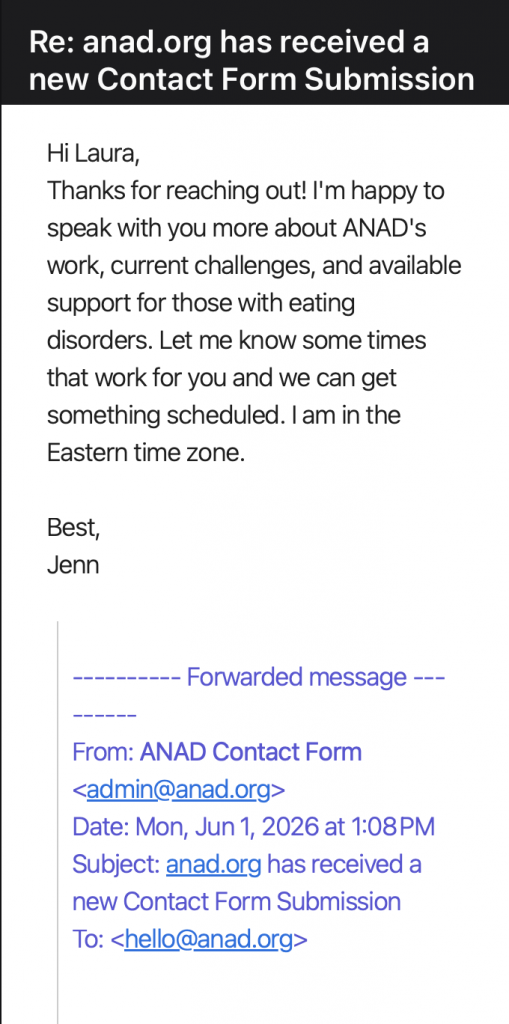
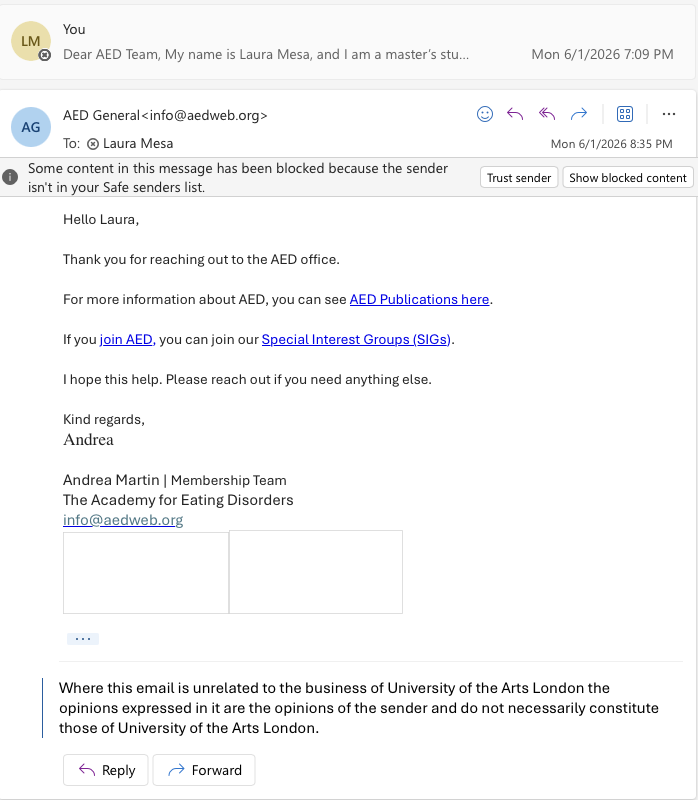
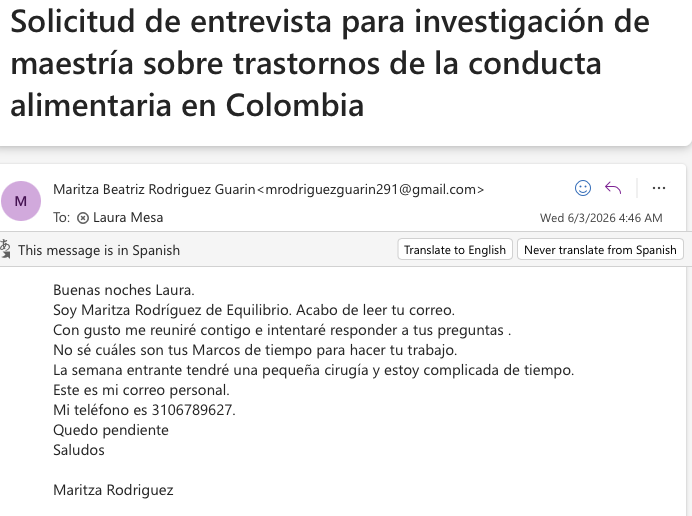
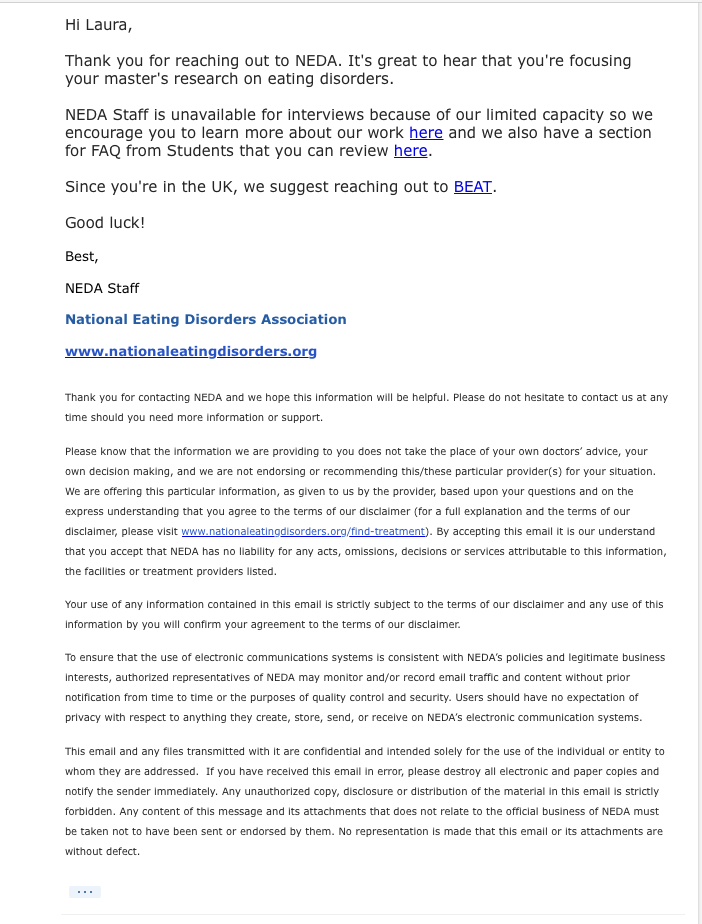
    After my tutorial this week I realized I needed to get my brain into doing more networking and started to reach out to organizations that work both with eating disorders and body image and there have been mixed responses but I was happy to get responses either way, First of I was careful to respond everyone who reached out to me even if it was to tell me that they could not help me but I wanted to say thank you for the time they even took the time to respond to me instead of just ghosting me however I have gotten two responses about the possibility of meeting. I have a couple of organizations from the USA, the UK, and Colombia, and hope to have a time we can meet by the end of this week or the beginning of next. Even though it was hard to put myself out there with these organizations, it is important to do it, and it is a part of the process that needs to be followed. I hope to get a couple more interviews and learn what the prescription for the inside looks like for these issues.

  • -Network-

    My network is evolving right now, and I have faced a couple of challenges along the way. I am sure that they will continue to happen, but I will not stop until I find the correct network that can help me achieve my goals. I have started by reaching out to influencers in Colombia who have openly discussed their struggles with food and body image. I have only received one response, and I am waiting to see who else I can contact who might be helpful in this area. I have also started reaching out to several organizations that are trying to combat this in various ways, such as NAAFA (BBC). However, I have also started to reach out to several support groups dealing with eating disorders, but want to find more to reach out to and will continue to research this is a challenge because a lot of these groups are very closed, and the people participating in some of them might not want to discuss their struggles since this is something that is still very taboo in a lot of societies. I also have reached out to several artists, including Ally Z, who creates pieces about her experience with her several eating disorder struggles and how it looks different at several times and what it means to her (Ally). I have also started looking at more artists with a similar goal whom I could contact. I also was able to look at some of the previous projects that were done in the masters that are relevant to my topic and decided to contact them as well to see what similarities they might have and ways in which they could help me complete a meaningful project tis artists are Shuang Zheng who looked at eating disorders in China and how there could be a change on education (Zheng). One thing that I discussed with my tutor is the fact that I want to do something after I graduate pertaining fashion, marketing, journalism or PR and I want to try to build a network around it in order to create something that can help when I graduate as well which includes reaching out to different magazines as news papers and some different media outlets as well as experts in this fields that I might find and I will continue to work on who else is relevant in my network. One person I have access to, whom I had not even realized, is my aunt, who I actually have had several conversations with this past week, since she is an activist in Colombia and has been involved in aspects pertaining to our culture, and our conversations actually led me to look at my project from many different angles that one might not even realize are possibilities. However, I am aware that plans might change, since networking is very challenging and it can be hard to get a response at times. I will have to look at different people than the ones I have planned, but everything is doable if I stay persistent, even when it is hard. 

    (No date) Eat well – Shuang Zheng – Ual Showcase. Available at: https://ualshowcase.arts.ac.uk/project/510139/cover (Accessed: 21 May 2026). 

    What is the history of body positivity? (2023) BBC Bitesize. Available at: https://www.bbc.co.uk/bitesize/articles/z2w7dp3 (Accessed: 20 May 2026). 
  • Conversation at Eatica

    Eatica is an eating disorder clinic in Barcelona, Spain were they treat all kinds of eating disorders and disordered eating and through conversations with one of their psychologist I was able to learn a new fact that I had no idea had any correlation between the two and it is of neurodivergent and Bulimia Nervosa and it is that there is a direct correlation between the two especially when the neurodivergent hyperactivity Is not diagnosed and is left to the child to deal with that they experience coping mechanisms and one of them is binging and purging which is a clear symptom of the eating disorder swell as the fact that the only medicine that has been approved by several countries for Bulimia and its regulation is one that is also used for ADHD which brings us to the idea of inadequacy and that if a person is not diagnosed for several reasons with ADHD they have a higher risk of developing an eating disorder such as this.