Author: Laura Mesa

  • “De que sirve comerse el mundo si nos obligan a vomitarlo” – “What is the point of overeating if we are forced to purge it?

    https://www.conexionsabana360.com/historias/desafios/trastornos-alimenticios-en-colombia-historias-reales-y-un-sistema-ausente

    This is an article I found about a Colombian media enterprise, and the title was very provocative but also extremely relevant. There is no direct English translation because it uses a lot of Spanish vocabulary. I did my best to make it as close a translation as possible. 

    • In t furtherhis article there is a following of young women called Catalina, Daniela and Merari and their personal experiences with their eating disorders and the first image that comes up is of Catalina measuring her wrist every morning with her other hand to see the amount of extra space that she has been able to create she had severe symptoms with running 6km at 4am and going to work out more at 5am and then not having eaten properly the night before. While she was in line at the school cafeteria, she heard some of her classmates talking about another girl and saying she got fat during the break because she had let herself go; even though this wasn’t a comment about Catalina per se, she took it to heart. After this, she starts to open up Instagram and starts seeing what is out there today, which are unreal bodies, comments, and likes that have become a form of currency, and through all of this, her illness continues to grow and become stronger. 
    • In Colombia, one out of 5 young people have symptoms of Ed’s as part of their day-to-day lives, and 8 out of ten never make it to a doctor’s office to get help. They call it a small epidemic because in Colombia, there is a belief that it is a stubborn childhood thing. 
    • For years we have been told that ED’s have nothing to do with vanity, but in reality we have to start questioning this. It is not vanity of the individual, but the author believes that it is collective vanity which has been fabricated through word of mouth but also through algorithms, publications, and comments that talk about the ideal body, which is a form of romanticizing the extreme thinness that we are seeing today. It is not just teenagers wanting to fit in; it is a world where this has become the standard to follow. Society has taught us that there is no room for bodies that look different. 
    • Daniela is a 23-year-old woman, and she lived the struggle because she knew most of the pictures and media out there were edited. However, she still felt she needed to meet that standard to have any worth as an individual (why is our body or our appearance part of our worth?). Merari, who is 24, remembers that at age 12, a family member, after commenting on her appearance, recommended she have a couple of cosmetic procedures done, and that she was helped at different medical institutions while she was expecting to receive help. Their concern was just your fat, even though it was a much greater problem, and this is a form of violence (however, this is something that we have normalized in Colombia; everyone has an opinion and they feel it is their job to share it; no one can just stay quiet). (Even if they think they are being nice, I had this experience when I was visiting a friend in Barranquilla, where I had never been, but we went to an event where we ran into a lot of people and friends of her mom’s, and their reaction was to tell her how thin she looked, that she looked amazing, and I could tell she felt uncomfortable; she did not want people to comment on her body, but it is our normal no matter how much we try to change it. My question is: will there ever be a point when people no longer comment on others’ bodies, or is that an impossible hope? 
    • The numbers about how little information is out there can be seen in the fact that less than 20% of young people who suffer through symptoms get specialized treatment. A nutritionist consultation is around 150,000 pesos, and one with a psychiatrist is 300,000; for people who actually make it out of this illness, it is a luxury. Daniela speaks about how she looked for help after having a health scare at her university but had to leave this behind because the therapy treatments were just too expensive. 
    • There is a law in Colombia called 2560 however there are some gaps that include this, this is a law that tries to help with mental health services however there is no direct mention of eating disorders and the help that is needed for this, there needs to be a specific focus on this (as I have said in other blog posts the treatment is the same one they give alcoholics and drug adicts) Paola who is a nutritionist said that the problem is not just social media but the fact that ones entire life is made to loose weight if you eyxcersice it is to loose weight, if you eat healthy it is to loose weight. We have made well-being an obsession about a size, and this makes it easier for people to fall into eating disorder issues. The mirror becomes an enemy that always shows us where we are not good enough, and negative thoughts about one’s body are like social media notifications that can’t be turned off. The algorithm is not your friend” (When interviewing a young girl from Colombia who is 23, she feels as if it is based on what side of the algorithm you are in and how you feed it because she feels as if her algorithm is about accepting your body, but there are other extremes; this is something to look into as well). 
    • One of the main questions that is posed on the inside of the article is the fact that we have the stats, we have the numbers, and the possible effects it might have on other people; however, we still try to minimize it by saying it’s life and it’s all vanity, but narratives and messages that we send out into the world such as this make things much worse and give out a message of people not needing help. 
    • A lot of people assume this is something that happens in one’s teenage years. It is something people think they will grow out of; however, this is not reality at all because we have created “an entire system that is obsessed culturally with impossible standards and an appearance of trends that ends up being an illness.” This leads us to ask: if we deleted a picture on Instagram because it didn’t fit the standard, we should take care of our brain the same way we take care of our size. 
    • The toxic fitness culture (this is a huge issue in Colombia and you can see it just by speaking to normal people it is normal for a child to do more than 3 hours of exercise a day because there is the feeding of the line that you always have to keep your body moving) this is a game no one will ever win because you are always chasing the imaginary perfect body however even though this is an issue and people understand this there is the fact that the health cares system in Colombia does not have prevention campaigns, no easy way to get early diagnosis and no teams that work in interdisciplinary ways. What should be a right to health care is turned into a luxury (this is what I have been talking about in my positionality statement because even though I have suffered with my body image and eating disorders, I have had access to pay for all the different treatments and programs, which is not something everyone has access to, and there should be different forms to make this accessible, such as it is in other countries of doctors I have spoken to).
    • During this article, at the end, different things are spoken about; for example, there is the relationship between the collective and the intimate, and this is what truly makes everything uncomfortable, such as the fact that Catalina is still measuring her wrists. Daniela still remembers having passed out in the middle of her university, and Merari is still pissed off at the doctors who did not listen to her, and what is scary is that these are not rare cases; there are many more. The writer of this article wrote at the end that she was a victim of an ED, and while she understands that it’s an illness, she makes note of the fact that it is born out of vanity of wanting to fit into the standard. It is a trap to try to find the impossible.

    This article really makes me think because we treat it as isolated incidents, but in reality the pressure around the body in Colombia is very strong. It is not easy to fight against, given that we are all put into this little hamster wheel where we are trying to fit into a specific body size and fit in. – This is my own experience, but I always tried to fit into the society of my town in Medellin, and I never truly could. It was a mess for my self-esteem because I was always looked at as different, but that difference is seen as bad, and in reality it is just different. Everyone tries to mask something about themselves, which is important to consider as we look at how people can break out of the mold without feeling like failures. (This is not a part of my investigation; it is just a thought that came to mind while I was reading this article).
  • Positionally Statement

    I am approaching this research surrounding body image and eating disorders from an extreme position of privilege and difference because I consider myself a survivor of Bulimia Nervosa after suffering for 10 years, as well as disordered eating; however, I had the possibility of approaching treatment and help through doctors and psychologists as well as psychiatrists. I was never in a position where I had to think about how much getting help was going to cost me since I had the financial and emotional support of my family. I am of a straight size; as an ally, I am not a person who lives inside of a marginalized body, and I do not face discrimination around my body size in my everyday life. It is a struggle whenever I am talking about my family, but I have never felt unsafe because of the way my body looked. The access to help that I had is not common, and even though it was a struggle and I only approached the moment of getting actually specialized help earlier this year and continue to be in treatment, I was always able to get help through other means, which is very helpful, and it is not something that everyone in my circle has access to. 

    Through my research, I am looking at my stakeholders as young women who have suffered through eating disorders as well as body image struggles and focused more on body image since eating disorders is such a sensitive topic. I never want to make people feel unsafe, and I want everything to be as ethical as possible. I am very upfront about what is happening and set the parameters, and I let everyone I talk to know that our conversation will be added to my student blog; I ask whether they are okay with that to make sure I am following all ethical parameters. I also understand that this is a taboo and hard subject for people in Colombia to speak about and hear about, so if at any moment they want to retract their statements, they are completely free to do so. I am a mix of different cultures, which is also a part of my position because, even though I was raised in Colombia and identify as Colombian, I also grew up between the States and Europe, which gives me a different outlook on the subject and makes it even more necessary for me to be extremely sensitive to the different people I am speaking with. 

  • How to identify if an eating disorder exists in your surrounding

    This is a piece I found from a group of Colombian investigators about eating disorders and how to identify when they might be happening.

    • One of the main things that they talk about is how for a lot of patients this was an issue that started during the time of the pandemic in lock down. Especially in the cities there was a lot of isolation, there was a lot of fear surrounding the economy and a lot of uncertainty in the world which lead to there being a rise in eating disorders in the years that have followed after the pandemic in 2020 in this cases there are worst symptoms in the patients. One of the main things one should try to do is catch the issue early and this is where parents need to learn what is going on. (Parents don’t think its real or try to ignore it because they are not aware that it is happening or some of them even like it because it is helping their children fit into a standard that we have all had in our brain as what should be done).
    • There are physical warning signs and this include when there is a large amount of weight loss, this also causes malnutrition which comes with their own set of symptoms including hair loss, always feeling cols and period irregularities. they also talk about the fact that not all eating disorders mean that there is extreme weight loss there are a lot of eating disorders where the weight might remain stable or even have an increase, however one thing that is persistent in all of this eating disorders is the fact that there is always a fear of gaining weight. (It is extremely important to explain and get education out there to say that eating disorders do not just include loosing a n extreme amount of weight there are a lot of them that do not include this and there is even a weight gain for example I suffered from a very strong bulimia for a long time and people would not notice it because I was of a healthy weight or even at times overweight so it did not make sense to them that I needed help and my family was not doing this because they did not care but because they did not know).
    • (There are a lot of signs that are actually in a form of behavior and that need to be looked at closely because you don’t want to be the person that is responsible for offsetting a moment to make a person uncomfortable and take a path like this because of their own personal trauma) The signs that one might look out for are a lot of new found interest in cooking and nutrition knowing how many calories are in everything, what oil and amount is being used, they will start to only eat certain types of food for example what is considered healthy and will not have anything else, leaving the table and going straight to the bathroom between meals, social media and being on a path of only following people who are fitness influencers and about diets and healthy eating (an example I can think about is how know there is Liv Shmidt and the skinny society and how now everyone is obsessed with walking because it is the new trend to follow). Felling guilty after eating and doing an exaggerated amount of eyxcersice.
    • There are also a lot of emotional signs that can be seen in individuals who are suffering through an eating disorder (One thing that I think is very important is to not look at them through the eyes of judgment and thinking that they are doing this to themselves and they are not being honest but you have to look at them as sick and needing help whenever I felt judged I felt the urge to go back to my compensatory habits but when people actually sat down and tried to understand it was what helped the most). They start to have a lot of moments of sadness, irritability, low self esteem, mood swings and are always on edge (They are always scared of getting caught) there is also the fact that there starts to be a distortion on their body image they start to think they look different than how they actually look and there is distress about what they look like. There is a severe dissatisfaction with their bodies and they are always chasing the self imposed impossible standards but it is not just about their body you start to see this surrounding their food, school, work and there is a level of perfectionism and severe fear of failing.
    • There are different tips that they try to give parents in this article, they say that they should not try to approach it through hopping that is they ignore it then it will go away the research and statistics show that this actually makes the situation worse. Open up spaces to speak about this and dont just wait until they ask for help try to intervene when you see there is a problem and speak about it openly, DOnt make this the discussion you have around the dinner table because there is already a lot of pressure in that space if your child is suffering try to talk about other subjects at the dinner table. Gently try to get them some help maybe starting out with a therapist they feel safe speaking to.

    this was an interesting article because I think that a lot of parents might be able to see themselves somewhat through this because parents don’t now how to act when it comes to this subject there is a lot of pressure on parents but no one has taught them how to be parents there is no perfect way to handle a subject such as an eating disorder and disordered eating with a child or loved one and this gives some good tips on what one should do I think that there should be more information about what to do when the eating disorder looks different than what the stereotype we have built in our brain is because even if they look healthy they are not necessarily healthy and they deserve the same kind of help and attention.

  • “How the Use of BMI Fetishizes White Embodiment and Racializes Fat Phobia”

    https://journalofethics.ama-assn.org/article/how-use-bmi-fetishizes-white-embodiment-and-racializes-fat-phobia/2023-07

    This article, written by Sabrina Strings, whom I met with, has been fundamental to my project and the research I have been doing, and it explains the origins of fat phobia. One of the main things I have been learning is that there is a belief around the world that says if a woman is bigger in size,

    then that means that they are unhealthy, and everyone is looking down on them, like saying Poor thing, they don’t know how to control themselves or eat; they must not know how to manage their emotions; what a pity and this is something that is complemented with BMI because it is a study that people use very often, and if you do not fit into the categories, then you are overweight or underweight, and that means unhealthy, and that is not necessarily the case; they are not mutually exclusive. 

    • What she is trying to express in this article is the fact that BMI is not a neutral medical tool; it is not scientific. It started as a way of saying that fat was not a white issue but a “problem” of non-white people, which made them bad or a problem or even inferior, and this was a way used to rationalize this theory as medicine and health; however, it is a way to rationalize the bias towards different races as well as beauty. If you don’t fit into this square or range, then you are incorrect. 
    • This was something that started as racism, not health, in the 1700s because fatness was a common denominator in ethnic groups such as African and Chinese women, so this made them inherently less, and this was the “proof” that they used, which shows us that it was not about health; it was about finding a way to make different people inferior, but reality is that it was just different. 
    • In the years 1800-1900, this theory was made official by eugenics. This science was used to make people think of differences as better or worse; some traits were considered more attractive, while others were considered worse. This was even backed by scientists such as Charles Davenport, who made the claim that being fat was a defect and stated that people who were racially Chinese or Jewish were the main people who suffered from “racial obesity.” This was when people started to believe it was a disease, not just an opinion or a fashion.
    • In the Early and mid-1900s, there was the case of insurance companies having their own parameter in the form of a standard weight in their insurance policies to limit issues and make sure that whoever they were insuring was “safe” (One of the main things that we need to learn is that fat does not mean unhealthy and thin does not mean healthy). However, these standards were based on white men, not women, and did not consider other races. Then there were medical papers that were published saying that people who were overweight under the BMI standard that the cause of 95% of the people being overweight because of overeating and not having healthy habits; however, there is no real proof of this. It is just words. Still, they have power, and people keep believing this statement even without real scientific backing.
    • In the 1950s and 1970s, a scientist named Ancel Keys gained attention. He actually created BMI, which was the easiest way to calculate who was overweight and who was underweight, and even though it had little scientific backing, it was still something that continued to be pushed, and he, as a person, referred to fat people as “disgusting and repugnant,” which shows us that he had ulterior motives based on his own images or his own opinions. 
    • In the years of 1973-1995, BMI became the standard by which government and medical agencies measured bodies, and what is even scarier is that we still use it today (Why? When we have had all of these researchers talk about how this is inherently only made for a certain kind of person and body). These numbers weren’t shaped only by science, but by beauty standards, and what is sad is that it was tested on a very small group of people, so it didn’t apply to everyone. 
    • Even though it seems scientific and natural, it is honestly just a new form of racism, but it makes it seem official. 
  • ATAVIOS book

    Earlier this week while I was trying o look for new books to read in order to get even more information on the subject of body image and trying to connect it to Colombia I came across this book of photography that shows, “The roots of Colombian Fashion” when looking at it I thought it was very interesting however there was one thing that I kept looking at and it was the fact that al of the women’s bodies who are represented seem to be the same they all look like models if the idea of the book which is expressed to be, “…Colombian Jewlery on display against a black background would look infinitely better if it were molded by nude men and women, whose bare skin would show off the inartistic beauty of the object” (pg.9) I understand the context that it was a fashion book and we have evolved and times have changed however there are a lot of things that come into play but if we are critically thinking that it is done to show the beauty of the objects then what it is telling us is that it would not look beautiful on people who are of a larger body and this brings in the question of asymmetries making one better than the other or thinking something is better than the others but this is something that is very complicated because if your life depended on your art and there comes a time when we have to think about the message we are sending because this is not a representation of most Colombians it is the people that dedicate their life to this however when I am thinking out loud and through my own opinion I realize that betray is in the differences if not why where we all made different and this is what has to be seen in the beauty of our differences but we have been told we need to fit into a specific mold in order to be worth anything and this is a very scary subject because it makes me think about what is next and how we are always trying to get to the next level, there is a saying in Colombia “Si yo me hubiera echo me seguiria puliendo” Which is in translation if I had made myself I would still be perfecting me and this is scary because when are we going to be okay with what we are when is enough going to be enough why do I only see perfection in this books and magazines but its not even perfect it is just an idea we have in our brain of what is perfect and what is not. (Why do we believe there is such a thing as perfect?)

  • Pivot from Intervention at Euston Square

    https://padlet.com/cuerpoundefined/collage-el-cuerpo-undefined-s023lvc2f36el4vh3xuh

    After realizing this wasn’t going to work and that no one was interacting with my artifact, I decided to do some damage control. I got a lot of traction when I asked questions in a Padlet, so I used the same Padlet. I created a pause; I included all of the questions I was trying to ask and asked people to analyze the artifact at the top, including the ethical and consent part, where I told them that if at any moment they felt uncomfortable or as if they no longer wanted to participate, to stop, and if at any moment they felt as if they wanted their comment or interaction to be deleted, to let me know. I would do it immediately, since I wanted to make sure this was done as ethically as possible, and I started to send out this Padlet and asked my network to help me get it out there. I got a lot of reactions and saw that different people interpreted what I created differently. It was interesting to look at so many points of view. Still, one really important thing was realizing that when I ask people to participate in activities like this, some are willing to participate and think it is important. This was an important finding, as was realizing that in this format I have a better chance of reaching my actual stakeholders, not random people at a train station. 

  • Consent and Ethics

    I have only had one intervention about signing that they are okay with, but this is participation likeness when using. However, when I spoke to my experts and to different people I interviewed, specifically when I was filming or voice recording them, I made sure to ask them several times if this was something that they were okay with and if it was okay if the information that I had gotten and made into notes or the videos be shared with my professors and teachers, as well as with my classmates. They all agreed, and I have their verbal consent in my voice notes. This is also why when I have gotten the recommendation that maybe one of my interventions can be to make some of my blog posts open to the public I explained that I did not have permission to do this and did not ask for this type of consent and I have no way of reaching out to some of the people who participated since it was done in a very uncontrolled setting however they all agreed to participate and whenever a person was not comfortable I immediately moved on and left them alone because I never want to make people feel unsafe or disrespected however this was not something I felt was very common in my previous interventions but it might have been a good idea to get not just verbal consent from the people I interviewed and recorded even though I made sure they were okay with it and when we finished the meetings I asked them again and made sure this was something they were comfortable with but I should have had it more in writing which is a mistake I have made in this process but hope to be able to learn from it. 

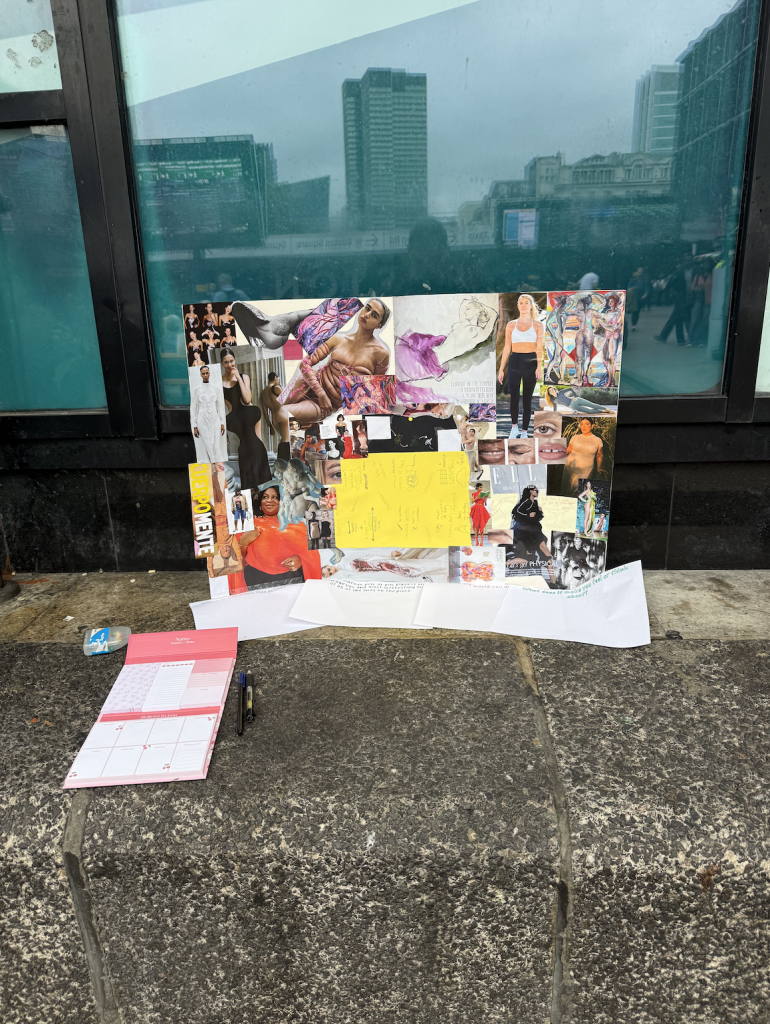
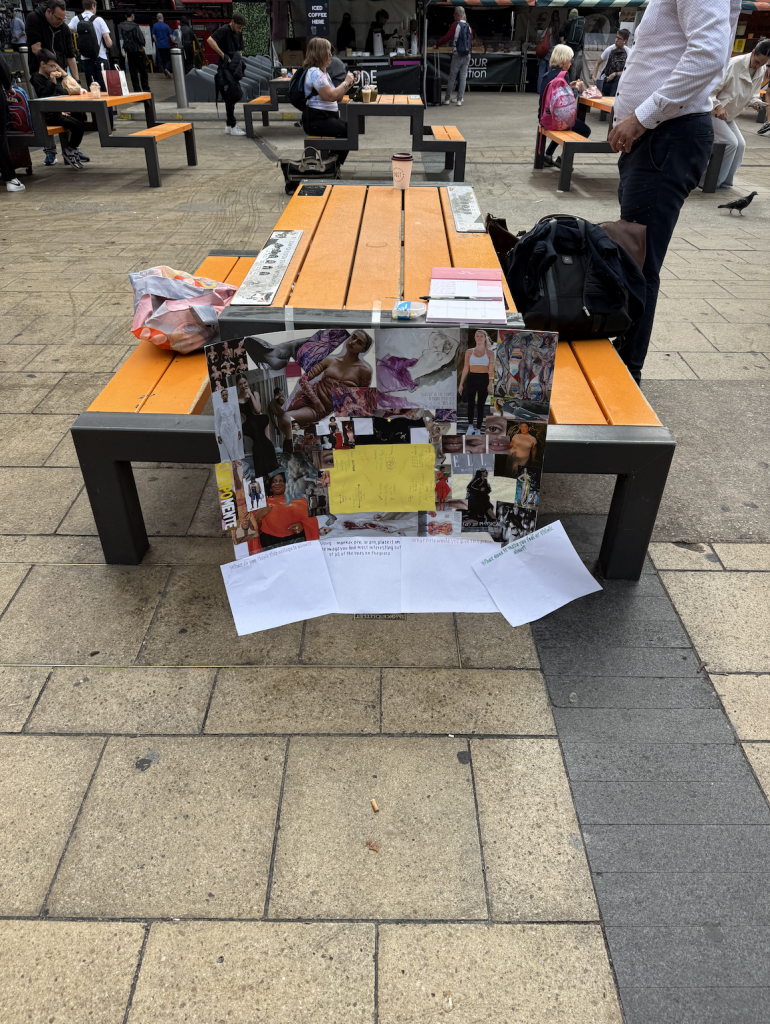
  • Intervention Euston Station

    I took some inspiration from some of my classmates and thought it might be a good idea to try and achieve an intervention here in London however it was not very successful, I created an artifact which I will set a picture of bellow with was a collage surrounding different subjects of body image and I stated a set of question with it and even though a lot of people were looking at it there were no people who interacted with it or actually came up to speak to me but I could see people looking and reading about it which made me think maybe I should not have been so ambitious and tried to get people who wanted to interact with it to wander 4 question maybe I should just stick to one and maybe it was not the correct audience, tomorrow I am going to approach the area of elephant and castle because that is the area in London where most Colombians live and even though I have expanded to Latin America because getting access to people in Colombia has been such a challenge maybe I can get more traction and get some more insight and something that I might try doing is actually talking to people instead of just letting people interact with it asking them to wander the interaction directly because I feel as if this is more successful in their different form than just waiting around but I am open of feedback on this because I have come to a point where I am not sure what to do next and this uncertainty at this point in the masters is really starting to overwhelm me and I want to make sure I am doing a good job.

    When I saw that the first location was not working I moved to another one but it did not work either so maybe tomorrow I am going to try the change that I described above. The questions I asked were, “What do you think the main subject of this collage is?”, “What title would you give this piece?”, “What does it make you feel or think about?”, “Use a pin, marker or pen to make a park on the image that you find the most interesting or impactful.” No one interacted with the artifact in the form that I thought they might however I cannot be discouraged and I will continue to keep working through it in order to make sure that I am in the right time line for this masters.

  • Tutorial with Zuleika

    I am a little behind on my journal entries, which is why I’m writing this, but it is not for information; I’m writing to get back on track with the project. I came prepared for the tutorial, and it is important to have some feedback to note and see what I considered, especially. How am I going to make it different from what other people have already been doing, and how can I actually get to something innovative? This is a very hard question, and I am still trying to figure it out; however, I’ve worked further with designers and spoken to multiple people who think a creative outlet could be a good idea, or something like setting standard sizing. However, I really need to finalize this since my investigation time is only until December, and that is now, even if we do not realize it. 

    Something else I heard from Richard while completing my presentation was that negative feedback is still valuable. It is still something that I need to look at, such as the fact that I have gotten backlash from my family and have had people tell me they don’t understand what I am doing and what the point is, as well as having people not show up to set meetings, but what this shows me, and the way I need to start looking at it, is the fact that it is something important. It is certainly making people uncomfortable, which is important to realize. One of the main pieces of feedback I got was that I could do something like rage bait to get more people to interact with my project and what I am doing. 

    I also need to look further into how to proceed with people on this topic because I know I need to make sure I am doing this well. I have been respectful and completely understand when people don’t want to participate, but I have had moments where I have reached a breaking point. 

    I could try to do a podcast with some people; however, this is hard because if I can hardly get people to speak to me, how am I going to get people to podcast? When it is unanimous, it is easier, but now that I am starting to look at it differently, things are changing. It is becoming harder to get people to want to participate even though they think it is a very interesting project and a subject that should be looked at more. I need to use this negativity and resistance to my advantage because it’s a way of looking at it. 

    I have tried contacting different designers, as one of her suggestions was, however, it has been hard to get designers to spare time for me as well. Still, I found one, and I am currently working with her. I’ll have a definitive artifact in two weeks, which is the time frame she gave me since she also has her actual job. 

    I could intervene on sizing, as well as one about food and the culture around it. 

    Also, I could be making some of these blogs that I have written go towards the public as a part of an intervention; however, I need to be very careful with this since I have permission from my participants to post it on a blog my teachers, tutors, and peers can see but not the general public, so I would need to find a way that is ethical to do this or make the ones where I did not speak to specific people open to the public. 

  • El Cuerpo que somos Meeting 1

    This is an organization that I really admire and have already spoken about. Still, I was having a hard time getting in contact with them which lead me to see the fact on their social media that they were going to be having a master class on the fear of gaining weight or getting fat. I decided to attend to learn and see if I could get my foot in the door.

    • They spoke about how paralyzing this fear is and how it can affect your day-to-day life. (This is a fear that at times can shut you out from everyday activities as well as responsibilities, and it also causes you to lose friendships and have further problems down the road because of this fear).
    • The team is led by three people: Maria Elvira, Lili, and Vero, and they have other support since they have one-on-one psychology sessions. Lili had her own experience with an eating disorder, while the other founders suffered from dissatisfaction but not necessarily symptoms. 
    • This movement or organization was born 10 years ago; it offers psychotherapy and body-image support and fights the battles people face in everyday life around food and their bodies. 
    • One of their main points is that diet culture and aesthetics are major problems, and that Colombia, like the rest of the world, has a strong beauty industry. 
    • They aren’t just offering treatment or making it available. They also want the organization to have a social movement, which is why they don’t only have a website and social media. They also have podcasts and many other resources to raise awareness. They speak about the fact that, as humans, we always have a survival mechanism, and because of this, we are always looking to fit in in two ways, specifically mentally and physically, especially when it comes to health (Which I think is where a lot of stigmas come from, not just because of body shape and some people thinking one body is healthier than the other, but because there is the example of people not wanting to go to a psychologist or psychiatrist because they always want to project that everything is perfect and that there are no problems)
    • One very large misconception which they have faced in their community is the fact that people think that if people lose the fear of being fat, then it means permission to become fat or that this is how they do it, but this is not the case (I think that this leads to a lot of people not looking for help from them because this is an assumption that is had, and I am not going to lie, it is one I had myself when I entered treatment)
    • The idea they are trying to accomplish is for people to be less hypervigilant about their bodies and to be able to live freely and in peace. 
    • The fear of gaining weight is learned and almost always inherited but they believe it is everyones journey to to decide wether they are going to keep acting on this fear or if they are going to change it:
      • Rejection
      • Only the mother loves them (A los gordigtos solo los quire la mama)(This is a very common saying in Colombia)
      • Not being beautiful
      • losing value as a woman
      • being seen as fat
      • being told that I stopped taking care of myself
      • feeling uncomfortable with our own body
      • not seeing myself well in the mirror
      • that people will stop loving you
      • not being attractive
    • These are just some of the beliefs that came up in the meeting and that they presented in the workshop, which a lot of people attending agreed with.

    One of the exercises they made us do was to realize how subjective the word fat ” is and what it looks like, starting with asking us what we considered tall and writing it in the group chat. People had very different answers, which I found interesting, and it made me think about what everyone’s beliefs might be. There are normally associations that come with this word, and these are some of the ones that were mentioned:

    • Lazy
    • They don’t have willpower.
    • They don’t take care of themselves.
    • They don’t love or care about themselves.
    • They have emotional struggles.
    • They are not attractive.
    • There is no such thing as a person who is fat and happy.

    This leads them to ask participants a couple of questions: Why can’t we be fat? Why don’t we allow it to ourselves? These beliefs are most common in Guatemala and Colombia because people immediately ask why they don’t eat less and take better care of themselves. 

    • As an organization, they mentor one-on-one and offer group therapy, also exploring each participant’s beliefs about fatness and how it’s built, not real, and how people read themselves. (One of the main tips they give is not to allow the noise, or at least not to perpetuate it, so don’t ask so many opinions specifically about your appearance)
      • The idea that being fat is inherently associated with rejection is something we have learned as a society, and that we continue to grow; this can also be considered a protection mechanism)
      • There are a lot of ways in which we see it in our everyday lifestyle; for example, when our parents start speaking about our fat friend and how they have a pretty face, but what a pity that they are fat. Why aren’t their parents doing anything about it? It’s so sad that she got fat. 
      • “No me veo como estoy; siempre me falta un centavo para el peso.” No matter how well I am doing, it is never enough. I am always missing the quarter to get to the dollar. It is never enough, and this is what leads to illness because you start thinking okay 1 more pound, and this leads to a very scary pattern. 
      • Who wants to be fat when our elders have told us our entire lives that being fat is a fate worse than death? (People stop living because they start to think they will do something when they lose a little more weight, for example, going on a trip or wearing an outfit) – Maybe I could create an artifact where I have people interact about what they have stopped doing because of their fear of how their body looks. 
      • One of the main things we have to start doing is using the word fat, because if we do, then we take away its power. You have to ask yourself several questions, such as what it means to me to be fat, and recognize the perspective in my brain as well as the one I have to challenge. One of the main things that they asked us to challenge was when it will actually be enough. (I can personally think about this because I will finally buy a certain outfit when I get down to a certain size, or many more situations to look at, because I limit myself based on how my body looks and feels, and from my experience speaking to people, this is something many people live with). 
      • They spoke about when they started to lose weight. It still wasn’t good enough; the problems or insecurities they had were going to stay, even if they lost the weight they thought would make them happy. There is also a lot of praise around it because everyone asks you what you did to look the way you look now; what is next? If you praise one type of change in the body, why not the other? 

    We use the body as a form of control. For example, there is a saying in Colombia or Latin America: when you do not like someone, “Ese me cae gordo.” There is no direct translation in English, but it basically means, “I can’t stand her/him,” using the word fat. There is also the fact that we are now living in a world where everything is so easy to get for example, food- as well as losing weight, because we now have medicine or products that do it for you. There is an oversell or exposure to this, whether it works or not; for example, there was a time when this was tapeworms, smoking, or heroin; now it is any GLP1s.

    The mental illnesses of eating disorders are very hard to explain when it is not something you live; it is abnormal for people who have seen this, but it is important to find some support to not feel alone in these experiences.

    • Some of how this is all seen are how there is always body checking whenever a person is walking past a mirror or window they see their body as well as always being hyper vigilant towards the body, you are always comparing yourself to others (this is the main issue I feel like because I think that if we just all saw out bodies for what they were and not thinking of it as something we have to adapt part of the problem would be solved), because of this pressures and the feelings that come from it there are moments where we make wrong decisions such as lying about what we are eating or making ourselves feel a different way in out own experiences.
      • Bingeing, not eating (restriction), purging, excessive exercise, GLP1s, wearing thin clothing, and not wanting to get ready because I don’t want to be seen, making myself invisible, avoiding activities to hide from the fear, and this makes it even bigger. 
    • We always see different comments being made, and this has a tremendous effect on the people receiving them, especially when they are young and very sensitive. There is a sanitization of the word fat; however, when we look at its counterpart, fat and ugly, they are always being looked at as thin and pretty. They are respected and seen as something they must achieve, and it becomes a way to make sure you aren’t disappointing anyone by staying extremely thin. 

    These are fears we have constructed ourselves and the societies we live in; however, we need to start seeing how we can change this and view it differently. For example, think about the fact that people who truly love us will never place conditions on how we look or take away their love, not if it’s an actual connection. 

    They recommend five strategies to handle this fear better.

    • Keep exploring where this fear comes from
    • Identify the actions or behaviors that we do.
      • It is not about trying to stop the fear because it is never going to disappear; it’s about gradually exposing yourself to the things you are scared of. 
    • Take action and do the opposite of what the fear is telling you to do, especially if the fear isn’t a big deal, because sometimes we get the opposite reaction. (We try to restrict to control and lose weight but end up having binges, which in turn leads to weight gain, even if you have compensatory strategies)
    • Be consistent (therapy and doing what you said you were going to do)
    • Build a critical identity around diet culture. 

    There has to be a focus on the body not just aesthetically and about how it looks, but actually about what it can do, because there is no use in being extremely thin and malnourished and not being able to have children or walk around because your body has gotten to that level of illness, so it is also important to look at it from this perspective. 

    • Try to avoid body checking; don’t always look at yourself in the mirror or in a window.
    • When this fear comes up, admit it, sit with it, and talk it through in therapy or by writing it down so you can work through it, consider options, and ask questions about the fear. 

    Going to this workshop was an incredible and enlightening experience because I signed up for the program, which includes weekly follow-ups and a support group with different women. This will not only help me with my project and the knowledge I need to gather. Still, it will also help me with my own process because I have been struggling recentley since I associate stress with food wether that is over eating or under eating. It leads to very problematic behaviors, which I need to nip in the bud so that I can continue living a healthy life and not live in constant fear that I will need further treatment than the one I am already in. I think that this is very helpful because, from my own expeiences nd what I have found from my research, people around you are always telling you to stop compensatory behaviors nd tell you to stop however they do not find ways of helping you and seeing how you can get further help and move forward which is why I found this experience so enriching.