Introduction:
Since the beginning of my research, I have had a clear goal set, which is to focus on Body image and Eating disorders, even though I realize that they can be very different and, in a lot of cases, cannot be combined. However, through my work and interventions, I decided to focus more on where the pressure of beauty and body standards comes from and the effects it might have on our society.
Question:
How can I collaborate with creatives and people who have lived body image struggles to create an artifact or event that raises awareness of body image pressure?
Research Methodology:
This has been a hard part of the project. My job is to review and analyze it to the best of my ability and criteria based on what I have been learning, but creating my own research and interventions has definitely been a challenge. However, I have tried creating artifacts and seeing people’s reactions, or the conversations that start after I show them these artifacts. I have also been doing a lot of research, conducting direct interviews, and having conversations with psychologists who speak to this work, as well as nutritionists and people who are still on their own journey. One of the main things I have been hearing is that people are often treated the same way, even when they want to be treated as individuals.
Research:
One of the main points of my research has been fat phobia and racism, Sabrina Springs, whom I will be meeting up with on August 31st. She has been a main point in my research, “Fearing the black body”, which speaks about the way that body superiority or the preference for thin bodies comes from Europeans trying to act superior to find a reason why Black people were less than and finding irrational ways to prove this (Springs, 2019). I have also been doing a lot of research on different organizations that have been speaking about something similar, specifically in Colombia. I found one that I found very interesting called “El Cuerpo que Somos”; they started their work in 2016 and have used several formats, including a short blog and, later, podcasts over the past couple of years, which have created a lot of traction (El Cuerpo que somos, 2026). Through my research, I also realized there are many different stereotypes about the type of body you should have, not only because of the city you live in but also because of your socioeconomic background and your family’s beliefs around body image (Pommper, 2004).
Interventions:
For me, having done the intervention has been very hard because I am dealing with a very sensitive subject matter. If I spoke to someone in interviews, filmed them, or took notes, I asked for their consent many times because I never want anything to be misconstrued, and they really appreciated that. However when I started to think about my interventions the first thought that came to my mind was creating some social media platform however this was something that I have absolutely hated the idea of because to gain traction specifically with people from Colombia I would need to post it on my own social media pages and this opens me up to a lot of criticism. (Instagram) Secondly, in the previous tutorial, I was given the idea of creating a workshop or roundtable to discuss different subjects with focus groups, but this didn’t work out, which led me to create a Padlet which gave me some great insight (Padlet). However, after I realized this format wasn’t going to work, I had to go out into the streets because I wasn’t going to keep waiting for something to happen. If I didn’t start producing something or getting different reactions, I might not be able to finish this investigation on time, and honestly, that was not an option. So I created two different artifacts: one was a set of questions that I printed on periwinkle paper, since this is the color that represents ED awareness, and I went to a shopping center where I asked 30 different women to participate; 304 agreed, and 264 did not. (Blog for this intervention)
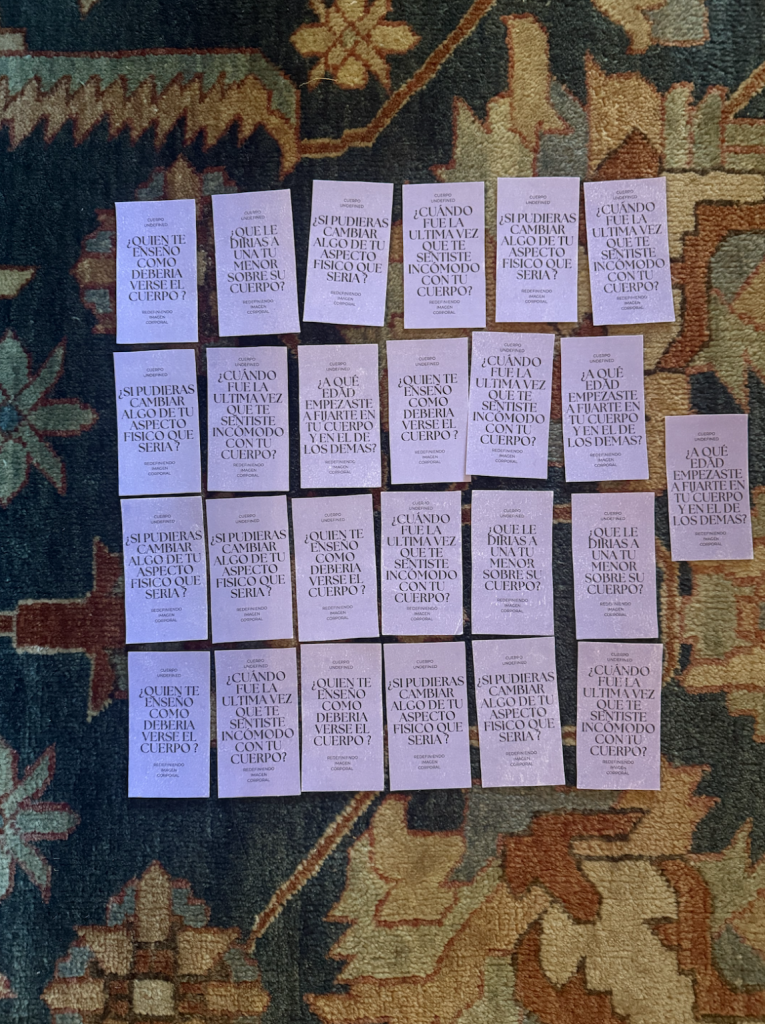
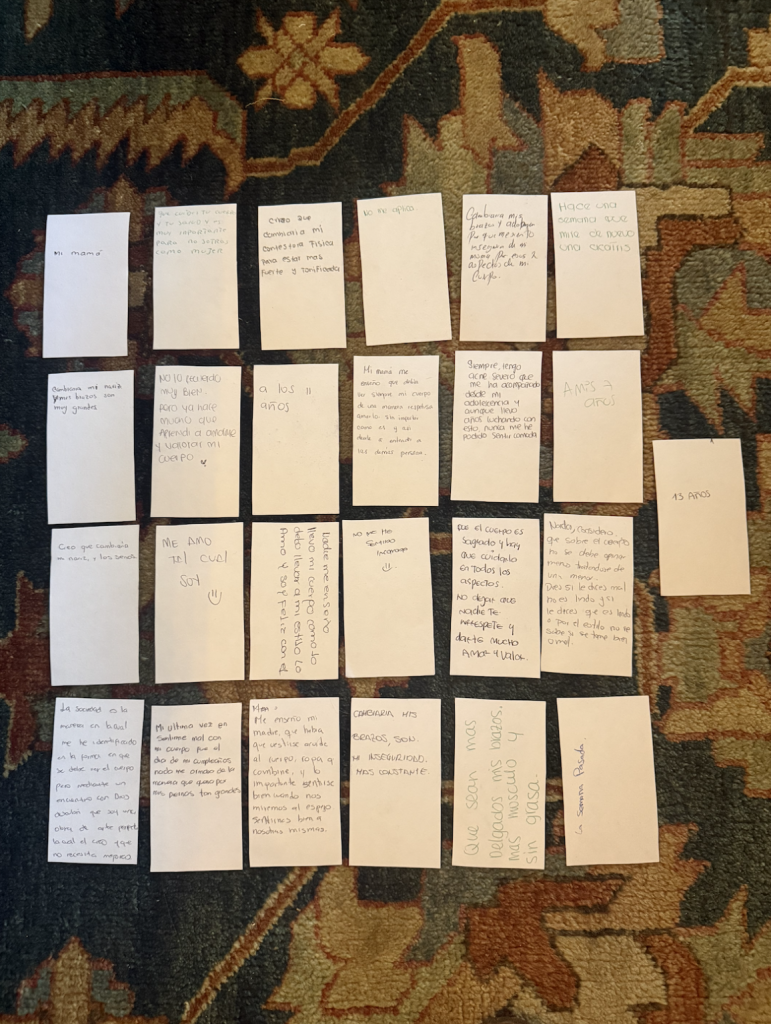
The second artifact I used explored assumptions people in Medellin might have about fashion design, where they had to tell me or signal which of the forms below they felt fashion designers should use when creating a new garment.
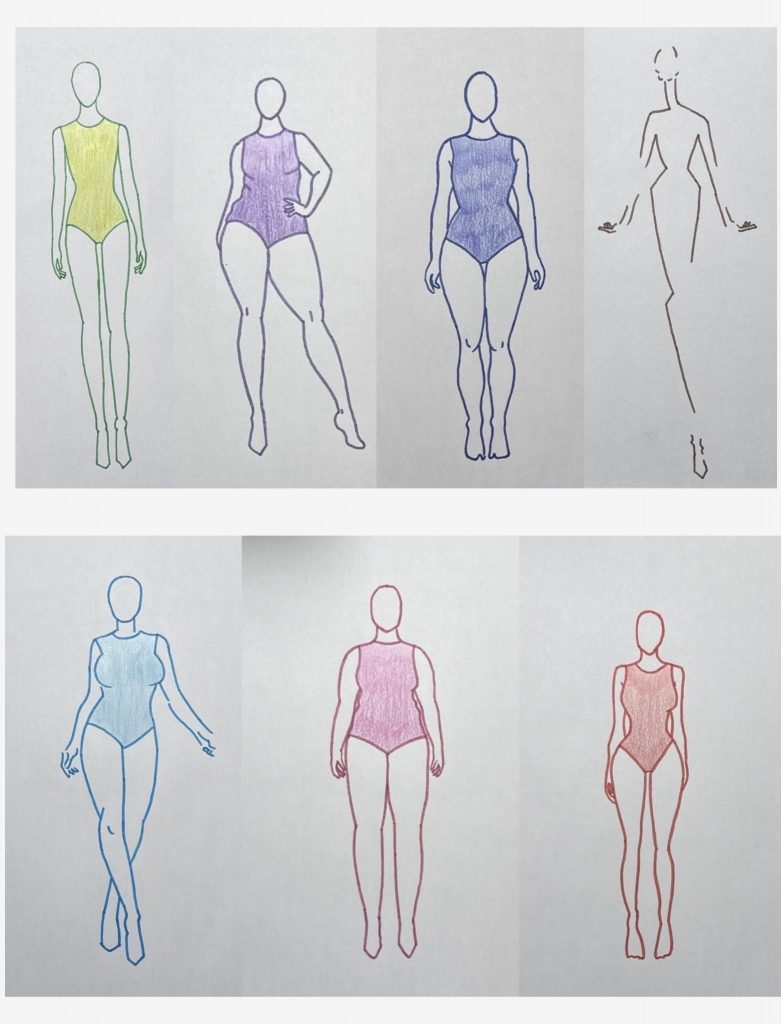
I tried to include a lot of different body types, and I asked around 21 women; they all had different opinions and were open to participating. This led me to see how many different assumptions people have about body image and how important it is to destigmatize it. (Blog) Both of these last interventions were definitely hard because it took me putting myself out there and being vulnerable. I knew that if I ran into people I know, I would be severely judged; however, it is an important exercise. When I was speaking with my family about it, they had a very good reaction when it came to my father and grandfather because they told me this is an exercise that a lot of entrepreneurs make their children do not to fear rejection, but it was definitely a struggle mentally.
Audience:
Right now my audience is very broad. I started out thinking my audience would be people who are vocal on social media about body image. EDs, however, this is not precisely the case because I have also chosen creatives specifically in Colombia, as well as random people I do not know, and medical professionals who do this for a living, and what I have heard is that there needs to be more education.
Conclusion:
While doing this part of my research, it has been a journey, and there have been some really hard and frustrating moments; however, I think that there has been a lot of growth, specifically in myself, because I had to start putting myself out there and being more okay with rejection. In the next steps, I want to take the interventions that I have done and take them a step further or make them deeper, for example, designing an actual garment in the different body silhouettes. When I spoke with Diana, she suggested I do it life-sized, and it might be hard to make it life-sized. Still, I will definitely try to make it larger and have people interact with it directly; however, there is still a lot more space for me to grow and move forward in this project (Blog).
Bibliography
Blog: El Cuerpo Que Somos · el cuerpo que Somos (no date) El Cuerpo Que Somos. Available at: https://elcuerpoquesomos.com/blog/ (Accessed: 27 August 2026).
Pompper, D. and Koenig, J. (2004) ‘Cross-cultural-generational perceptions of ideal body image: Hispanic Women and Magazine Standards’, Journalism & Mass Communication Quarterly, 81(1), pp. 89–107. doi:10.1177/107769900408100107.
Strings, S. (2019) Fearing the black body: The racial origins of fat phobia. New York: New York University Press.
Leave a Reply