Category: Critical Analysis of Current knowledge

  • How to identify if an eating disorder exists in your surrounding

    This is a piece I found from a group of Colombian investigators about eating disorders and how to identify when they might be happening.

    • One of the main things that they talk about is how for a lot of patients this was an issue that started during the time of the pandemic in lock down. Especially in the cities there was a lot of isolation, there was a lot of fear surrounding the economy and a lot of uncertainty in the world which lead to there being a rise in eating disorders in the years that have followed after the pandemic in 2020 in this cases there are worst symptoms in the patients. One of the main things one should try to do is catch the issue early and this is where parents need to learn what is going on. (Parents don’t think its real or try to ignore it because they are not aware that it is happening or some of them even like it because it is helping their children fit into a standard that we have all had in our brain as what should be done).
    • There are physical warning signs and this include when there is a large amount of weight loss, this also causes malnutrition which comes with their own set of symptoms including hair loss, always feeling cols and period irregularities. they also talk about the fact that not all eating disorders mean that there is extreme weight loss there are a lot of eating disorders where the weight might remain stable or even have an increase, however one thing that is persistent in all of this eating disorders is the fact that there is always a fear of gaining weight. (It is extremely important to explain and get education out there to say that eating disorders do not just include loosing a n extreme amount of weight there are a lot of them that do not include this and there is even a weight gain for example I suffered from a very strong bulimia for a long time and people would not notice it because I was of a healthy weight or even at times overweight so it did not make sense to them that I needed help and my family was not doing this because they did not care but because they did not know).
    • (There are a lot of signs that are actually in a form of behavior and that need to be looked at closely because you don’t want to be the person that is responsible for offsetting a moment to make a person uncomfortable and take a path like this because of their own personal trauma) The signs that one might look out for are a lot of new found interest in cooking and nutrition knowing how many calories are in everything, what oil and amount is being used, they will start to only eat certain types of food for example what is considered healthy and will not have anything else, leaving the table and going straight to the bathroom between meals, social media and being on a path of only following people who are fitness influencers and about diets and healthy eating (an example I can think about is how know there is Liv Shmidt and the skinny society and how now everyone is obsessed with walking because it is the new trend to follow). Felling guilty after eating and doing an exaggerated amount of eyxcersice.
    • There are also a lot of emotional signs that can be seen in individuals who are suffering through an eating disorder (One thing that I think is very important is to not look at them through the eyes of judgment and thinking that they are doing this to themselves and they are not being honest but you have to look at them as sick and needing help whenever I felt judged I felt the urge to go back to my compensatory habits but when people actually sat down and tried to understand it was what helped the most). They start to have a lot of moments of sadness, irritability, low self esteem, mood swings and are always on edge (They are always scared of getting caught) there is also the fact that there starts to be a distortion on their body image they start to think they look different than how they actually look and there is distress about what they look like. There is a severe dissatisfaction with their bodies and they are always chasing the self imposed impossible standards but it is not just about their body you start to see this surrounding their food, school, work and there is a level of perfectionism and severe fear of failing.
    • There are different tips that they try to give parents in this article, they say that they should not try to approach it through hopping that is they ignore it then it will go away the research and statistics show that this actually makes the situation worse. Open up spaces to speak about this and dont just wait until they ask for help try to intervene when you see there is a problem and speak about it openly, DOnt make this the discussion you have around the dinner table because there is already a lot of pressure in that space if your child is suffering try to talk about other subjects at the dinner table. Gently try to get them some help maybe starting out with a therapist they feel safe speaking to.

    this was an interesting article because I think that a lot of parents might be able to see themselves somewhat through this because parents don’t now how to act when it comes to this subject there is a lot of pressure on parents but no one has taught them how to be parents there is no perfect way to handle a subject such as an eating disorder and disordered eating with a child or loved one and this gives some good tips on what one should do I think that there should be more information about what to do when the eating disorder looks different than what the stereotype we have built in our brain is because even if they look healthy they are not necessarily healthy and they deserve the same kind of help and attention.
  • “How the Use of BMI Fetishizes White Embodiment and Racializes Fat Phobia”

    https://journalofethics.ama-assn.org/article/how-use-bmi-fetishizes-white-embodiment-and-racializes-fat-phobia/2023-07

    This article, written by Sabrina Strings, whom I met with, has been fundamental to my project and the research I have been doing, and it explains the origins of fat phobia. One of the main things I have been learning is that there is a belief around the world that says if a woman is bigger in size,

    then that means that they are unhealthy, and everyone is looking down on them, like saying Poor thing, they don’t know how to control themselves or eat; they must not know how to manage their emotions; what a pity and this is something that is complemented with BMI because it is a study that people use very often, and if you do not fit into the categories, then you are overweight or underweight, and that means unhealthy, and that is not necessarily the case; they are not mutually exclusive. 

    • What she is trying to express in this article is the fact that BMI is not a neutral medical tool; it is not scientific. It started as a way of saying that fat was not a white issue but a “problem” of non-white people, which made them bad or a problem or even inferior, and this was a way used to rationalize this theory as medicine and health; however, it is a way to rationalize the bias towards different races as well as beauty. If you don’t fit into this square or range, then you are incorrect. 
    • This was something that started as racism, not health, in the 1700s because fatness was a common denominator in ethnic groups such as African and Chinese women, so this made them inherently less, and this was the “proof” that they used, which shows us that it was not about health; it was about finding a way to make different people inferior, but reality is that it was just different. 
    • In the years 1800-1900, this theory was made official by eugenics. This science was used to make people think of differences as better or worse; some traits were considered more attractive, while others were considered worse. This was even backed by scientists such as Charles Davenport, who made the claim that being fat was a defect and stated that people who were racially Chinese or Jewish were the main people who suffered from “racial obesity.” This was when people started to believe it was a disease, not just an opinion or a fashion.
    • In the Early and mid-1900s, there was the case of insurance companies having their own parameter in the form of a standard weight in their insurance policies to limit issues and make sure that whoever they were insuring was “safe” (One of the main things that we need to learn is that fat does not mean unhealthy and thin does not mean healthy). However, these standards were based on white men, not women, and did not consider other races. Then there were medical papers that were published saying that people who were overweight under the BMI standard that the cause of 95% of the people being overweight because of overeating and not having healthy habits; however, there is no real proof of this. It is just words. Still, they have power, and people keep believing this statement even without real scientific backing.
    • In the 1950s and 1970s, a scientist named Ancel Keys gained attention. He actually created BMI, which was the easiest way to calculate who was overweight and who was underweight, and even though it had little scientific backing, it was still something that continued to be pushed, and he, as a person, referred to fat people as “disgusting and repugnant,” which shows us that he had ulterior motives based on his own images or his own opinions. 
    • In the years of 1973-1995, BMI became the standard by which government and medical agencies measured bodies, and what is even scarier is that we still use it today (Why? When we have had all of these researchers talk about how this is inherently only made for a certain kind of person and body). These numbers weren’t shaped only by science, but by beauty standards, and what is sad is that it was tested on a very small group of people, so it didn’t apply to everyone. 
    • Even though it seems scientific and natural, it is honestly just a new form of racism, but it makes it seem official. 
  • ATAVIOS book

    Earlier this week while I was trying o look for new books to read in order to get even more information on the subject of body image and trying to connect it to Colombia I came across this book of photography that shows, “The roots of Colombian Fashion” when looking at it I thought it was very interesting however there was one thing that I kept looking at and it was the fact that al of the women’s bodies who are represented seem to be the same they all look like models if the idea of the book which is expressed to be, “…Colombian Jewlery on display against a black background would look infinitely better if it were molded by nude men and women, whose bare skin would show off the inartistic beauty of the object” (pg.9) I understand the context that it was a fashion book and we have evolved and times have changed however there are a lot of things that come into play but if we are critically thinking that it is done to show the beauty of the objects then what it is telling us is that it would not look beautiful on people who are of a larger body and this brings in the question of asymmetries making one better than the other or thinking something is better than the others but this is something that is very complicated because if your life depended on your art and there comes a time when we have to think about the message we are sending because this is not a representation of most Colombians it is the people that dedicate their life to this however when I am thinking out loud and through my own opinion I realize that betray is in the differences if not why where we all made different and this is what has to be seen in the beauty of our differences but we have been told we need to fit into a specific mold in order to be worth anything and this is a very scary subject because it makes me think about what is next and how we are always trying to get to the next level, there is a saying in Colombia “Si yo me hubiera echo me seguiria puliendo” Which is in translation if I had made myself I would still be perfecting me and this is scary because when are we going to be okay with what we are when is enough going to be enough why do I only see perfection in this books and magazines but its not even perfect it is just an idea we have in our brain of what is perfect and what is not. (Why do we believe there is such a thing as perfect?)

  • Fernando Botero

    This came to mind because, while I was in Colombia, some of my sister’s American friends were in town, and they talked to me about everything they saw, including a museum with paintings of fat people. This was Fernando Botero’s main painting style. I started thinking about why this was and whether it had any impact, and one thing I can say is that it definitely made people uncomfortable and made them think because it wasn’t the normal style of painting at the time. It was interesting that this was the only description they came up with, but it may be gold because the main thing I saw in this research was not thinking of fat as a bad word, but as a descriptor. After all, if we still have taboos about it, it will never change. 

    I saw this article about this subject and the artist. I found it interesting that the connection she made was with eating disorders and the way that this is on the rise in the world, but specifically women, and the way that maybe through his work and having a sort of way of showing a larger body in all sorts of contexts helped this and made people see life in a different persecutive because he has people dancing, working raising children and much more so it is about living in our bodies not constantly trying to change them. Maybe I could do something similar through my paintings? But the question is how to I get them to actually make an impact?

  • “El Cuerpo Que Somos”- (The body we are)

    While I was looking for different examples and different people who talk about this specifically in Colombia, I came across this page. It was wonderful because, even if it doesn’t discuss the historical conception of body image, it shows different examples of what people in Colombia go through. They have incredible podcasts with different people in Colombia who have gone through it. I think that their messages are incredible and one thing that I found very interesting is that the founders Liliana Gaviria and Maria Elvira Tobon also talk about their own journeys and they do not only have the page on instagram but they are kind of a program and it is incredible in my pinion because they have a YouTube channel where they have podcasts with different people who are talking about body image and their own struggles, they also have physiologists that work with them and have therapy treatments for the people who are interested in this specific type of companionship because there are very few resources like this that exist in Colombia nd I think that they have done a fantastic job, I found them in a very weird way because one of the people who they interviewed was Miss Colombia and I follow her and they did a podcast together so I started listening to it and then got more intrigued and went in deeper and looked at more stuff they were doing and one of the things I found most interesting was the fact that the looked at the problems with body image as an algorithm that was already put into our heads as if it is an automatic in the city where we live. This movement started in 2016, so it is 10 years old. Still, looking at the page, it was a process; however, the work they are doing is incredible. They definitely got in there at a moment when it was very difficult to talk about this, even though this is a very saturated movement I could do with it. I will keep working on it and see where I end up, but I am starting to worry because I don’t know what to do. I feel very lost in this process. This is definitely a page for me to look for inspiration and to remind myself that this is a process and that I will keep going through it. 

  • “Tuberculosis: The Lasting Effect”

    @trendsofthetimes

    For generations, women’s soft figures and natural curves were celebrated as signs of health—and therefore beauty. But when tuberculosis broke out in the Victorian Era, ideas surrounding beauty suddenly changed. The modern fixation with “skinny”—and the way women are still measured against it—may have largely originated with the spread of tuberculosis in the Victorian era. Fast forward to today, we’re once again seeing a trend towards shrinking frames and figures. Although tuberculosis was eventually cured, the romanticized “aesthetic” seems to have lingered even more than a century later. . . #fashionhistory #fashionhistorian #historyoffashion

    ♬ Blade Runner 2049 – Synthwave Goose

    While scrolling through social media today, I came across a TikTok post that made me think about all the research I’ve done on the backstory of body image and its connection to racism; it is another theory I found interesting and relevant. This explains how for a lot of generations the idea was to be more full figured and to have curves and this was the ideal body for many generations, however in this video the explanation was that this was happening until there was a spread in tuberculosis which during the time this was most common and afterwards women wanted to look skinny and sick the exact words used were, “they wanted to look like they were slowly dying” because people thought that the lines of tuberculosis no matter how bad it was and how many people died from it the women were considered to be more beautiful. After all, it gave them sparkly eyes and rosy cheeks, which is still the idea today; the lines also caused a loss of appetite, which came with a malnourished, thin body. This was unattainable beauty, but it could only be achieved through suffering, a, nd thit waseverely roromanticized and shown as beautiful in different pieces of artwork. For women to achieve this new look, they would take extreme measures: women would take poison, undergo blood withdrawals, and starve themselves. 

    It is interesting that this is another point of contention, and that many different factors might lead to this trend because both are true at the same time. I need to research this further because it is important to consider different points of view; however, this might not be as thoroughly researched as the other hypothesis, so that I will look into it further. 

  • Fearing the Black Body Reading Notes

    • I have been reading the book Fear the Black Body by Sabrina Strings, which was recommended by both Zulinka and one of the people I interviewed, and it has made many interesting points even though I have not finished it. 
    • One of the main points that the book starts with is how doctors and philosophers could not understand why people were starving when there was plenty of money for people to be eating, and how the ideal body had changed since now the description of people’s bodies in the United States was thin and pale, and this was called an epidemic. There were two sides to the argument: some people thought slenderness was a matter of fashion, while others considered it an American shortcoming and linked it to subjects such as religion and morals. 
    • One of the main issues we see is how roundness and a more volume-heavy body were connected to blackness. This is a history that starts to be explained in the sense that it was anti-African and that the fact that they had more volume in their body was considered ungodly because it must have meant that they were eating more and that was gluttonous. One of the ways they started this was by the fear of the fat black woman, and this came from religious ideals on how to go against a certain race but then discipline white women: “synchronized repression of ‘savage’ blackness and the generation of disciplined whiteness”. The idea behind this was to create a society where there were some people who were above others by telling them that the thin ideal was better because that was the reality of Europeans and Americans, and then degrade those who were not the same, even those who could be considered white (Irish, Russians). 
    • This chapter starts with a story about a girl named Katharina, who was a slave in Antwerp and was drawn in 1521; she is described as having a round face and a plump body.
    • One of the main things that is interesting is that English women in the Elizabethan era did not just paint themselves as whiter, but actually painted themselves black to show the difference and make themselves look like the beauty ideal. This was definitely supremacy culture, and something that was very interesting was the fact that in England there was not a glamorization of black people like they were in other countries in Europe; there was, from the beginning, a deep disdain, but they did not enter the slave trade until later than the other European countries, such as Portugal. (page 55)
    • The slave trade had a tremendus effect in england and holland throught the creation of sugar and how it started to be so highly available that now people were having it as a daily luxury which ment a lot of people in england who were middle class were starting to become fat. (57) The word obesity was used for the first time in 1620 in Oxford from the investigation of people in England getting fatter. The growth of the wellness gout, this was called before as the king’s disease, robust habit
    • The main thing that we are able to see in the introduction is the fact that she talks about the fact that fatphobia is actually about racism and not actual health concerns, which is one of the main arguments which is said in the mainstream media today. (An example I thought about when reading this is Lv Schmit an influencer about weight loss who speaks of portion control and excessive steps in order to live in a perfect body and she does not speak of nutrients or muscle density just thinness and this might work while she is in her 20s but what will happen when she is older and has just been eating what she wants but with small quantities). 
    • The way that she is explaining this is by mixing a lot of multidisciplinary ideas including history and her own analysis with what was going on at the historical time and the different resources we have from back when all of this started in the renaissance era when there started to be a mix of races in europe not just white europeans. 
    • She asks the question of why, when people think of fat women, there are a lot of times when fatness is directly correlated with black bodies because of the stereotypes out there. (Is there a connection of this to Medellin? Do we not want to look anything different from Europeans?)
    • A large conversation or point that is made throughout the book is the fact that, mostly in America, there is a clear disdain for fat bodies, and women try to be as lean as possible. (I believe this comes to the point where it has become almost a sickness where they cannot rest and they have to be active all day and counting their food, even though they have tried to move on from this and have more food freedom is what it is called it is something that is constantly on women’s minds and it has even gone as far as to become a social media phenomenon were they speak about what they eat and the work outs they do daily).
    • One of the main things the author talks about is how this is a subject that has been constructed there was not always the idea that one has to be as thin as possible but it is something that has evolved and in her opinion it has evolved at the same time as racism, she also explains how there have always been different bodies in different societies and most of them at one time or another have been appreciated or admired, for example the fact that in mediaeval times a more voluminous body was preferred by many but as most things in this world this evolved and I believe that this evolution is the reason why we are in the ozempicedemic today. 
    • I believe that this is a book that is not just written as a piece of academic work but that it was intended to be an intervention to help us understand why we view bodies the way they are viewed because as I have read in many sources about history repeating itself it is very important to understand our history in order to not keep on repeating it and this is a good way to start looking at our bodies differently and look more at the core problem than the overview. However I don’t think it got the attention it deserved and should be known more by different forms of media because I have found it a very hard book to read and I don’t think people who are specifically interested in this subject will actually sit down to read it for extended periods of time so it might have been interesting to have maybe a smaller more easy to read version of it in order to get it to be more widespread. 
    • In this chapter, Strings goes back in time to the 15th and 16th centuries to examine the body ideals of the time and how they evolved. I think it is very important to look at why things started in order to understand their effect on today’s society. 
    • One of the main things she looks into is religion and the way that in the 15th and 16th centuries there was mostly a wave of Christianity in Europe, but following the protestant reformation, specifically in England and France, and how this led to there being much more thought and energy being put into the body and what it looked like, as well as what it meant. However one of the main arguments to there being a preference to large bodies was the fact that society thought it represented wealth and this is something I hear in my family even today, saying that when someone looks to thin it means they look poor or as if they don’t have enough food however this is also a problem because even if discrimination or negativity and out hin bodies is not the same as Fatphobia it is still not right.
    • One of the main things that she does during the first chapter is the fact that she went back before there was exposure to black bodies in Europe, which started through the transatlantic slave trade, which was the reason that the distinction and preference for a certain body came from.
    • One of the main things that I find very interesting was the knee-jerk change that happened when black women were brought into the picture, because if they had been of a different shade, they would have been considered some of the most beautiful women and the standard to follow, but since they came in a different color, they needed to go against everything they believed in order to make themselves different. There was also a complete change in narrative, saying that the Africans had no self-control and were indulgent, and this was the reason for their bigger bodies, which is a complete hypocrisy because it was seen as a good thing in Europeans but as a terrible quality in black individuals. 
    • There were a lot of words used by the travelers who were the ones that saw the most black bodies and they called this individuals as primitive, lazy, uncontrolled animals and this was just a way to rationalise to themselves that they were better than them and this was the reason why they could be enslaved and treated as less than which lead to there being a shift in dynamic and making two things that should have never been put together blackness and fatness and they were synonymous with each other. 
    • The history of how this were represented were different in every country and there is a lot of history behind it because in a lot of catholic images there are pictures of black people as slaves or helpers to the superior as they would have been described white people however this was not something that happened in England until the start of the slave trade and at the beggining of black people being included and introduced into early european society through the slave trade they were a hot new fun commodity even so that even a de medici girl asked for the blackest girl they could find because she thought it was interesting however as time went by they stopped looking at them as curiosity and started looking at them with disdain and as if they were no longer interesting they had enough, however in England they did not go through this they immediately went to hatred and discrimination when they started arriving through the slave trade. 
    • There was a lot of talk about gluttony, not just in food but also in alcohol, and this was widespread in letters travelers sent home and in authors’ writing during the Enlightenment. 
    • During the eighteenth century in England, there was a change that many feared because it seemed to threaten how they described society, moral order, and organization, leading leaders and high-profile figures to change the rules about what should and should not be done. With these new social norms of etiquette, there were new ideas about how men and women should act in certain contexts, how they should eat and drink, and about having restraint when it came to food, and I think this was just another way to control what was considered the common masses. 
    • Thomas Muffet was trained as a doctor, but his investigations led him more toward the idea of how to prepare food properly, what food should be consumed, and how to avoid needing or wanting food. Maybe looking at this could be connected to the current trend of fasting as a tool for weight loss. 
    • The idea of the slender physique began as a notion of racial superiority; the aesthetic emerged in the eighteenth century, due to a new idea of the reappearance of religious movements. There was also a large amount of fear of immigration by people who were considered “part-Negroid” 
  • Trapped in the Body

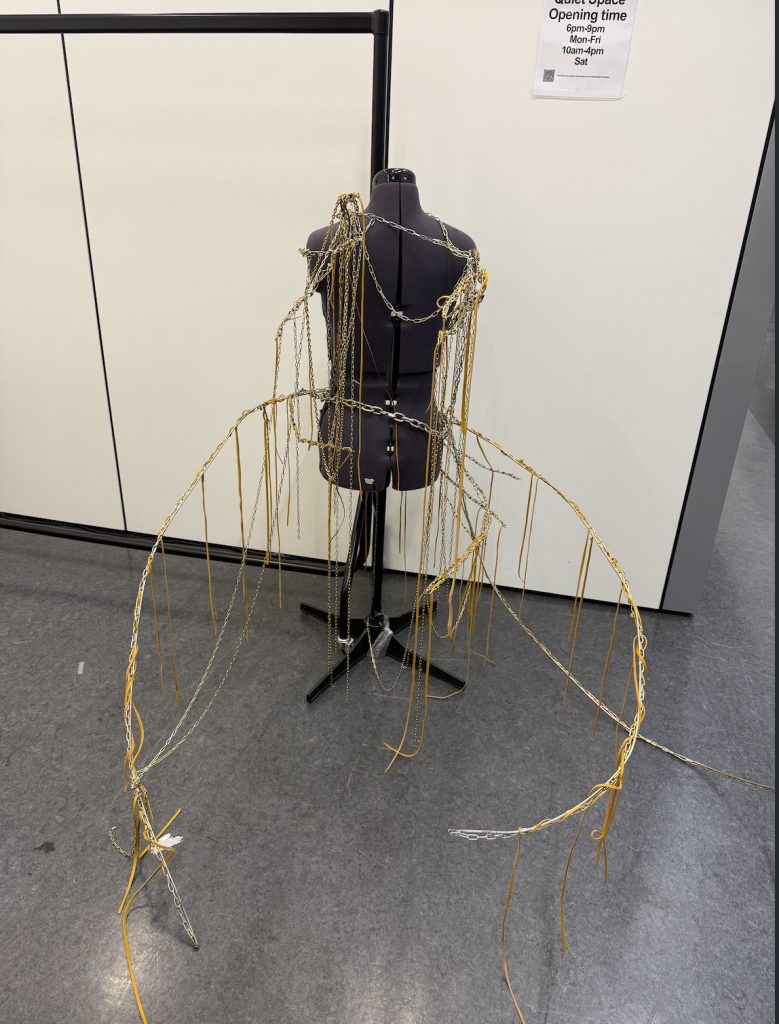
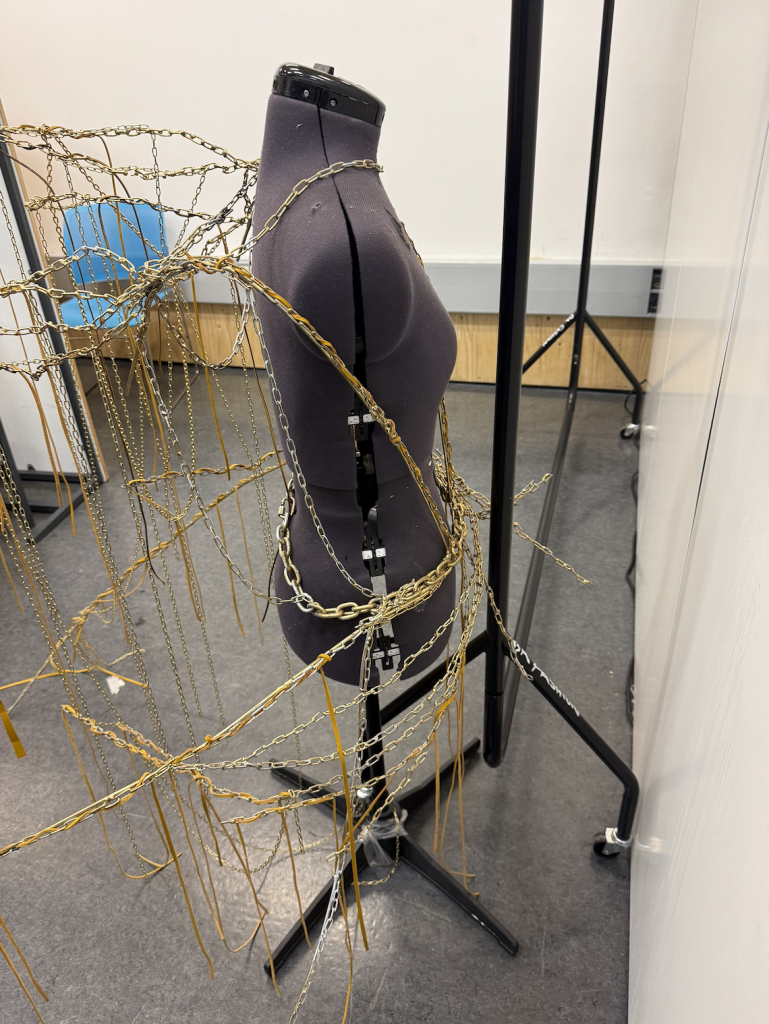
    I was walking to the library at school this week and came across this piece. I thought it was very interesting because, to me, it felt as if your body is behind bars and you are trapped in your own body, since it has the figurine of the body inside. When I saw it, I thought about how there are a lot of women who feel as if they are trapped in their bodies because what they are told the standard for how they should look is very different from what actually happens with their bodies. Many people go to war with their bodies in order to feel beautiful, and if they don’t reach that standard, they have a problem with it. I just thought this was an interesting representation of that.

  • Kensington Palace Exhibit

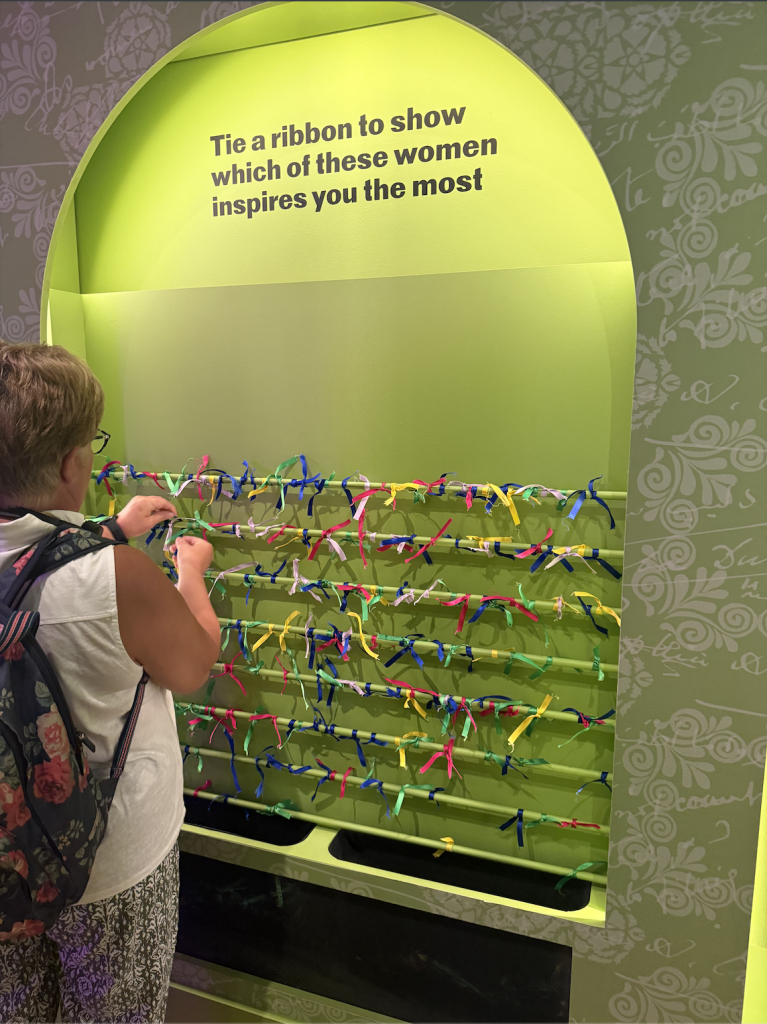
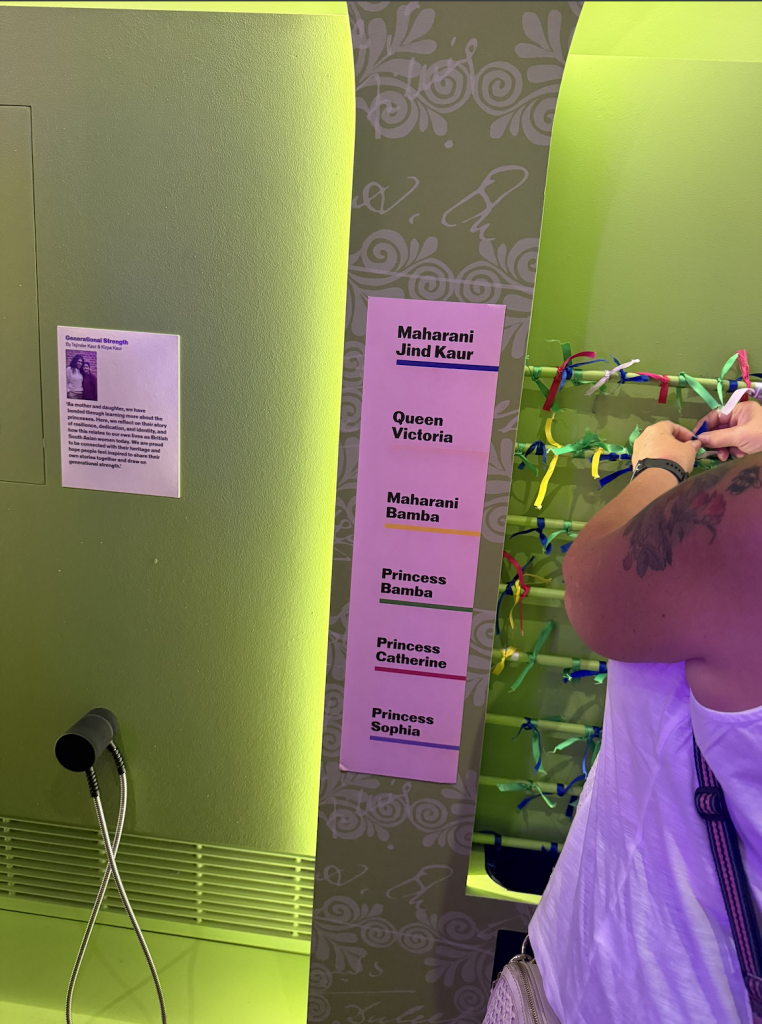
    This weekend, I had the opportunity to visit Kensington Palace and see the exhibit about the last princess of Punjab, where I learned about the interconnected family between the English royal family and the royal family of Punjab. There were three last princesses of Punjab in India because none of the seven descendants had children, making them the last princesses. They were all very significant and important, with all three being female rights activists in various forms, and one of them being openly in a lesbian relationship, which was uncommon at the time. The point in all this is that at the end of the exhibit, we were asked to participate in what I can only assume is some sort of intervention, where we were asked to tie a piece of fabric around the bars in a specific color based on which of the women we learned about during the exhibit we found the most inspiring. I thought that was a very interesting way to get people to interact with and think about the exhibition, specifically these inspiring women. Since I am thinking of maybe doing something with cloth, I found it very interesting and took note of it as some sort of inspiration for a future intervention.

  • Images on Instagram

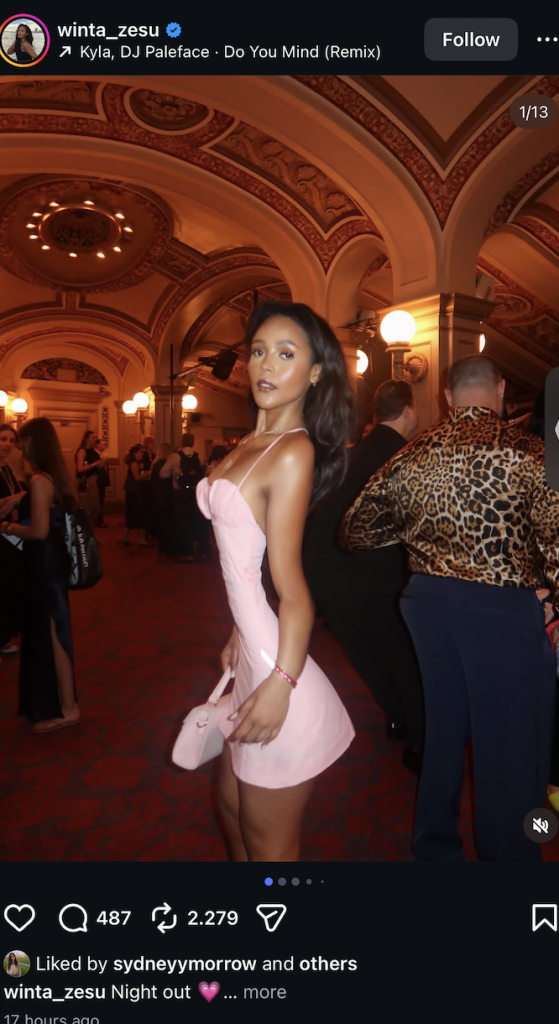
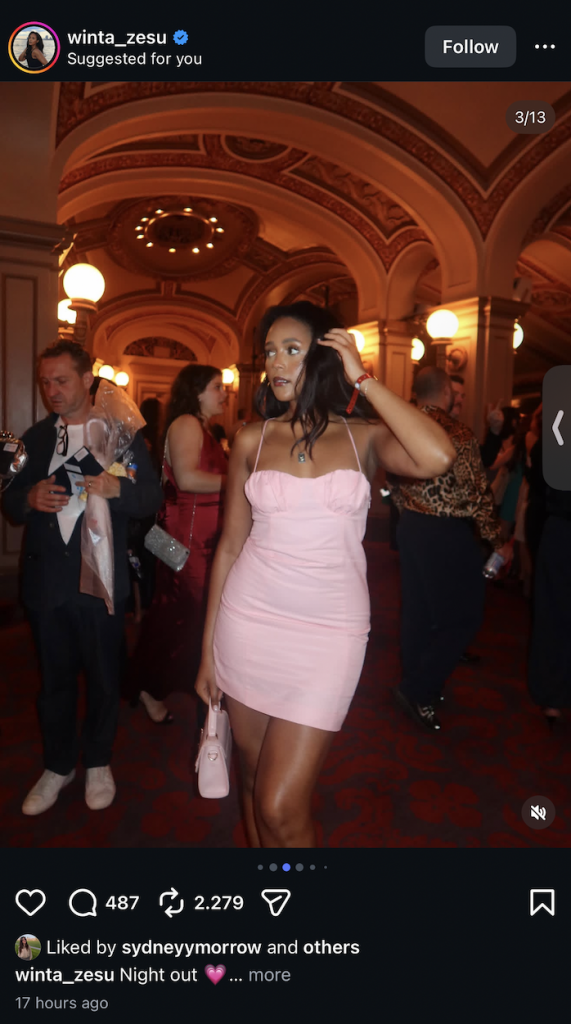
    This week I was scrolling through instagram and I came across the first image shown above and I was so interested in it and the idea of shrinking your body to the most possible small version no matter the cost and then I was interested in what the other pictures she posted were and I saw the second one were she is a normal girl and I was just very curious about what the message she was trying to spread. Her name is Winita Zesu and she is an Ethiopian model and influencer and she has had several scandals when it comes to food even if it was done just in order to gain visibility, one thing that kept coming to my mind is how it made me scroll into the next page and this made me think do I need to do something this aggressive in order to get noticed during my interventions?