As I have been going through different parts of my investigation in the past couple of weeks, I discovered that I am not as healed as I thought I was about my eating disorder. I have had times were I have thought I might relapse when I have been going through my journey however I still consider this to be an extremely important subject and want to do something around it but maybe not directly around eating disorders because I have realized as well that there is a severe barrier to entry so I am now going to try to be more focused on the side of body image and the root that causes all of this issues. For example, looking at the history of Fat phobia and the way that we still see the effects in today’s societies as well as looking at the different comments and ways that people not only view food but their relationship with their body because if I stay focused directly with eating disorders I am not sure where it will take me in my educational journey as well as in my personal one. I also spoke to several psychologists, and they recommended that I take this project and look at it from the perspective of the root issue and the behaviors around it, but that still leaves me a little in the air. I still don’t have everything figured out, but I need to look into it further to understand what’s going on in the project, given all the processes I have been going through.
Category: Uncategorised
-
Round Table Analysis and Journey
This blog post began when I started reflecting. I was talking about this as one of my first interventions I realized that I was not going to have enough words. I needed to think critically about what I wanted to include in this piece. So I decided to work more on the blog, and my tutors can look at it whenever I reference it, because if I tried to include everything here, I might never finish, or it would be endless for a tutor to read.
When I was first thinking about interventions I was thinking of creating workshops and circles to inspire conversations about the subject and get this to lead to different conclusions my first test honestly went really well however when I wanted to do it more towards a different focus group which were people who were actively talking about their eating disorders online I got into a completely different field because I reached out to 172 people who are active online specifically in Tik Tok and from those 74 got back to me and started chatting with me and asking me questions about what this would look like from those 9 people told me no directly or that they were not up for it or they were underage and needed consent so it would not work out however I did thank them very much for reaching back out to me. After starting chatting with several people some of them stopped responding some were not interested I am assuming or did not feel comfortable with participating and others told me they had to speak with their therapists and never got back to me so I am assuming that this means that they were recommended not to participate but this is something that I completely understand in total this people were around 34 individuals or accounts however they might answer in the next couple of days who now because some people have taken a while to respond. 10 of the individuals I reached out to told me they would prefer private correspondence through messages. Then I had 4 people say they were going to show up for a group but did not end up showing up or canceled at the last minute which is also very valid since this is such a sensitive group however because of this different situations I have been able to talk to 5 people one on one about different subjects some of them are health practitioners and some of them are people in recovery or survivors (I like to use the word survivor because I do believe and the people who i have spoken to that there can be true recovery and they can live a very normal life even if at times they still go through struggles). I still have a couple of meetings set up in the next few days so I have to wait and see how those go, however I was realizing that planning on people getting together was not very realistic and if I stayed on doing this it was going to be a mess so I decided that since some people were still corresponding with me that did not have time or did not want to participate with a group go people I gave them another option which was to wander a couple of questions on a padlet. Honestly, most people I asked responded and were very receptive. Still, I needed more interventions; I could not just show up with a Padlet, and this is where the ideas I described previously in my blog about going to the malls came from. Even though I described this in previous blog posts, I hadn’t included specific numbers, which I find important, and I need to address this more in my analysis. I am still looking to create some roundtables for talks with different Colombian designers, as well as to talk to more creatives, but I may have to do this one-on-one; who knows, I will see as time goes on.
-
Padlet
https://padlet.com/cuerpoundefined/cuerpo-undefined-221g26tn4767tvtd
While I was trying to set up different focus groups and activities with different groups of people I found out that is was very difficult to set up a time to get different people to meet and some of them did not want to meet in a group however there was the fact that a lot of them were willing to participate in a pallet it honestly started as an activity I was going to use in the meetings. Still, it ended up being one I could use in general when people didn’t have time for a meeting. This was a pivot I had to make because it is not okay to wait until the time is right; I actually have to do something, and I got a lot of different and interesting comments from this Padlet. In the Padlet, I asked two questions and then gave people the opportunity to share what they wanted. The first question was “What is the most common misconception you see around eating disorders?” The second was “How do you think we can create a safer environment so there are not so many people suffering through body image struggles?” and lastly, I gave people the option to write “Any other thought you might have on eating disorders or body image struggles”
One of the main things I found interesting about this exercise is that people were more willing to do this than to speak to me directly when the idea of focus groups came up. This may be because they are anonymous, and no one will ever know who did it. This is definitely a factor to consider because when I tell people it is anonymous, they are happy to help me, but when it is more of a person-to-person activity, they find it harder to accept.
For the first question, I had 15 different responses; for the second one, I had 13 responses, and for the third one, or the last one, which was if they had any comments, I had 10. The fact that the one where I did not ask a direct question still got so many responses is interesting, because maybe it means I was not asking the right questions. Because of the number of comments in this section, maybe I should have asked more questions. There are a lot of themes that keep on repeating themselves for the different questions, starting with the first question, which is about the stereotypes related to eating disorders. Many of them spoke about the fact that it is only about the body and about feeling pressure when it comes to the body they express the fact that it comes from emotional control and having issues with not knowing who they are and needing an identity and needing to deal with psychological issues issues such as trauma and when they are looking at all of this they use food as a tool to deal with this no matter what type of disorder it is that they are dealing with. For example, other mental disorders are also an effect of this but are dealt with in different ways. Secondly, they talk about the fact that it is something that can be controlled and that it is a choice that people decide to be sick because of the way that they look or many others. There is also the fact that it was never a choice; it might have started with a diet and seemed to grow from there, but there is a lot more going on mentally that is uncontrollable and takes a lot of time. Thirdly, there is the fact that the identity or how bad an ED is based on the way a body looks, and this is completely false since ED’s can look very different on different people. This stereotype also suggests that if someone looks well on the outside, they must not be sick, but in reality, if they are sick, they need the same amount of help, and it is bad for everyone no matter how they look. Another thing that came up a lot in the wander of this question is the fact that eating disorders are treated all the same. There are a lot of different eating disorders that one does not even realize exist; for example, there was talk about AFRID, which is sometimes described as a person being a picky eater, and doctors and people think that this is a disorder which is used to mask anorexia. Still, in reality, many people have this disorder, and it mustn’t be confused with others. Lastly there was the way in which now people are glamorizing extreme thinness in the media which leads to people assuming that people with eating disorders but what they must really be thinking is about the people that look extremely thin is the fact that they are seen as good or even at times as if they are not really a disorder that people choose to do it which is ridiculous and this are all really assumptions that people have in the outside world when it is not something that they live with in their every day life. When I see all these responses, I start to think that no one really knows what an eating disorder feels like or looks like for one person, because there are always changes, and not everything looks the way one might think. Another thing that was really emphasized was how a lack of education affects this, and how understanding the effects a disorder like this has in the long or short run is important.
For the second question, there was a lot to consider. I think that some of the things that they expressed are things that are already in the media but that sometimes it is hard to see, for example I think one thing that really should be seen more is about how people are at times paying attention to other peoples habits when it comes to food and exercise as well as people bodies and this are two subjects that should not be discussed people would have their choices and not be judged on them. The media also has an effect because the trend now is to be thin. People compare the thinness that celebrities and public figures have with people who are actually suffering from this disorder. This connects to the need for change on social media because thinness and being as fit as possible are extremely glamorized. Since it’s on entire platforms, people need to see that it is not just something you show online. Still, it is something you must live with forever because you cannot change or buy a new body; you have to take care of it, and this is the message that should be spread. We should also put a stop to diet culture because it has become so normalized. Some people thought that it is possible to see this change in our society, but that it is something that has to start from the top: having people that we admire or we think have incredible qualities and making sure that they are spreading a positive message. We also need more education about what an adult says to a child and what the effect is, because as an adult you might think you are helping someone lose weight or look better by your standards. Still, the comments you make about a Childs body are comments that might stay with them for the rest of their lives and this is something you really have to think about (are you comfortable with being the one who made a comment which might affect someone for the rest of their life and lead to a mental disorder) you don’t have to say everything you think it is impotant to actually think before you start spreading messages specifically when it comes to this subject. The last point in this answer, which I think is important to look at, is how everyone is glamorizing GLP-1 nowadays. I do think they are important and necessary for some people, but I don’t think people should make comments like, “You should go on a GLP-1 to see if you can finally lose weight.” Finally, what most of them say is that we need to start showing real bodies; however, I don’t want this to be interpreted as bodies that are on the larger side. This also means including bodies that are shorter or taller, as well as slimmer, because even though we assume slim bodies do not face criticism, that is not reality. Hence, it is important to have all types of bodies because people have such different forms that no single body should be seen as wrong or unreal.
Lastly, in the last column about comments people might make about this subject, there was still a lot of talk about assumptions people make regarding these disorders. One example of this is how people sometimes assume recovery is easy you just have to eat but the reality is that when your body is so malnourished and going through so much it is impossible to just think that if you eat you will recover because this is not a weight illness it is a mental illness and a lot of times people do not realize this for example in Colombia when someone is so sick that their heart is no longer working and their brain is shrinking they are not put into a hospital that is specialized for this they are hospitalized not for mental health but for malnourishment and when you gain a little weight you are sent home but they don’t treat the underlining part of it then it is also important to look at the treatment centers and how a lot of them are not always positive and there is a lot of abuse going on around it at times it is also something that can come back or that you might not fully recover from for a lot of people it is an every day struggle and it is not as easy as just going to a clinical hospital to get help it takes a lot more than that. The point that got a lot of attention was that EDs aren’t always about one body. Still, it is always assumed as this at times it is a coping mechanism (One part that is very important to look at as well is the fact that at times there is a direct correlation for example with the ED of Bulimia and binge eating with ADHD when it is not diagnosed because people were not taught that their brain was different and given help with leads to them looking for a new way to control or to regulate their brain and emotion and this is something I learned in one of my visits to a ED treatment center in Barcelona). Lastly there is talk about GLP1 and how this is something that can really affect people that are going through recovery and not just that but there are also a lot of people that triggered an ED when they started using a GLP1 because they got addicted to the fast weight loss and staying small and this is something that must always be looked at as well because this is truly and lines and when given a drug such as this people can get sicker or triggered because they must conform to this new standard.
-
Intervention with random participant 2 (Artifact)
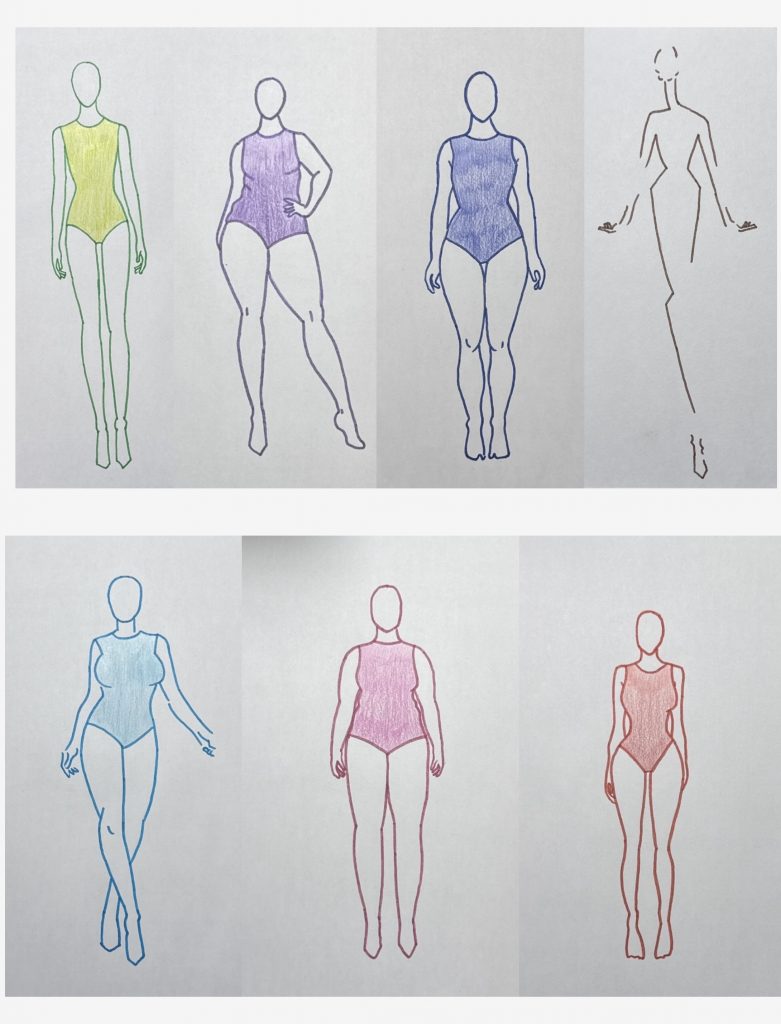
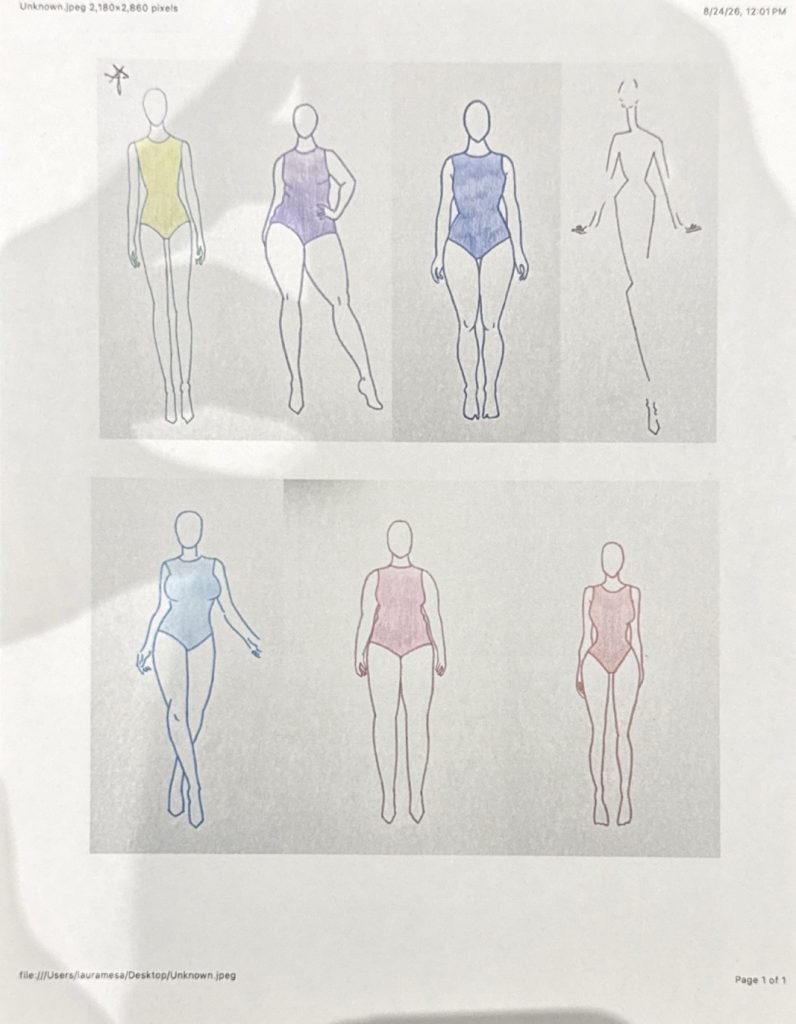
For this interventions I changed the format as well as the place because when I was talking with some of my family members about the interventions I was doing my family asked me where I did it and when I told them I was doing it in Santa Fe they recommended that maybe I try another mall that had more diversity of people so I decided to do my next test in the mall Viva Envigado which is also huge but something that is different is the fact that there is a metro station which makes it more transited and by a larger variety of people which I thought might make it more interesting. For this one I wanted to make 100% sure that I was making an intervention as complete as possible so I decided to make an artifact to go with it. In this artifact what I wanted to accomplish was to include different body types in the form of silhouettes that I use when I am making fashion illustrations which is something I have been doing for years. In all honestly the one I have used until now for the past couple of years has not been the most inclusive because when I was creating my sketches in the beginning I used curvier models but later on I took on some tutoring and my tutor gave me very slim models to use and I thought it made my sketches look very beautiful and this was the feedback I got from everyone in my life I used the one in the top right but now that I think about it and as I have been going through my project I realized it was important to use different body types in my sketches so when I started speaking to people the question I asked them with the artifact to wander was, “If you were thinking as a fashion designer which of this primary sketches do you think she or he should be using when creating new fashion garments or a new fashion line?”
This was the page that I showed them and the part of the activity that they had to do was mark which one they thought and then at the bottom they had to explain why. Some of them did not want to awes or did not have time so they just left it blank and she of them told me to write it for them since they did not consider they had good letter for writing on paper so that is why some of them might look as if they have the same penmanship.
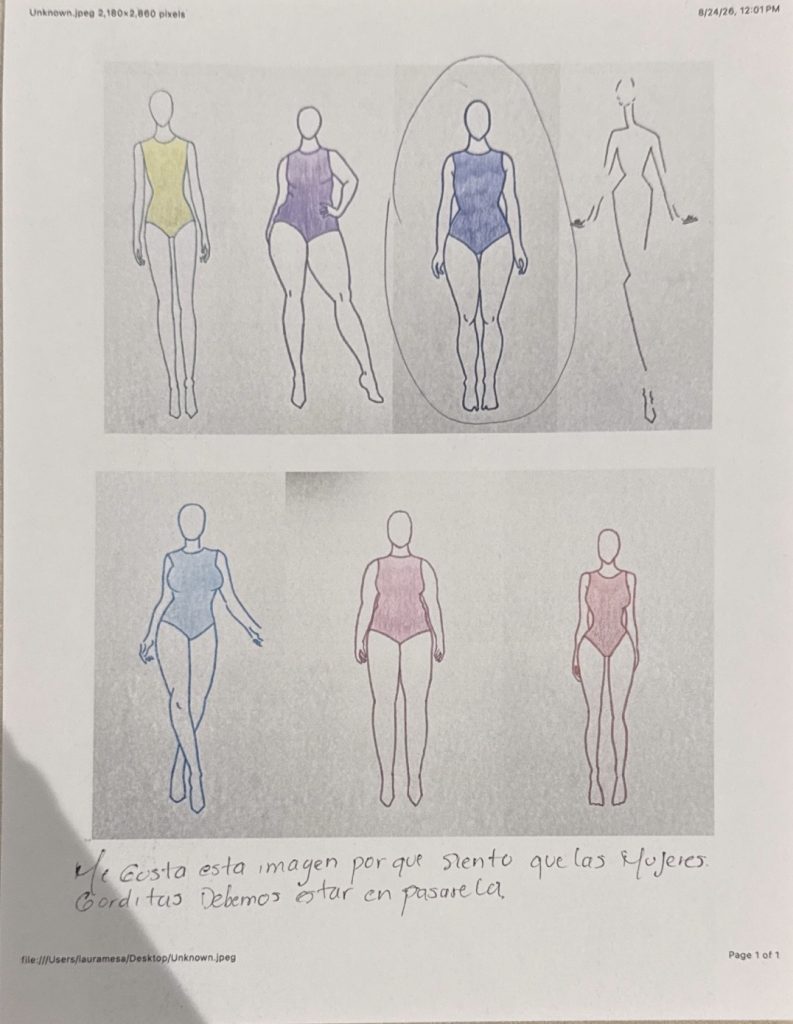
(I like this image because I feel that fatter women need to be more in the runway)
- I really like this wander because, even though it doesn’t directly answer the question, it sheds light on what some people might want to see in different forms. (Maybe a fashion show including different bodies? However, I feel this is something that people have already done)
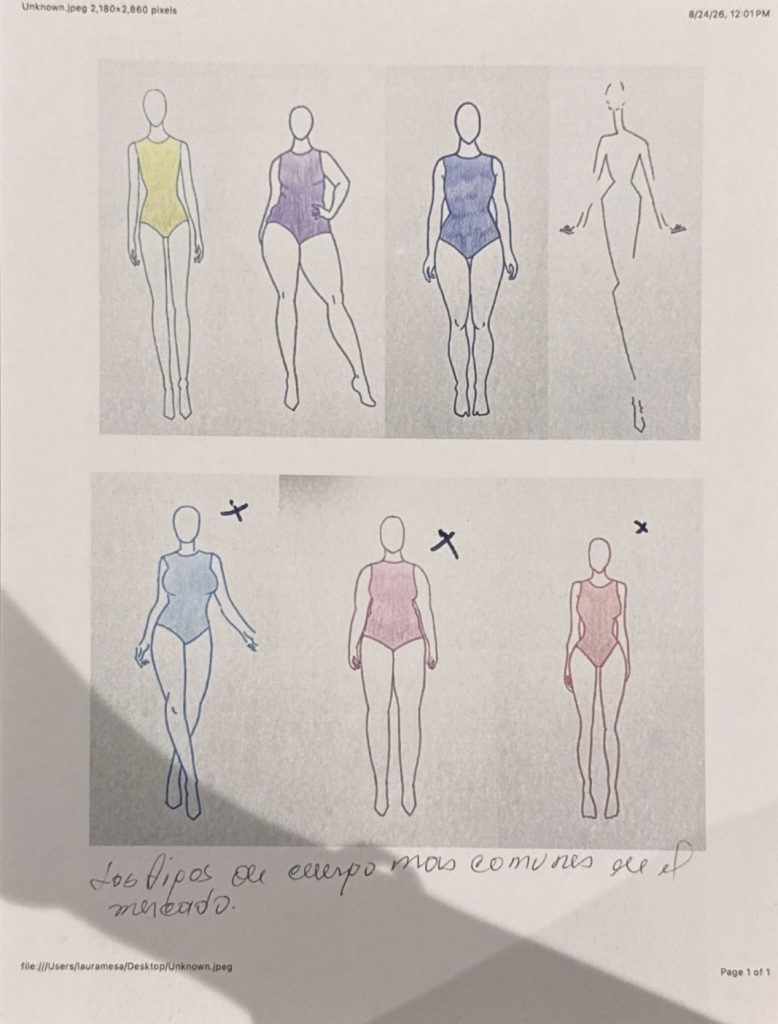
(The types of bodies that are more common in the market)
- Interesting assumption, and it was interesting that she considered the market when she pondered the question; maybe she really took it seriously, trying to get into the designer’s mind and what they had to accomplish.
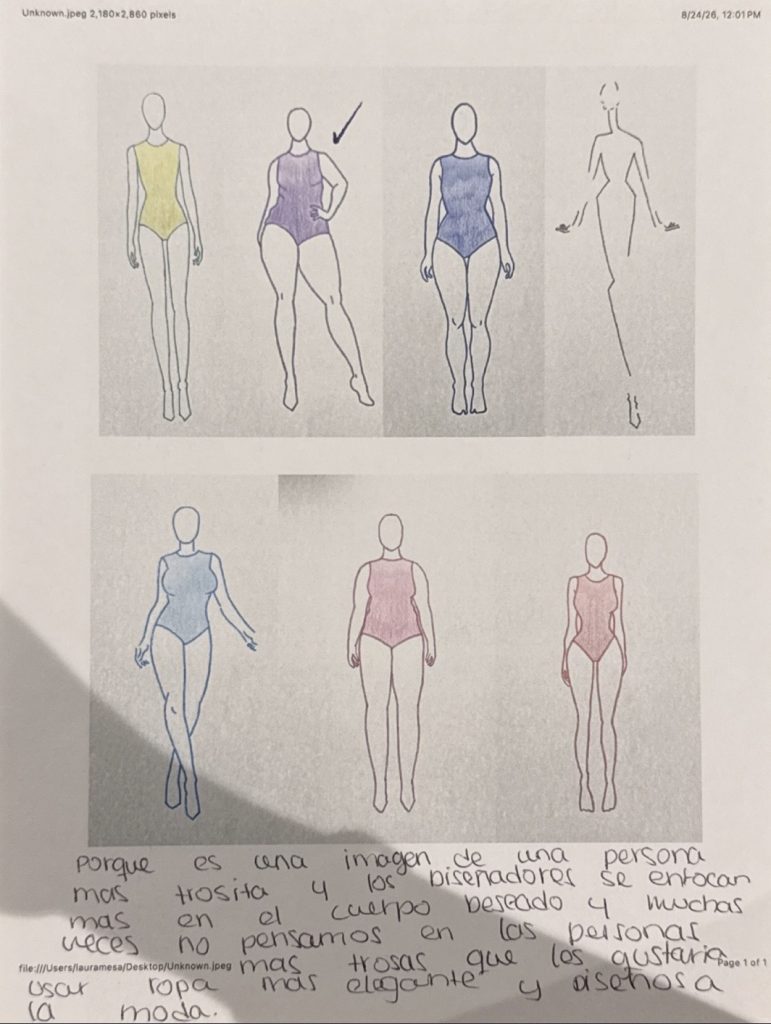
(Because this is an image of a curvier person, and designers are mostly focused on the dream or ideal body, and a lot of times do not think of the people with bigger sizes who would like to use clothing that is more elegant and designs that are trendy ) - It was interesting that she thinks that the industry is looking at the ideal body and designers as well. Still, one important thing to keep in mind is that the ideal body has always been evolving. Bodies are sometimes treated as trends. They are always changing, maybe not even in a healthy way; for example, today I heard a crazy statistic that around 50% of Americans are on GLP 1 to lose weight. Not all of them need it, which shows a shift toward extreme thinness as an ongoing trend.
- I also thought it was really important that she is talking about the fact that everyone should be allowed to participate and one brand that I thought of was good American Khloe Kardashians brand and the fact that when she sells the clothing to department stores she makes sure that they buy the whole size range and that they are all displayed in the same place there are no products in plus size sections and this is a ways that brands such as hers are making sure that everyone is included when it comes to the shopping experience and there are no differences.
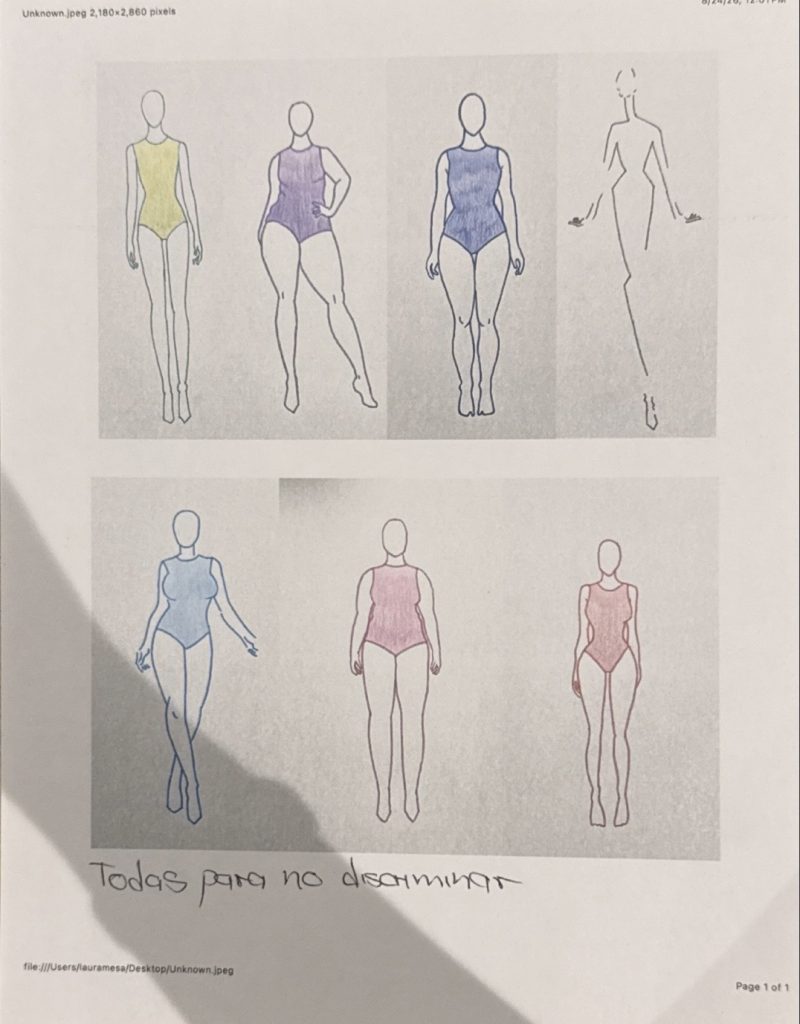
(All of them in order to not discriminate) - This person chose all of them. She didn’t think she had to choose, and she thought representing all of them was important, which is true because bodies can look very different in different scenarios.
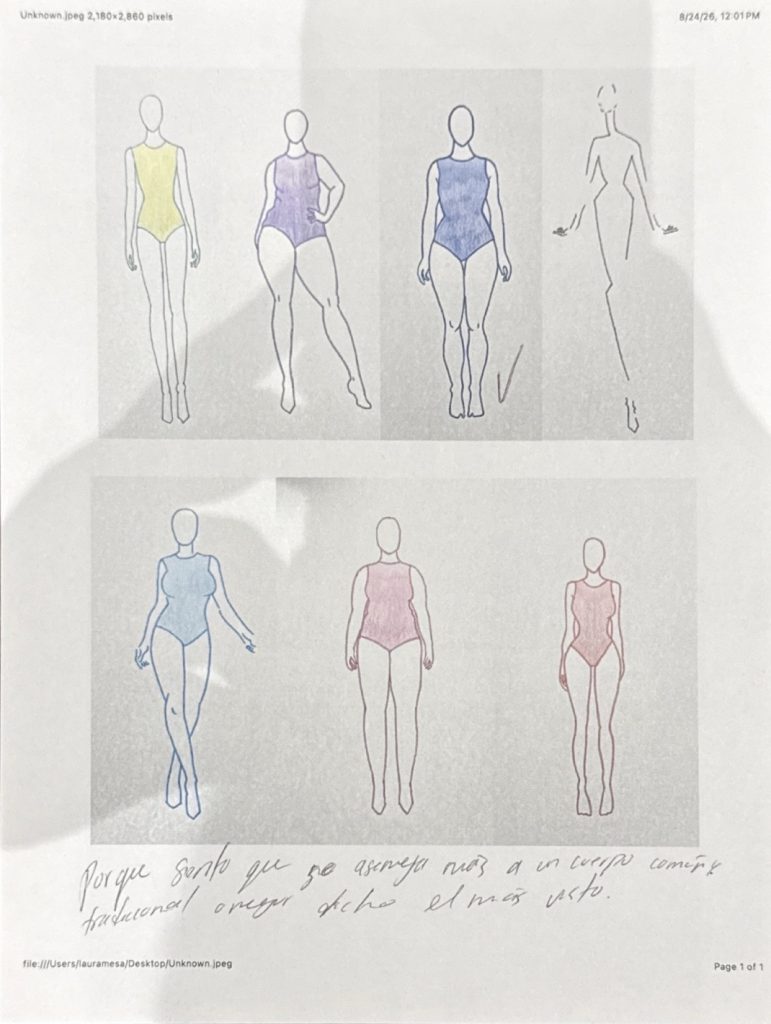
(Because I feel that it is the most similar one to a traditional and common body, or, to be more precise, the most common) - This person was thinking about the most inclusive of the norm when giving her words, but maybe it is not even the most common, but the average between them.
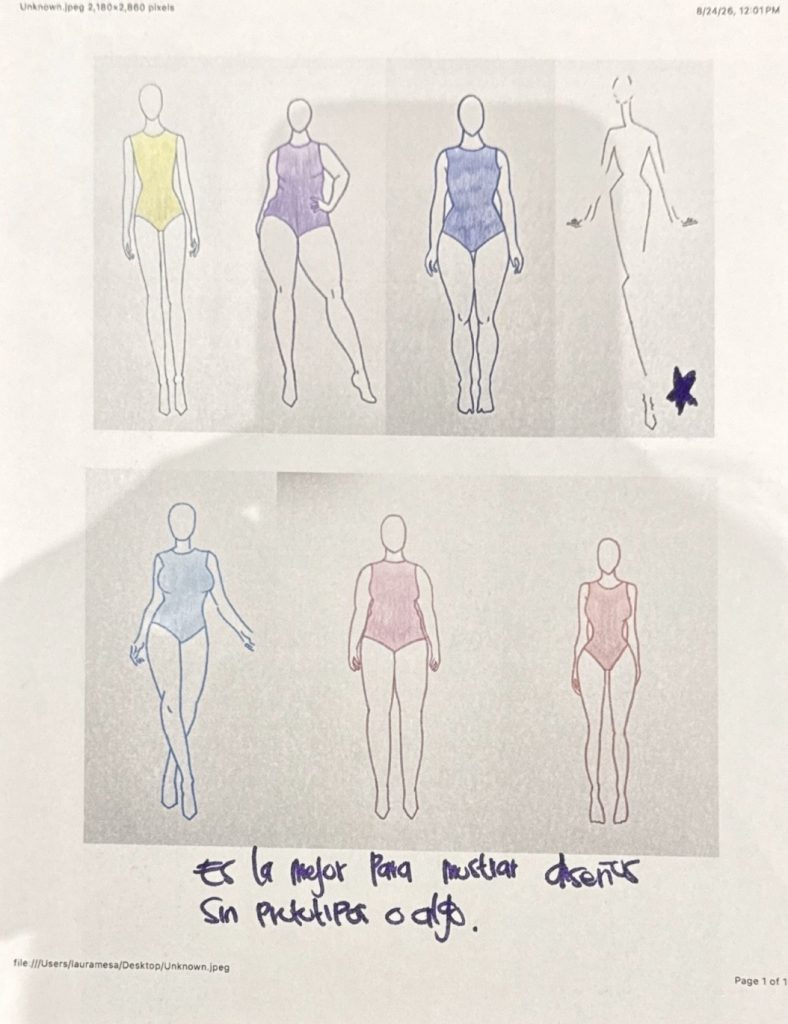
(It is the best one to show designs without prototypes or something) - This is the same assumption I included below: that it’s easier to work with it as a designer.
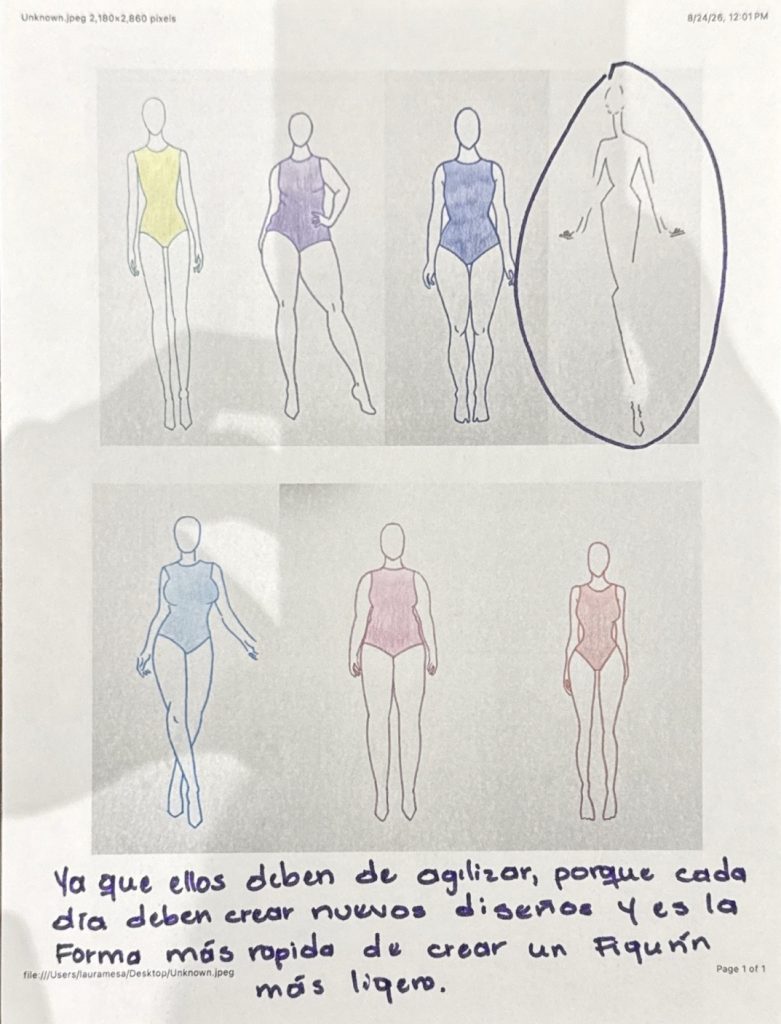
(Now that they must be agile because every day they must create new designs and his is the fastest way to create body image drawing with more agility and faster) - This applies the same way as above and below because it assumes that larger clothing takes more time to make. Still, it definitely shouldn’t affect the design because I don’t think drawing a couple more centimeters or millimeters is going to be the answer to helping people be productive
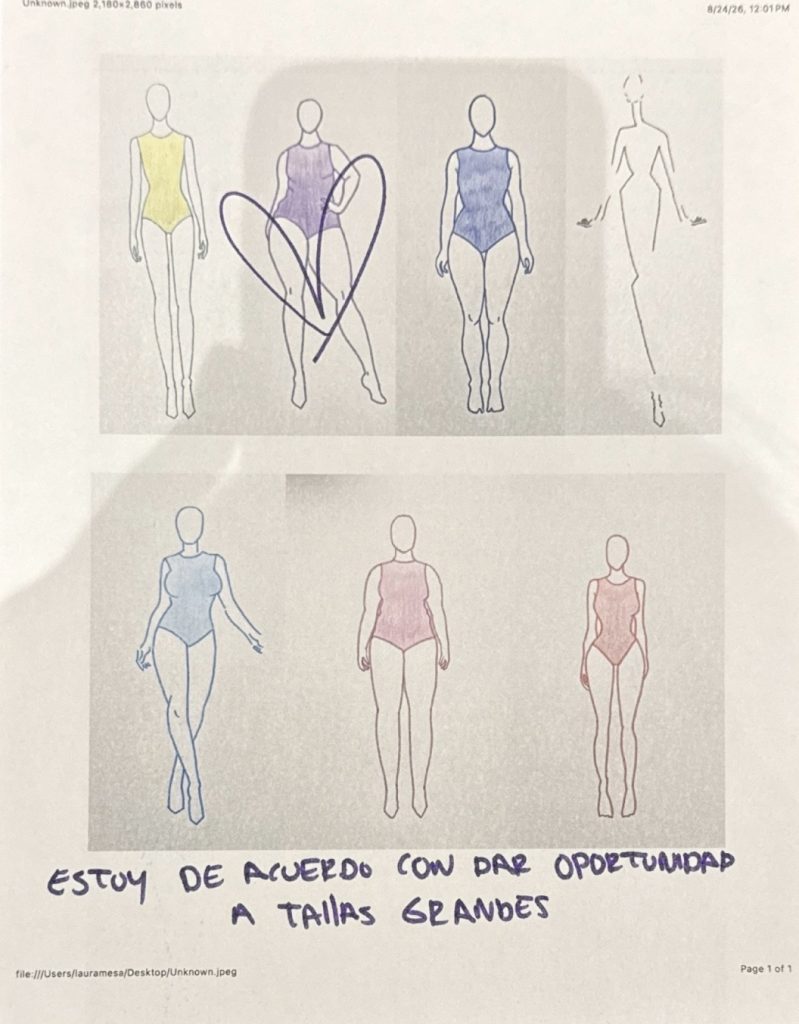
(I AM IN AGREEMENT WITH GIVING BIGGER SIZES OPPORTUNITIES) - This person was really interested in seeing more diversity in body sizes and giving larger people more of a voice, especially in the fashion industry. It was interesting that she used a heart to signal her choice; maybe it represents love, and maybe this is a body that needs more love and compassion. (I feel that a lot of times bigger people are looked at as less disciplined or as if they are not as deserving, and this is something I have heard is an assumption people have by many I have interviewed, and I think it is important to look at them from this different perspective.)
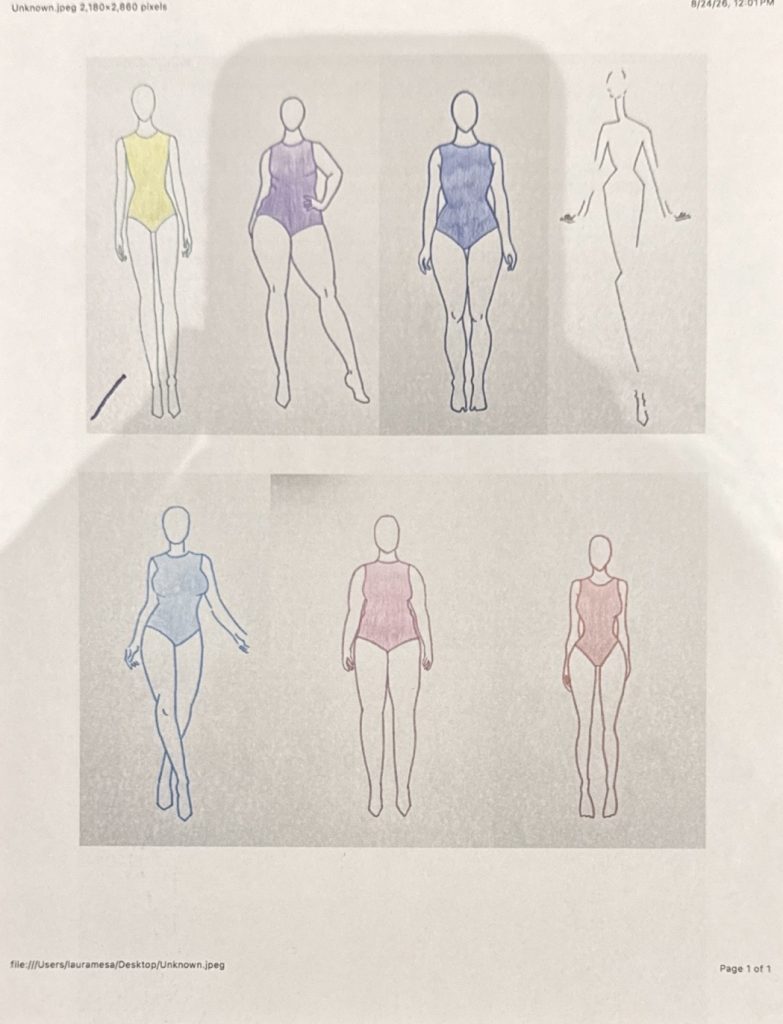
This person was in a hurry, so she just answered with a check in the one she found more appropriate. 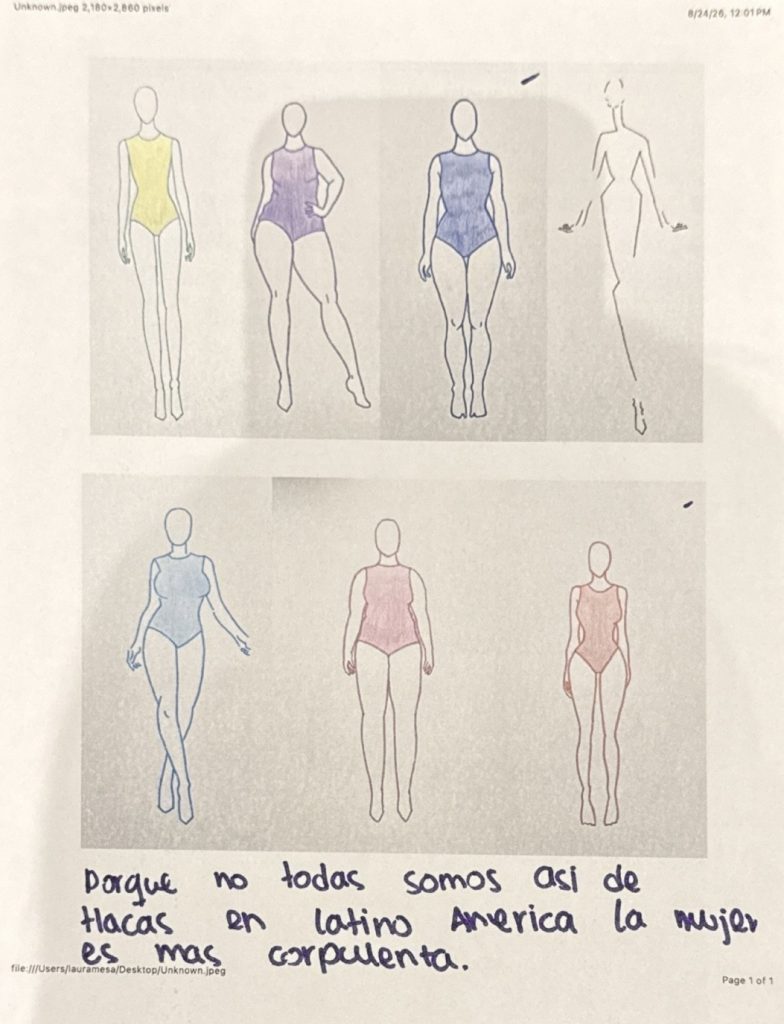
(Because not all of us are that skinny in Latin America, the women have more curves or more body)- This person really looked at the reality of the people in her community because she made a point to talk about them specifically, and that is why she made her choice.
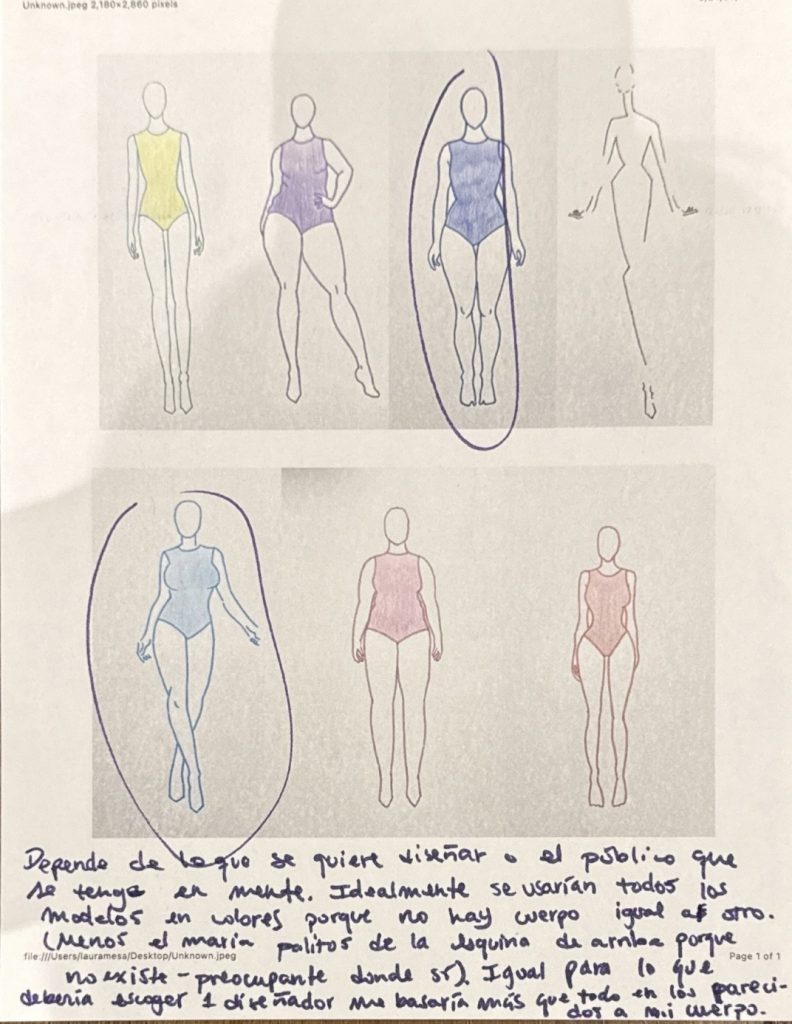
(It depends on what you want to design or the public that is had in mind. Ideally, I would use all the models and colors because the two bodies are the same except for the “Maria Palitos” in the right-hand corner. After all, it is not very worrisome if it exists. Either way, I base my choice mostly on the ones most similar to my body. * Maria Palitos is a very Colombian saying that talks about extreme skinniness and it is at times used as an insult for very thin people who are not capable of gaining weight if I had to find an English comparison I would call it long bean.
- This was very interesting to look at because this person based her decision on the fact that these were the bodies that looked the most like them. They want designers to use them, but they also acknowledge that all bodies should be used; however, they are definitely going against the slimmest one in the right-hand corner because she doesn’t feel it represents any body type. I am guessing by her answer that the most important thing is to have a body which is real.
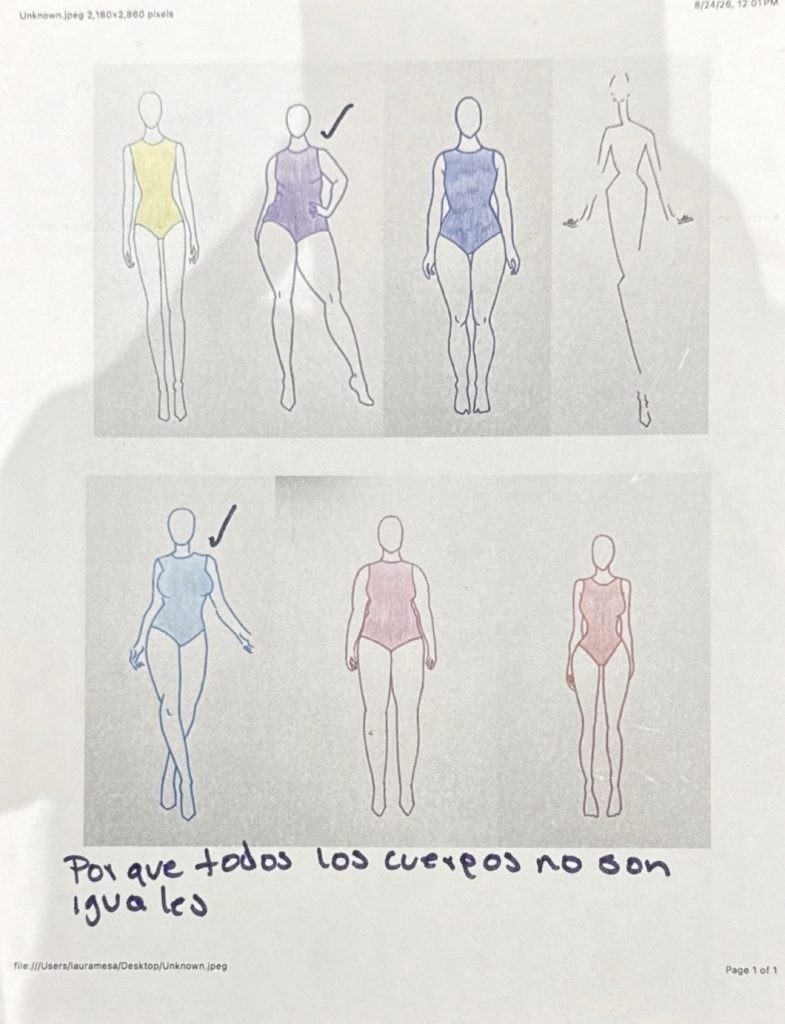
(Because all bodies are not the same) - They acknowledge differences, but like the one below, they still choose. So what made this person choose this one is the wander; maybe it is because of her preference or because they are seen a lot in Colombia, or who knows what the wander might be, but they reason that there are definitely differences between bodies and no two are the same, which is important to notice.
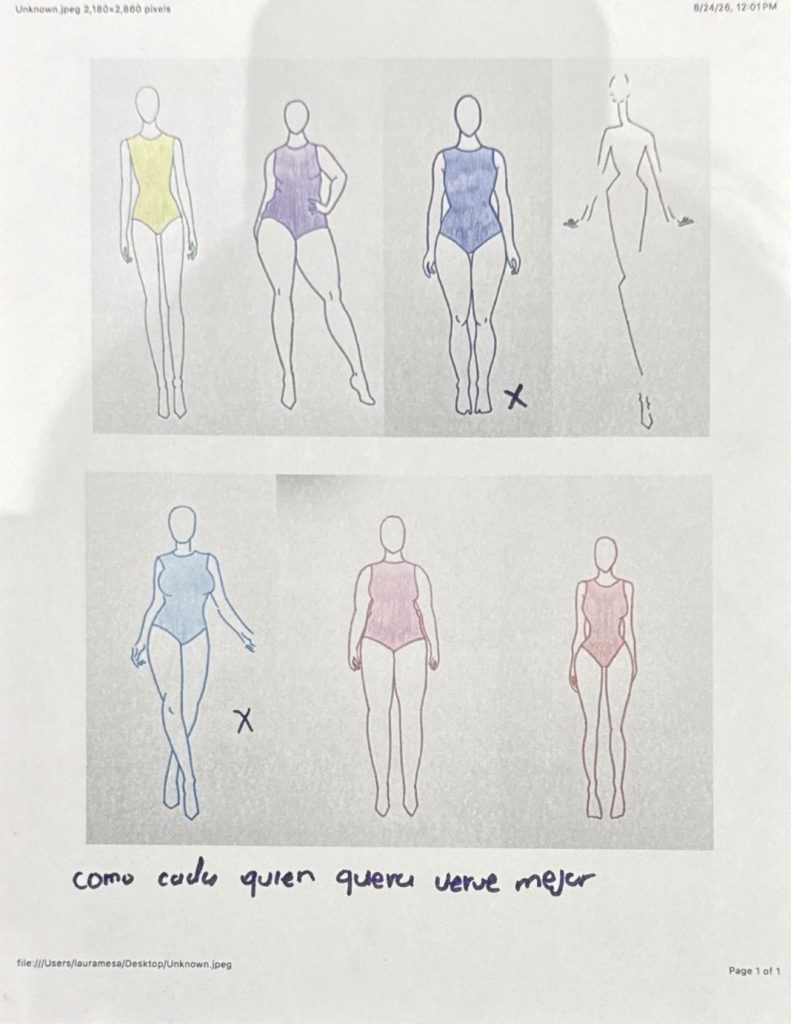
(Como cada quien quiera verse mejor) - This person took a very polite approach but still chose specific bodies, maybe because of her personal preference or because they were the ones she identified with most.
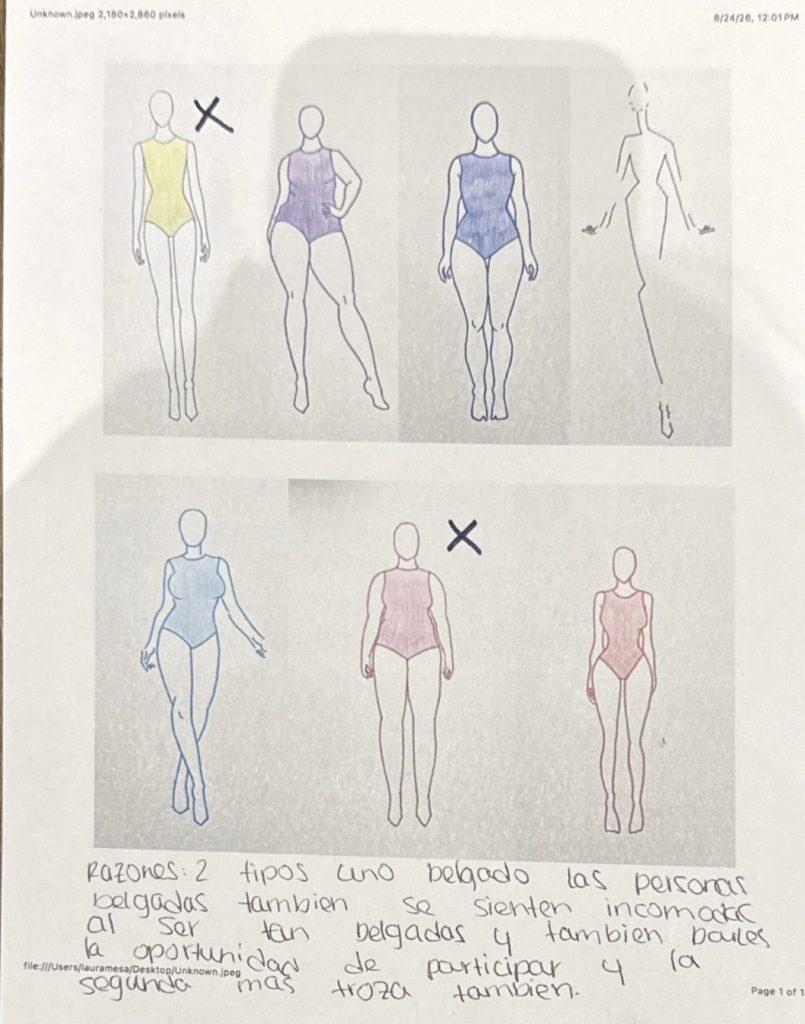
(Reasons: 2 types, one that is slimmer and slimmer people also feel uncomfortable with being so thin, and they also need the opportunity to participate as well as the thicker one) - I think it is really curious that this person choose 2 opposite body types, or what might be considered opposite, and not only talks about fat phobia and how larger people might feel uncomfortable in their skin but also how really slim people have struggles as well, even though they are not always acknowledged, and I thought this was definitely interesting.
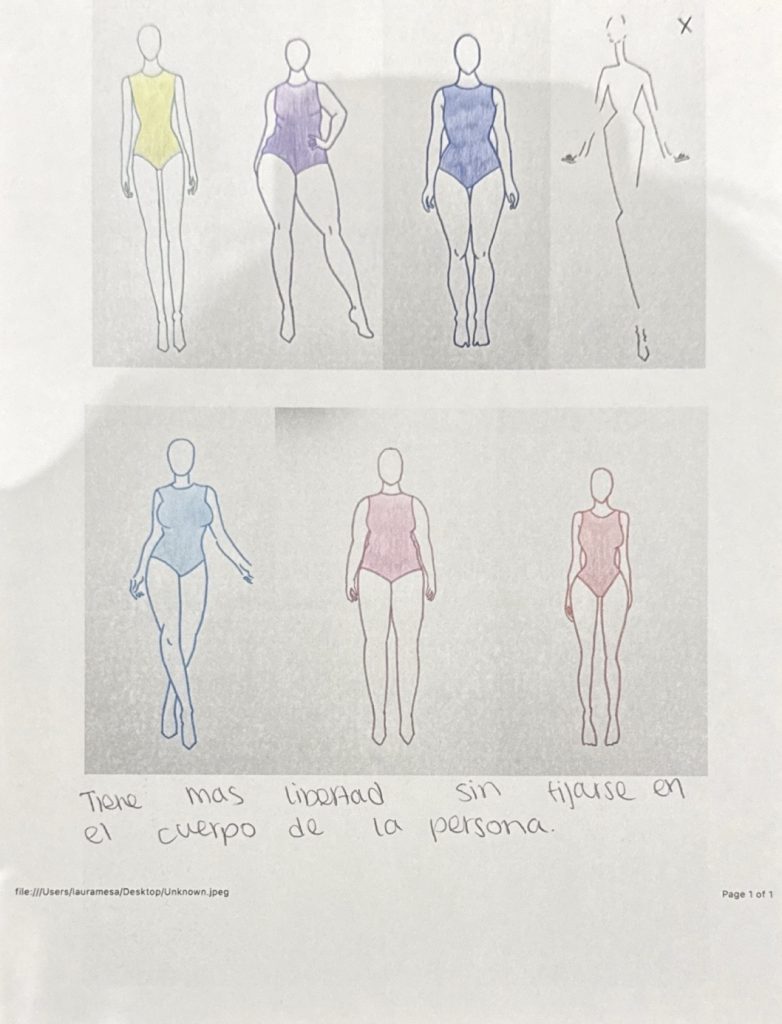
(They have more liberty without noticing the body of the person) - Here comes in a similar thing to what I saw on the bottom which was the assumption that it is easier to design for a timer body in mind without thinking about the body, however when I was speaking with a psychologist from Bolivia called Sissi earlier today she told me about this fact that at times people talk about the body as if it were a hanger ad that it has to fit as such. There is definitely a connection here because they are saying that the slimmer it is, the more liberty there is for the designer, but what I ask myself is (What does one have to do with the other?)
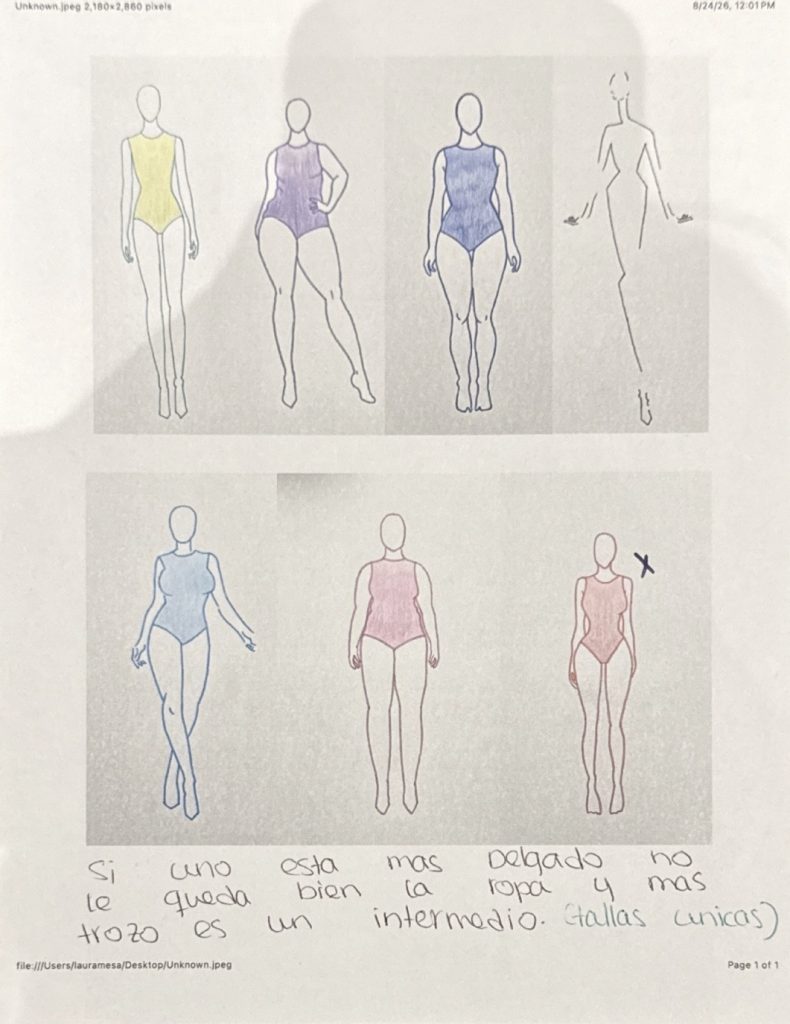
(If you are slimmer some clothes does not look good on you and more curvy is a better intermediate “only size clothing”) - I found it extremely interesting that the first thing that came to this woman’s mind was one-size clothing, and someone I interviewed told me that one-size-fits-all is an effect of the recession because it is cheaper to design the same thing for the economy. This made me think about how differences relate to this, and I found it interesting that 2 people have talked about this subject.
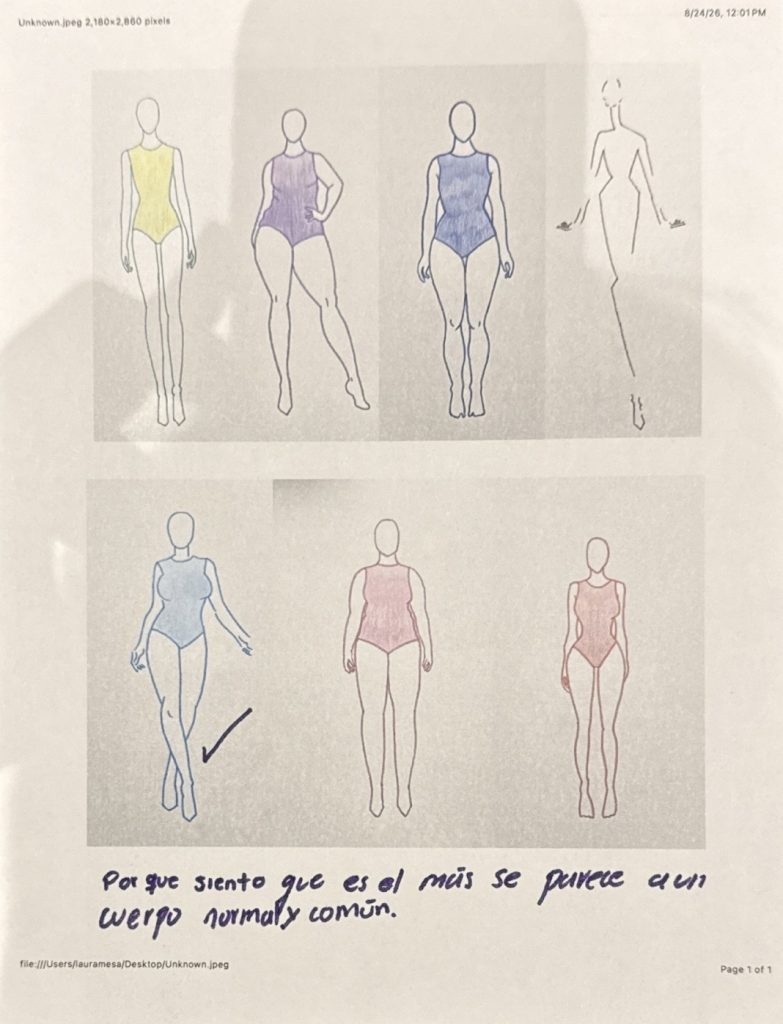
(Because I feel that it is the one that most looks like a common body) - I think this is a very common wonder because this is, in fact, a body type you see a lot in Colombia. I thought it was very interesting that this is why she choose this because it made me question one thing (why do models not look like the standard human, it also made me think about one of the people who I interviewed about ballet and the way that before the ballerinas body was like a standard person and later on this presser came by because of a group of ballerinas that looked a certain ways and maybe this is very similar to what has happened in fashion that since the slimmer figures were the most represented they became more desirable. However, this is just an assumption I am making based on what I am seeing)
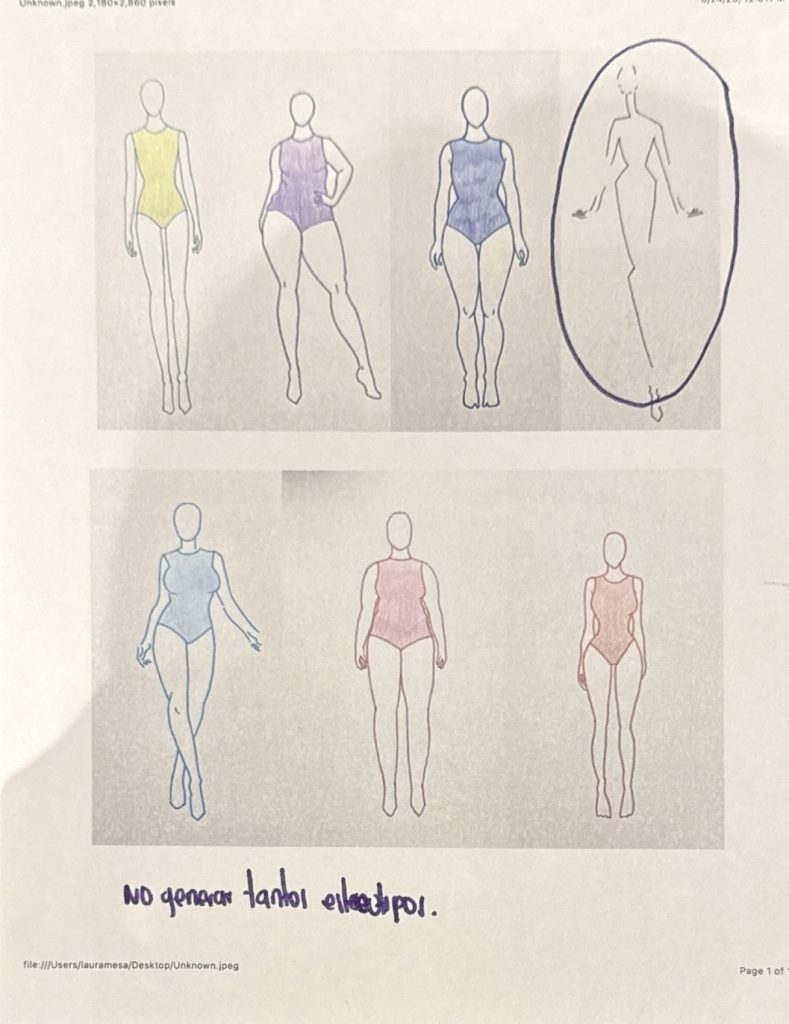
(Does not generate so many stereotypes) - This can be seen both ways: it might look extremely slim, but this person wasn’t about proving any prejudice against a specific body type, which I found extremely interesting.
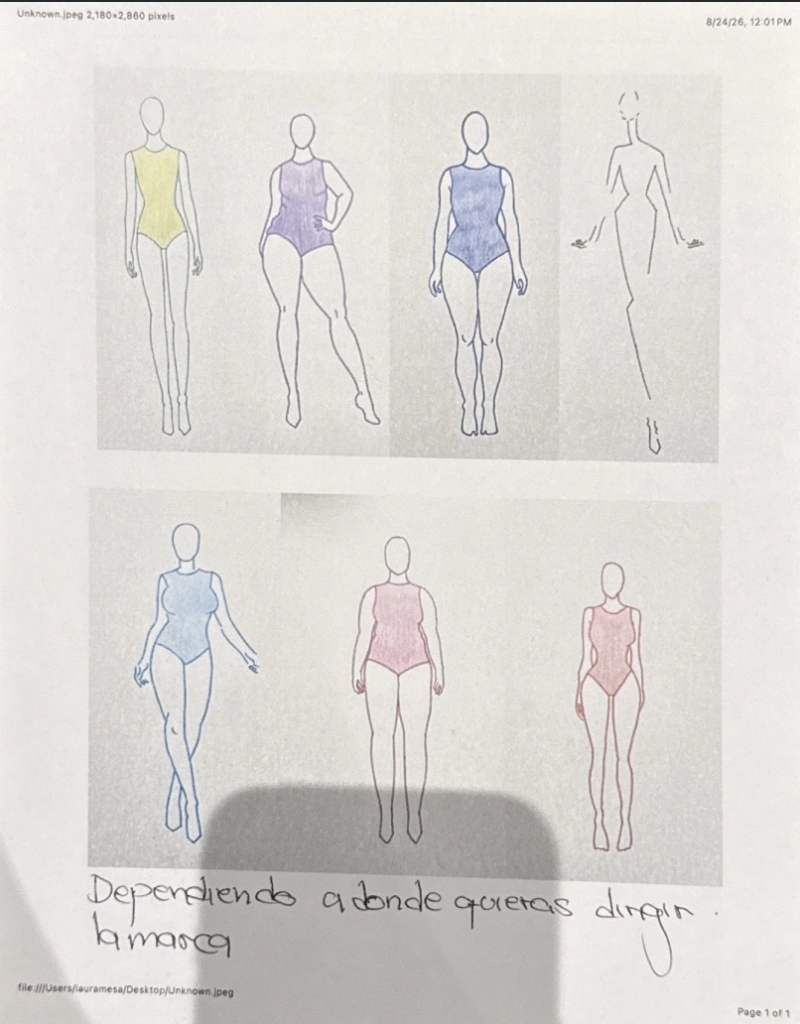
(Depending on where you want to take your brand)
- This was a very interesting reaction because, from the beginning, since they work in a fashion brand and were talking about how they assess, they immediately said it depended on the public they were speaking to or the person.
Honestly, looking at all of these answers, there were a lot of them that surprised me because I did not think I was going to get so many of them from people who were so emotionally aligned with what professionals consider the healthiest, such as the fact that a lot of them said that they accepted themselves the way that they were and that they love themselves. When it came to specific insecurities, the women I spoke to had a part of their body they weren’t completely comfortable with, though some said there are parts they don’t think they would change. Some of them weren’t even about the body, but about appearance as a whole. I also noticed that, overall, some people look at their bodies with the utmost respect and appreciate them for what they are. At the same time, other women thought there were aspects of their bodies they would like to change, which shows me there are two very different groups of people.
There is also the fact that when it comes to body parts and insecurities, as well as what they would change, there were three things that constantly came up: breasts, nose, and arms. There were some of these that I had already suspected, which are the nose and breasts; there is a tradition in Colombia that when you turn 15, you get your nose done as a gift, and a lot of people get breast implants for their graduation; this is very common in a lot of different social groups.
Secondly, I realized that the age at which girls start to notice their appearance varies,e, but most start noticing it before adolescence. Speaking from my personal experience, I was around the age of 8-9 when I started to notice my body and started to feel insecurities; however, I know a lot of people who started to notice it once they got older.
I also saw the fact that most girls learned about their bodies and about standards from their mothers, which makes a lot of sense because I think that, looking at it, the idea of bodies and the way some people are more comfortable than others comes very much from their families’ own views and perspectives, which I thought was very interesting.
However, when I saw some of the answers when it came to their own insecurities or when they felt uncomfortable, there were a lot of peole who do don’t want to answer or maybe not think about or maybe they genuinely have never felt insecure in their bodies who knows because maybe I am thinking through my own prejudices that everyone has to feel uncomfortable at some point in their lives. Still, maybe some people don’t think about it, and it was never part of their conversation or identity.
I also want to give a little of context about the people I asked questions to they were all warned that this was going to be used in my educational blog but that it was going to remain unanimous the only thing that I can include was the fact that I only asked women to participate mainly because I think women approach the subject differently but maybe in one of my future interventions or research I will use men to have different groups.
This was a successful exercise because I got a lot of partic. A very interesting experiment and with the difference in this one from the one I had done previously I was able to see the fact that everyone I spoke with today was willing to participate which I found very interesting because maybe this group of people was more interested in the subject and when I showed up with something they could interact with more rather than just asking them a question they were able to participate more and felt more included but I don’t know. I got a lot of interesting reactions from the people I spoke with for example one that really interested me was when one of the people who participated asked me if she had chosen the right one and that is when I had to explain that in this type of activities there was no right or wrong wander I just needed to see the different assumptions people might have about the fashion industry through this and by getting their answers I feel like I accomplished fart of the goal. I definitely want to do something similar and try different malls, but with different questions or images, because it is important to test different things as well as different backgrounds. Even though it wasn’t perfect and some people didn’t want to participate, many people gave me feedback on the questions and raised subjects I had never considered. It was also a good exercise for me to let go, go up to people, and ask them about different subjects related to the body. It was growth for me. It helped me get better at asking questions and seeing what comes back to me, and not be so afraid of rejection because it’s part of the process; some people won’t want to participate. Still, I learned a lot from the people who took part and from the people I spoke with.
It was interesting to look at everyone’s answers because some people approached it from the premise that it is easier to draw on a slimmer body and design from there, rather than on a bigger body. It is something people think is used, but I also saw that it might be used, or people assumed it should be this because they were trying to find a correct answer instead of doing the important part, which was honestly to look at everyone’s opinion. It was interesting that a lot of people thought it was important, and that some people were bigger in the picture. However, when I got home and showed what I had done to some of my family members, they thought I was missing one that was more intermediate, but I thought I had included a large variety; maybe next time I will try to have an even larger range.
While I was asking these questions, I walked into a store where 2 women were fashion advisors. They directly told me that they really liked what I was doing because they felt there was still a lot of discrimination in Colombia and when it came to bodies, because even though in their store there were sizes ranging from XS-XXL, in Colombia there are a lot of stores that do not have so much size inclusivity and that there are a lot of small one-size-fits-all pieces. However, looking at all of the women, I thought there were a lot of people who reacted based on their own bodies.
I feel that this has really helped me look at body image and fashion as a whole because I was able to see the different perspectives people have on designers and look at different things through the lens of people outside of the world and also looking on the beliefs that they have on the bodies of women in the country of Colombia and the way that I can see that there is a lot of more acceptance than there was before.
-
Intervention with random participation
I created different moments where I could use different circles as interventions. I realized it was really hard to get people together, and many people canceled at the last minute, even though it was very productive. Some things did work, and I met with a couple of individuals, but not a full group. I decided I had to do something because I couldn’t keep waiting to see what I could make happen, so I went to one of the largest shopping malls in Medellín, Colombia, called Santa Fe. I sat with a multiple-choice set of questions in Spanish, but I will translate them into English.
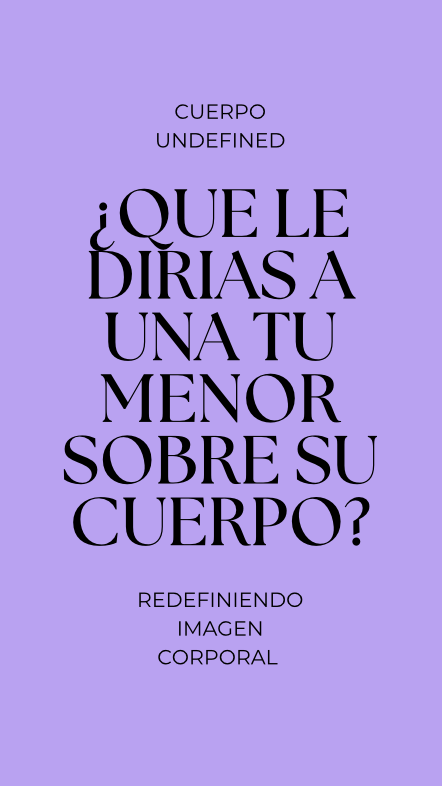
1.What would you tell a younger you about their body?
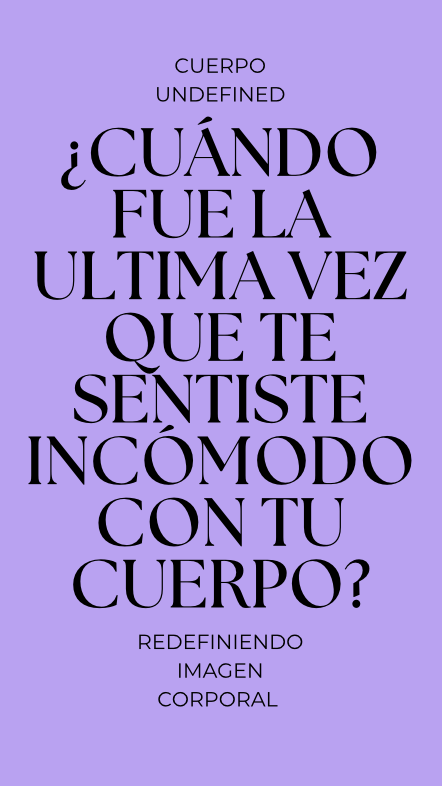
2.When was the last time you felt uncomfortable with your body?
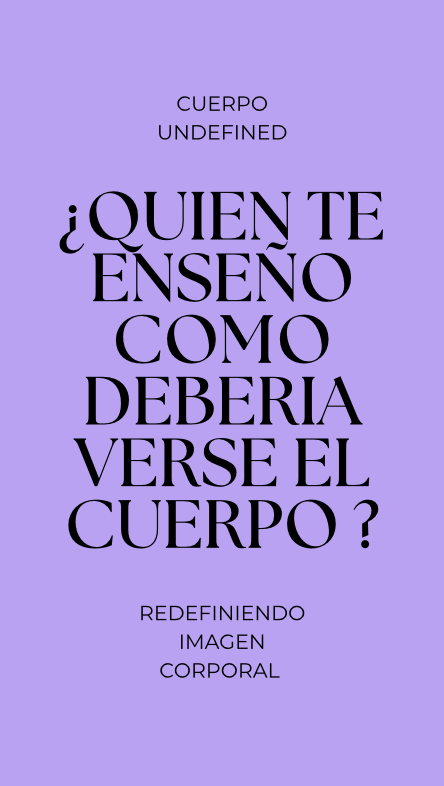
3.Who taught you what your body should look like?
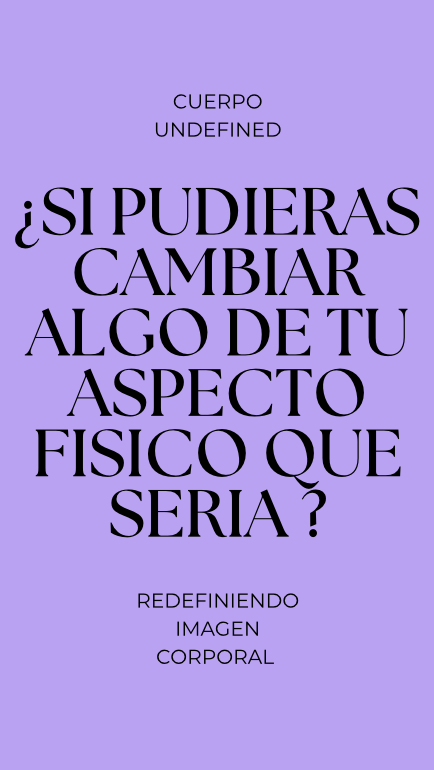
4.If there was something you could change about your physical appearance, what would it be?
5. At what age did you start noticing your own body and everyone around you?
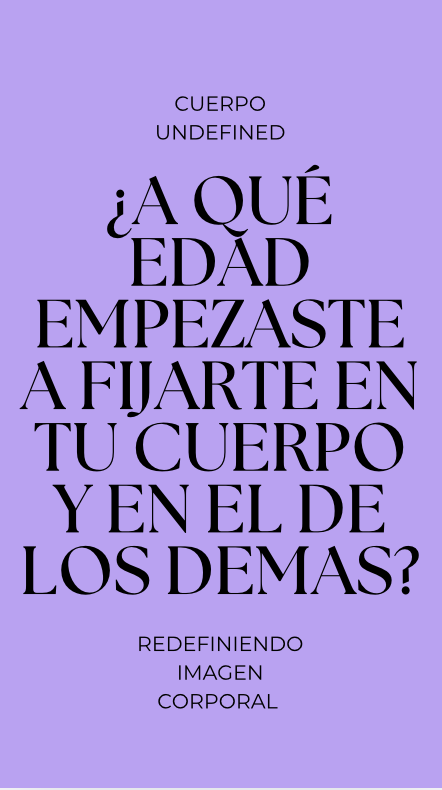
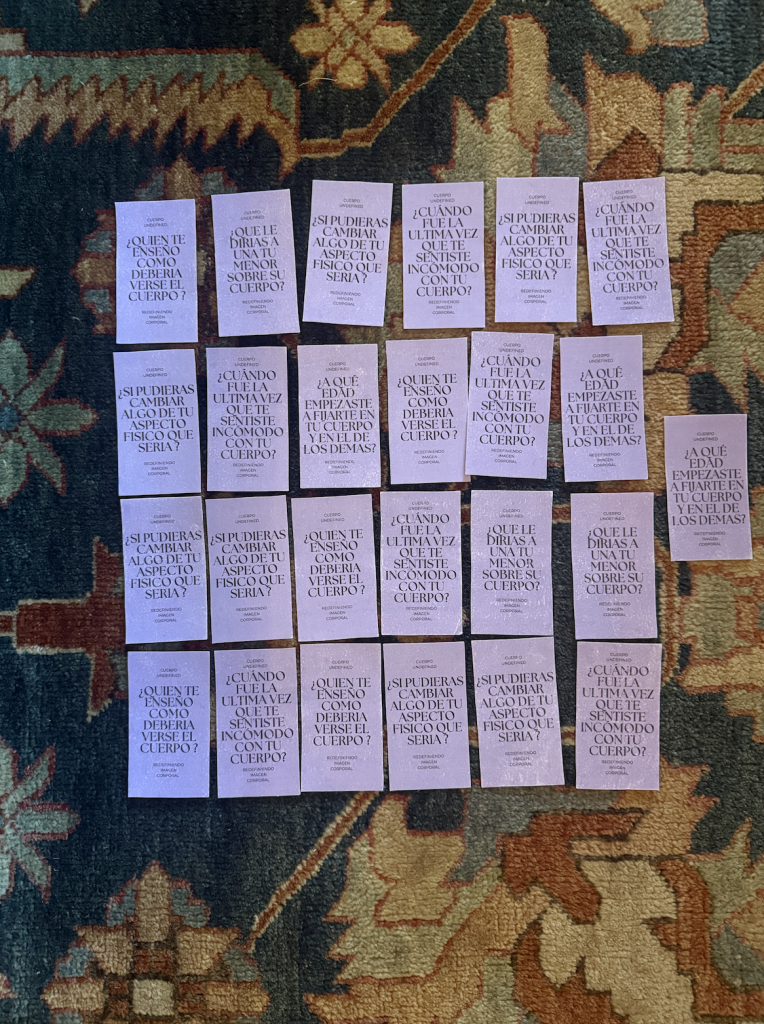
The design started with my wanting to incorporate the color periwinkle because it’s the color that, for ED awareness, and I wanted to ask questions and see what answers people came up with or how they felt about the questions. Surprisingly, people were very receptive, and of the 30 people I asked if they would be willing to participate and write their answer on the back of the note card I gave them, 26 agreed. I took that well because I honestly wasn’t very optimistic about how people would react. It was very interesting because most people asked me about how to respond. Some people gave details about the event or the moment, while others just wrote down a number. Still, that was the point: to get as many answers as possible. I told them it would be anonymous and used only for research with my professors, tutors, and peers in the master’s.
This was the result: To make the explanation and analysis easier, I numbered the questions from 1-5 and will continue with the answers and my analysis.
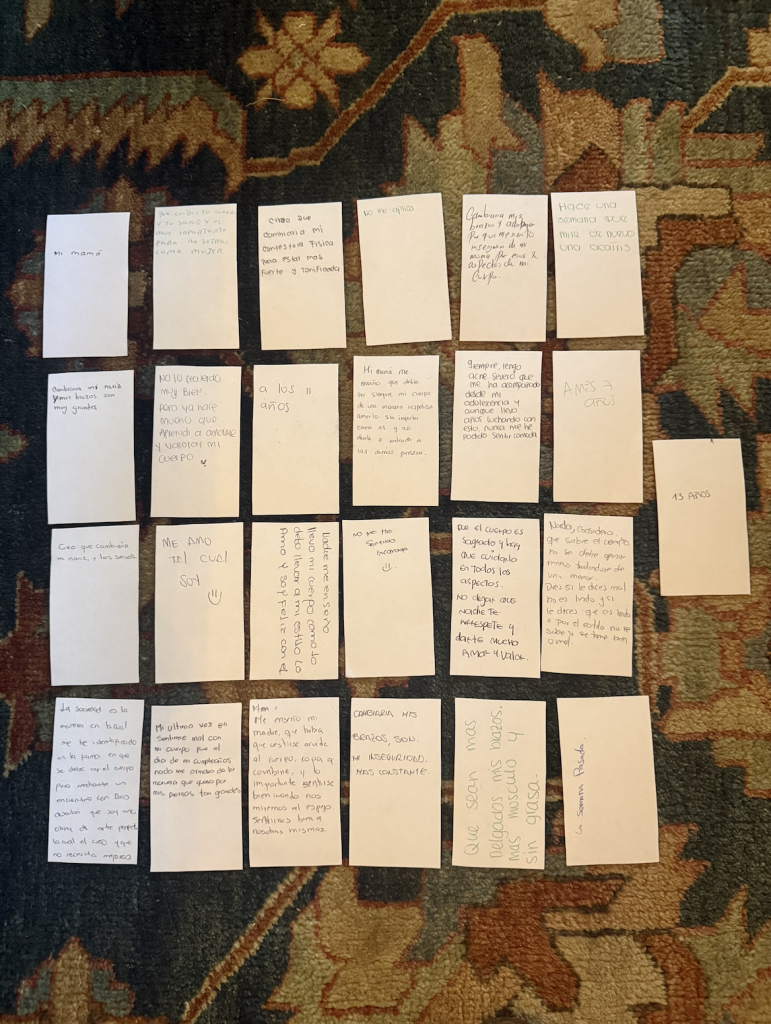
For Question 1: What would you tell a younger you about their body?
- “To take care of your body and your health, and it is very important for us as women.”
- “Nothing, I consider that about one’s body no one should have an opinion, especially when it comes to a minor. I think that if you say something bad, it is not nice, and if you say it is pretty or something of this nature, you don’t know if someone is going to take it in a good or bad way.”
- “That the body is sacred and you have to take care of it in every aspect. Don’t let anyone disrespect it and give yourself a lot of love and value.”
Question 2:When was the last time you felt uncomfortable with your body?
- “Does not apply to me.”
- “Last week.”
- “The last time I felt uncomfortable in my body was on the day of my birthday; nothing fit me in the way that I wanted because of my large legs.”
- “A week ago, I looked at an old scar again.”
- “I have severe acne that has been a part of my life since my adolescence, and even though I have been fighting against it, I have never been able to feel comfortable.”
- “I have never felt uncomfortable.”
- “I don’t remember it very well. But a long time ago I learned to love and value my body.”
Question 3: Who taught you what your body should look like?
- “My Mom”
- “My Mom taught me that I should always respectfully look at my body, love it no matter how it is, and without giving an explanation to people on the outside.”
- “No one taught me. I carry my body the way I should, in my own style. I love it, and I am happy with it.”
- “Society or the way in life which I have identified myself in a form in which my body should look, but during and after a closeness with god I discovered that I am a perfect masterpiece which he created and does not need improvement.”
- “My mother taught me to dress in accordance with my body type, with clothing that matches, and the most important part is to feel good when we look at ourselves in the mirror, feeling well with ourselves.”
Question 4:If there was something you could change about your physical appearance, what would it be?
- “I think I would change my physical structure to be stronger and more toned.”
- “I would change my arms and my abdomen since these are the greatest insecurities around my body, and that is why I would choose those 2 aspects.”
- “I would change my nose and arms because they are big.”
- “I think I would change my nose and my breasts.”
- “I LOVE ME JUST THE WAY I AM.”
- “I would change my arms; they are my most constant insecurity”
- “To have slimmer arms. Have more muscle and no fat.”
Question 5: At what age did you start noticing your own body and everyone around you?
- “At 11 years old.”
- “At 7 years old.”
- “13 years old.”
Honestly, looking at all of these answers, there were a lot of them that surprised me because I did not think I was going to get so many of them from people who were so emotionally aligned with what professionals consider the healthiest, such as the fact that a lot of them said that they accepted themselves the way that they were and that they love themselves. When it came to specific insecurities, the women I spoke to had a part of their body they weren’t completely comfortable with, though some said there are parts they don’t think they would change. Some of them weren’t even about the body, but about appearance as a whole. I also noticed that, overall, some people look at their bodies with the utmost respect and appreciate them for what they are. At the same time, other women thought there were aspects of their bodies they would like to change, which shows me there are two very different groups of people.
There is also the fact that when it comes to body parts and insecurities, as well as what they would change, there were three things that constantly came up: breasts, nose, and arms. There were some of these that I had already suspected, which are the nose and breasts; there is a tradition in Colombia that when you turn 15, you get your nose done as a gift, and a lot of people get breast implants for their graduation; this is very common in a lot of different social groups.
Secondly, I realized that the age at which girls start to notice their appearance varies,e, but most start noticing it before adolescence. Speaking from my personal experience, I was around the age of 8-9 when I started to notice my body and started to feel insecurities; however, I know a lot of people who started to notice it once they got older.
I also saw the fact that most girls learned about their bodies and about standards from their mothers, which makes a lot of sense because I think that, looking at it, the idea of bodies and the way some people are more comfortable than others comes very much from their families’ own views and perspectives, which I thought was very interesting.
However, when I saw some of the answers when it came to their own insecurities or when they felt uncomfortable, there were a lot of peole who do don’t want to answer or maybe not think about or maybe they genuinely have never felt insecure in their bodies who knows because maybe I am thinking through my own prejudices that everyone has to feel uncomfortable at some point in their lives. Still, maybe some people don’t think about it, and it was never part of their conversation or identity.
I also want to give a little of context about the people I asked questions to they were all warned that this was going to be used in my educational blog but that it was going to remain unanimous the only thing that I can include was the fact that I only asked women to participate mainly because I think women approach the subject differently but maybe in one of my future interventions or research I will use men to have different groups.
I thought this was a successful exercise because I got a lot of participants, in my opinion, and even though it was not perfect and some people did not want to participate, there were a lot of people who gave me feedback on the questions and had them thinking about subjects they had never thought of. It was also a good exercise for me to let go, go up to people, and ask them about different subjects related to the body. It was growth for me. It helped me get better at asking questions and seeing what comes back to me, and not be so afraid of rejection because it’s part of the process; some people won’t want to participate. Still, I learned a lot from the people who took part and who I got to speak with.
-
“El Cuerpo Que Somos”- (The body we are)
While I was looking for different examples and different people who talk about this specifically in Colombia, I came across this page. It was wonderful because, even if it doesn’t discuss the historical conception of body image, it shows different examples of what people in Colombia go through. They have incredible podcasts with different people in Colombia who have gone through it. I think that their messages are incredible and one thing that I found very interesting is that the founders Liliana Gaviria and Maria Elvira Tobon also talk about their own journeys and they do not only have the page on instagram but they are kind of a program and it is incredible in my pinion because they have a YouTube channel where they have podcasts with different people who are talking about body image and their own struggles, they also have physiologists that work with them and have therapy treatments for the people who are interested in this specific type of companionship because there are very few resources like this that exist in Colombia nd I think that they have done a fantastic job, I found them in a very weird way because one of the people who they interviewed was Miss Colombia and I follow her and they did a podcast together so I started listening to it and then got more intrigued and went in deeper and looked at more stuff they were doing and one of the things I found most interesting was the fact that the looked at the problems with body image as an algorithm that was already put into our heads as if it is an automatic in the city where we live. This movement started in 2016, so it is 10 years old. Still, looking at the page, it was a process; however, the work they are doing is incredible. They definitely got in there at a moment when it was very difficult to talk about this, even though this is a very saturated movement I could do with it. I will keep working on it and see where I end up, but I am starting to worry because I don’t know what to do. I feel very lost in this process. This is definitely a page for me to look for inspiration and to remind myself that this is a process and that I will keep going through it.
-
Failed Group Meeting Today
I was supposed to have a meeting that would be a circle where I’d get different opinions and experiences from different people; however, at the last minute, four of them canceled, and one of them didn’t show up. Still, I understand this is part of the process and that things like this happen a lot. I was very fortunate, and two of them agreed to meet tomorrow. Still, since I am dealing with such a vulnerable group, I understand that these are things that are bound to happen sometimes. I want to make sure I am being respectful; however, it is frustrating because I had been planning it for a week. They had already confirmed, so when people canceled at the last minute, it was frustrating, but I am still going to continue. I will keep working to make sure my interventions continue and that I am doing what I am supposed to do in my research. It is hard to get people to speak to me in the first place, so when I find a group and set a time, it is still difficult. Still, I will continue and persevere through this process. This happens to a lot of people, especially during field study.
-
Attempted Instagram
I created the Instagram account, tried posting, and I am starting to do so. Still, if I am being completely honest I am absolutely terrified of the response I am going to get, I am very sensitive because of my own struggles and I severely scared that I will get targeted as well as my family because of the controversial work I am doing specially in Colombia and in my town where everything is so hyper critical however I promised myself that I was going to start putting myself out there so even if I am scared shirtless to keep posting on the instagram I am still going to do it. If at some point it will impact my mental health, I will change it because the issue is that I am so afraid of what might happen that I might never start moving. However, I have been moving forward with a Padlet I started with different people I have been meeting with to understand different people’s perspectives and the ways I might have blind spots that need to be seen to find where things might be changing.
https://padlet.com/cuerpoundefined/cuerpo-undefined-221g26tn4767tvtd
Not everything I have done has been going according to plan. Still, I am beginning to trust the fact that it is a process and that I need to keep going to see results in this master’s. One of the many reasons I ended up in this master’s is to embrace the unexpected and the way life is; if I want everything to be put out.
-
First attempt at a round table focus group
I tried to hold the first focus group, and I was supposed to meet with two people who had confirmed they were attending. I sent them the link to join the meeting; however, one person who was supposed to join did not, and I asked if they were okay with joining. They did not respond, so I ended up having a one-on-one conversation with another person. I will not share their name because I want to protect their privacy, but she has an active social media presence, and that is how I came into contact with her. First of all, we introduced ourselves, and she started talking about how her experiences with eating disorders were especially when it came to the fact that she practiced ballet. She can attest that dancers are actually at fault for the entire situation; they are not treated as victims of this terrible system in ballet. The people who organize the system and the organization are not seen as the trigger (“the front of the room”). She believes this pressure comes from her own experience in a high school ballet boarding school. Most people would assume this pressure came from comparing herself with her classmates, but it wasn’t just that; it also came from the people above them in a hierarchy where the dancer was always the last priority. Her mentor who was a dancer for Bolshoi (which is one of the oldest and most renuaund ballet companies in the world) made a lot of different comments specifically when it came to their body image and normalizing the fact that these comments where okay to say maybe because of their own struggles with the way she was treated during her career but I don’t really have the teachers point of view just the student but this could. be an interesting point to look at. She became, as a dancer and a student, so close to her teacher that it was almost like a friendship, and she expresses how this was so unhealthy for herself because it became normal to have this toxic talk about one’s body. She specifically talked a lot about the way that when she was in constant contact with someone she admired so much and who was a dancer she wanted to be like, it became a very different relationship because you start absorbing her culture and the way she spoke to herself and what she did which lead to this dancer having this extreme body standards that where a part of this dance companies tradition. When I asked her what she thought was the beginning of this, specifically when it came to ballet wanting to have a very slim figure, she talked about how she feels it all started in the 1980s in the Balanchine era and the new American ballet institutions. She thinks that when ballet started as an art form, people looked like regular individuals, and the focus was more on technique; if you worked hard enough, you could make a career for yourself in this field. However, because ballet became such a popular and important art form in the United States, it became more commercialized and mixed with Hollywood glamour. New York City Ballet became one of the most important references for ballet worldwide, and the unrealistic body standards that started there spread around the world. There was also a huge change when this specific dance started to evolve from being an art into being a sport, and this is when body expectations changed so drastically. There was more of a want for dancers to be individuals in the past before this era started because now they want them all to meet specific rules such as weight, height, flexibility, feet, and much more, and this is such a difficult position to be in because it is the same way that athletes are looked at.
When she talks about her own experience I really admired her strength and her perseverance to want to be better and improve her health because of her life and the way that everything is structured because of her family belief system it was very rare that people get medical help and this meant that her process was extremely lonely and tough p=becuase she did not have a profesional to help her manage her emotions or understand why she was doing what she was doing and it took her about 2 years in order to fully accept her eating disorder and try to make it better because it was a process hsehad to do all on her own, one of the main things she had to do was look at ballet as her sport and not as her entire identity because she had to revert to what her life was like before she developed this disorder and she discovered that she actually used to love food and she had to completely change the way she looked at life because she really had to work on how she saw herself as a person connected with her body and not look at it as if her body was a shell. One of the main things she had to do was step back from ballet for a little while, but she is still a dancer today. Still, she had to be very careful in choosing the right company to work at that would respect her own identity and make sure that she was healthy. Her company (Ballet Trockadero) helps dancers by offering mental health talks and also by letting her participate in theatre and film. Dance opened those doors for her. She also spoke about how having a boundary between dance and her life helped because it meant her entire world wasn’t always revolving around this one subject.
She also talked about the direct correlation between ballet and body image pressure, and how social media makes this even more visible because she says the body is now a trend you must follow. There is always a change from one side to another, which is something we are seeing from going from a curvy aesthetic and how we are now seeing such extreme thinness, and this is something that happens in ballet as well because dancers who want to make it to a specific company must follow that aesthetic that is set for them. There is also the problem we are now seeing when it comes to GLP 1 medications and how there are a lot of people using this without needing them (However I also think this is a problem because I think people now assume that GLP 1 are only used for weight loss and that if you are not overweight you should not be using GLP 1 however there are a lot of studies out there that show that GLP1 help for a lot of things that are not just diabetes or weight loss, there are a lot of people using them for PCOS, insulin resistance, thyroid, menopause and much more and that they believe it is very good for some of this but now everyone who is on a GLP1 is criticized it they are not overweight which I do not believe is fair either – speaking from my own personal experience I used a GLP 1 and it actually helped me recover from my Bulimia which I suffered from for 10 years on and off and it completely changed my life when it came to my Hashimoto thyroid so I can be an example of one of this people and it did work for me and helped me a lot but I do understand the misconception). One of the main things she said was that the world and society as a whole is now a mirror for the toxic culture we saw in ballet previously.
One of the main issues she talked about was the way social media has not created a new for of comment culture aswell and how there is always a comparison and people are way to comfortable saying whatever it is they are thinking especially when they are behind a screen and are not always seen, she specifically saw this with dance and how there starts to be a competition with pears online. She believes that there should not be so much pressure for young children to post on their social media because it opens them up to a world of criticism, which might really affect their mental health. If they take their career more seriously and it grows, social media might be necessary, but it should be used when they are older. It is adults’ job as a whole to make sure social media platforms are used appropriately and that there is as little damage as possible on these platforms.
One of the main things that she talked bout was the fact that there are people in this industry that are always in a position of power, and there is an unbalanced structure, for example the directors of the big ballet companies. She doesn’t necessarily say it’s their fault; she says these people were trained during a time when toxic standards were the norm, and there was no way to know they were wrong, so they passed that on to younger generations. The organizations that receive such great funding are more focused on looks than the actual well-being of the dancers; however, when she looks at smaller companies, she sees that there is legitimate concern for the dancers, and they are not just looked at as dancers but as people as well (the individual is very important to them, not just the machine).
One idea that she came up with, which I thought was very interesting and I could maybe create something like this, is to bring a group of people together or a festival between these different smaller companies and from there take the winnings and give it to organizations of people that are helping people with eating disorders and research. One of the biggest things she talks about is the need for a change in language and greater education so people in power can understand the effects they have on these children.
I was also curious and asked her if there were any moments when she used dance as a form of expression for everything she had gone through. She said it has mostly been a tool for healing when she dances by herself, because when she dances for her company, she is telling the story they are portraying, not her own, but she thought this was sad. It is actually beautiful because she is only performing for herself.
This was a very productive interview because I was able to look at the subject through the lens of an athlete and as someone who uses their body for her job. I asked her, and she gave me full consent to take notes and analyze what she said in the interview, specifically the voice recording, and she fully agreed to my using it and to its use on my blog, which is important for ethical reasons. She was completely understanding that the other participant did not show up, since it was supposed to be a circle. Still, she was very open to talking and keeping in touch, since she feels this project could make a difference. I’m definitely going to take what I learned from this conversation and apply it to a larger idea about what I am going to be doing.
-
Responce Naomi Crowson
Naomi Crowson is a Trainee Health Psychologist for First Steps ED. This is an organization that focuses on helping people with all kinds of eating struggles of many different ages, with different team members including psychologists as well as psychiatrists. This organization started in 2004 and has helped many people through their process over the years. I was able to contact her because I was looking at all of the work from the years they had been doing it, this is an organization which is in England and with contacting the organization directly I got put into contact with Naomi however she was not able to have a conversation through a meeting but told me that I emailed her a couple of questions she would be happy to respond. I really appreciated this because she took the time to respond, which a lot of people have not. These were the questions that I sent over:
- What do you see or think are the most common misconceptions people have around eating disorders? How do you think this affects the type of treatment they have access to?
- What is the difference for you between a person who is battling an Eating Disorder and a person who is suffering severely with their body image, or do you consider them equal?
- How much of the issues surrounding this subject matter come from social media and the outside culture, and how much do you think comes from your family’s beliefs and the place where you have lived?
These were her answers:
- “There are still misconceptions in terms of who can have an eating disorder. This stereotypical view is that eating disorders only affect white women and girls, but we know that eating disorders affect anyone of any age, gender or background. Boys and men and those from ethnic minority backgrounds may be less likely to come forward for treatment. Misconceptions around ARFID in particular are what we see a lot at the moment. People consider ARFID as ‘picky eating’ when it is much more than that. Again, if people downplay ARFID, then there might be a reluctance to come forward for treatment and support.”
- “I’m unsure what you exactly mean by this question, but anyone who is struggling with an eating disorder, disordered eating or body image difficulties is worthy of support.”
- “Within the research, it states that eating disorders are not the result of one causal factor. Instead, they are believed to be a result of interconnecting biopsychosocial factors. It is hard to answer this question in terms of how much each factor contributes because it could be a combination of these things. Social factors like social media and family/home life can have a big influence. “
By looking at her answers, I can look at a lot of different perspectives; for example, her wander to the first question about how there is this thought that eating disorders only affect a certain group. I think this is something that directly connects to some of the research that I have done for fearing the black body and the way that there is this constant discrimination in the body when it comes to people of color; there is also this subject of maybe talking about how things are different, and experiences are different. It is important to seek to understand those around us and not look at it through a lens of judgment. Another thing I found interesting was her talk about ARFID (Avoidant/Restrictive Food Intake Disorder), and I question where the line is between being picky and having a problem. Someone actually has a problem with disordered eating because something I have been thinking about lately is the fact that all eating disorders are very strange disorders. After all, some of them can be hidden. People will never know because with eating disorders there is a lot of judgment when it comes to the body, and people are saying, ” Oh, she is too thin; she must be sick. Still, the reality is that we do not know because some bodies are slimmer than others naturally, so this cannot be a direct judgment; however, when it comes to people who are struggling with disorders such as Binge eating, the same thing comes into play: how do you judge that or discover that? A really big issue is that I believe people are too comfortable throwing around a diagnosis they think someone has because they are getting slimmer or thicker. The reality is that it is a very hard diagnosis for even doctors to make, so why are we letting random people off the street come in and talk about this? I think there needs to be clearer boundaries about what opinions people give and the way they talk specifically about other people’s bodies and their own as well.
When it comes to the second question, I completely agree with the fact that anyone who is struggling needs help; however, I believe there is a difference between someone who, at times, is not completely comfortable with their body and someone who is going through a mental illness. Still, I completely agree that both need to be looked at at the root cause.
In the third question, she is completely correct that it is a hard question to answer because everyone’s journey is different, and people have very different stories. It is important to look at all of them and better understand each person in their own journey, because they should not all be put in a specific box or denied the chance to tell their own story just because one is already being told for them.