Since my last tutorial with Zuleinka, I have been working on figuring out what different forms I want to start doing more interventions in because I have been more focused on the research aspect. It has been a struggle to actually start working on my interventions however I understand that this is what makes a masters a masters and not an undergrad and this is why I now it is an important step in the journey, I am going to start today to do a sort of social media strategy which will be more done on research and different ideas to start preparing my audience for what is coming because I feel as if it is a very hard subject to approach but that is the whole point. I have been reaching out to a lot of different people, and I have been rejected or told no to collaborations, which I am aware is part of the process, but at the same time I have had other people start to reach out. I am now going to start a social media campaign as part of my intervention, but I am still in the very early stages. I am going to be working on this for a while, while continuing to reach out, do interviews, and look for people I could collaborate with, all while implementing my own creative practice into this Instagram. I will continue to work on this. I am also going to be in Colombia, where I will have the opportunity to talk to many more people and see different ways I could pivot the ideas I am already bringing to the table. I am going to use this social media platform to educate people on different subjects and get them thinking and interacting. I plan to have some forms as well, and I am going to keep on working on this at the same time. I am also looking to speak to different people who have gone through these struggles. I really want to do something I spoke of with Zuleinka about having different people who feel they do not have the opportunity to be beautiful to be seen as beautiful by maybe getting them to help me create a fashion line which they would feel the most comfortable in and seen as beautiful and the most confident and do a shoot to represent this but this is an evolving idea and will continue to learn and see different ways in which this might change.
Blog
-
Updates on struggles and journey
-
Social Media Detox Impact – Ezgi Biçer
I met Ezgi through one of my peers in the master’s program, Defne, who is one of her friends. She told me how she changed her view of life by doing this experiment, and I asked her to share her experience; she was happy to, which shows me the effect social media might have on young girls. This girl decided to delete all of her social media for a month, except for Snapchat,e to keep in contact with her close friends because this was her form of communication. She started doing it specifically because she was addicted to social media and was always doomscrolling, which led to a large amount of procrastination and left her without time to do anything else. She spent all of her time on social media, and that is why she deleted it to be more present because she started to develop body dysmorphia. After moving to London, she noticed some changes in her body. Now everyone is on Ozempic, which led to her seeing a lot of unrealistic bodies, and the more she gained weight, the more she saw people getting skinnier. She started to consume this type of media; this led to her feeling depressed because she felt everyone had the perfect body and she was fat. Still, she started thinking that skinny fat was the new fat, and she was not even this, but this is how she felt, and as if she should see a doctor, and felt as if she was overweight when she was actually of normal weight, and she was worried. Every time she would like herself in an outfits and she would look at her phone and this girls with their bodies she would look at the mirror and feel as if she was larger and that was why clothing did not look good on her which lead to her stoping wearing the outfits she wanted to wear because she presided herself as fat and after deleting social media she had more time to be taking care of her body and dealing with the addiction to scrolling. She realized that she stopped snacking and would eat even if she knew she was full, and she had issues with bingeing. Maybe it was because she was determined to lose weight that she started to restrict herself, but she did not crave anything, which was weird for her. The best thing is that now that she does not see these girls on social media, she started to feel more confident in her body because she was not exposed to unobtainable bodies all the time; she does not have that reminder on her phone. She thinks everyone is having filler faces and having a lot of work done on their bodies as well; it is now a different beauty standard. She feels as if she has to do all of this and look like these girls as well. She is now more mindful of how social media affects her and realizes that these girls are only showing their best moments. It was good to get a break and talk about how easy it is to get lost in social media. Going through this and hearing about her experience, I think a lot of girls have this same issue and think a lot about comparisons with other people on social media, and one important thing is to understand that this is these girls’ job; it is their career, and that is also why they look the way they do.
-
Interview “Fundación Nuevo Rumbo”
During the last couple of weeks, I have really tried to reach out to different organizations that help with eating disorders and body image, specifically in Latin America, which I want to be my main focus of study. I was able to get in contact with this organization in Argentina called the “Fundación Nuevo Rumbo.” They were very quick to respond. I did not have time to obtain written consent, but I received verbal consent from Mauro, the person I spoke with, about using what they explained in our conversation for my blog. I am still in contact with them and plan to have a more formal conversation. The first thing that he explained to me is that this is not necessarily an eating disorder clinic. Still, it is a rehab center for different kinds of addiction; this includes alcohol and drugs, but they also treat people who have problems with food on a lot of sides of the spectrum. Something I have noticed is that a lot of places, specifically in Latin America, have this included in their form of eating disorders as addictions. They are treated the same way in centers such as this, which I find a hard approach because everyone is treated the same or lumped together when their issues might be very unique. I think this is a gap in Latin America, since many countries use the same system, and in Europe there are more specialized clinics. One of the most important things that he talks about is that they are not an organization that does outreach; they are a treatment center. They start by giving patients a structured program, which means they have specific hours when they are expected to eat, as well as the type of food, to help them decentralize and do it themselves; they take away that choice to give them more order. Then they start to integrate different forms of motivation to get them to want to get better and improve their health. Secondly, they want the family to be involved and to be part of the motivation for them to get better because they are trying, through different forms of therapy, to get the people who are part of their program involved; there is a lot of family therapy. They are instrumental to the recovery of the individual. Later on, after they have taken part in the program with different professionals such as psychodrama treatments, psychiatrists, therapists, and many more experts in the field to try to deal with the root of the issue, which is their goal, what they do is that they take the steps to reintegrate them into regular society. What they want to do through this entire process is to get to the root of the limiting thoughts that cause addictive behaviors in whatever shape or form they come in. They also look a lot at the issues surrounding social stigma because people feel very embarrassed that they have issues such as this one and that they do not know how to handle them. After all, their entire lives they have been told that they need to keep it together and that nobody can find out. One of the other things I asked them about is the difficulties that they face as an organization. They are a private foundation, which means that they run as a business; they do not get any funding from the state. They find that the greatest difficulty they have is paperwork and bureaucracy because sometimes people need treatment and at that exact moment, not later on. Bureaucracy gets in the way and makes things take longer than they should, but this is a greater issue.
-
Tutorial with Zuleika
I had my individual tutorial with Zuleika last week, and I had been feeling a little stuck about what I wanted to do. She helped me find ways to unlock this and gave feedback on some of the work I had done so far. One of the main things she told me was that when one is feeling stuck, one should always go back to the research question and look at what you originally wanted to do; however, I explained to her that my research question is still a work in progress, and I was still working on it since, after my tutorial with Diana, she had told me I needed to complete a couple of changes. One of the main things that was discussed was that I really wanted to create an intervention or project in which I was able to express my creative freedom aswell as having people better understand the root cause of eating disorders and body image and one thing that is really important to me is to make sure that the people I am working with feel safe and as if their story is being told looking at all this means I want to create something with some educational support. The idea of the question she gave me was “How can better knowledge or education about the history of eating disorders and body image thin culture help people feel safer in their bodies?” I still need to think it through and make sure it aligns with the stance I want to take, but this will keep changing. One of the main things we discussed is that people with larger bodies are often given opportunities to see themselves in a beautiful way, and this might be something I want to explore. One of the pieces of feedback she gave me for feeling stuck is to make some small interventions to generate new ideas and consider different perspectives, but I need to be careful to keep myself and my participants safe. One of the main points I came out of with this conversation is that I need to discover or make sure I am sure that I know what I want to do and write it out in as much detail as humanly possible in order to get different kinds of approval from the ethics board, one of the small interventions I could do is through social media or even on the street with asking questions. I really thought this tutorial helped me look at things from a different perspective and made me think about different ideas of what I should do in the coming weeks.
-
Fearing the Black Body Reading Notes
- I have been reading the book Fear the Black Body by Sabrina Strings, which was recommended by both Zulinka and one of the people I interviewed, and it has made many interesting points even though I have not finished it.
- One of the main points that the book starts with is how doctors and philosophers could not understand why people were starving when there was plenty of money for people to be eating, and how the ideal body had changed since now the description of people’s bodies in the United States was thin and pale, and this was called an epidemic. There were two sides to the argument: some people thought slenderness was a matter of fashion, while others considered it an American shortcoming and linked it to subjects such as religion and morals.
- One of the main issues we see is how roundness and a more volume-heavy body were connected to blackness. This is a history that starts to be explained in the sense that it was anti-African and that the fact that they had more volume in their body was considered ungodly because it must have meant that they were eating more and that was gluttonous. One of the ways they started this was by the fear of the fat black woman, and this came from religious ideals on how to go against a certain race but then discipline white women: “synchronized repression of ‘savage’ blackness and the generation of disciplined whiteness”. The idea behind this was to create a society where there were some people who were above others by telling them that the thin ideal was better because that was the reality of Europeans and Americans, and then degrade those who were not the same, even those who could be considered white (Irish, Russians).
- This chapter starts with a story about a girl named Katharina, who was a slave in Antwerp and was drawn in 1521; she is described as having a round face and a plump body.
- One of the main things that is interesting is that English women in the Elizabethan era did not just paint themselves as whiter, but actually painted themselves black to show the difference and make themselves look like the beauty ideal. This was definitely supremacy culture, and something that was very interesting was the fact that in England there was not a glamorization of black people like they were in other countries in Europe; there was, from the beginning, a deep disdain, but they did not enter the slave trade until later than the other European countries, such as Portugal. (page 55)
- The slave trade had a tremendus effect in england and holland throught the creation of sugar and how it started to be so highly available that now people were having it as a daily luxury which ment a lot of people in england who were middle class were starting to become fat. (57) The word obesity was used for the first time in 1620 in Oxford from the investigation of people in England getting fatter. The growth of the wellness gout, this was called before as the king’s disease, robust habit
- The main thing that we are able to see in the introduction is the fact that she talks about the fact that fatphobia is actually about racism and not actual health concerns, which is one of the main arguments which is said in the mainstream media today. (An example I thought about when reading this is Lv Schmit an influencer about weight loss who speaks of portion control and excessive steps in order to live in a perfect body and she does not speak of nutrients or muscle density just thinness and this might work while she is in her 20s but what will happen when she is older and has just been eating what she wants but with small quantities).
- The way that she is explaining this is by mixing a lot of multidisciplinary ideas including history and her own analysis with what was going on at the historical time and the different resources we have from back when all of this started in the renaissance era when there started to be a mix of races in europe not just white europeans.
- She asks the question of why, when people think of fat women, there are a lot of times when fatness is directly correlated with black bodies because of the stereotypes out there. (Is there a connection of this to Medellin? Do we not want to look anything different from Europeans?)
- A large conversation or point that is made throughout the book is the fact that, mostly in America, there is a clear disdain for fat bodies, and women try to be as lean as possible. (I believe this comes to the point where it has become almost a sickness where they cannot rest and they have to be active all day and counting their food, even though they have tried to move on from this and have more food freedom is what it is called it is something that is constantly on women’s minds and it has even gone as far as to become a social media phenomenon were they speak about what they eat and the work outs they do daily).
- One of the main things the author talks about is how this is a subject that has been constructed there was not always the idea that one has to be as thin as possible but it is something that has evolved and in her opinion it has evolved at the same time as racism, she also explains how there have always been different bodies in different societies and most of them at one time or another have been appreciated or admired, for example the fact that in mediaeval times a more voluminous body was preferred by many but as most things in this world this evolved and I believe that this evolution is the reason why we are in the ozempicedemic today.
- I believe that this is a book that is not just written as a piece of academic work but that it was intended to be an intervention to help us understand why we view bodies the way they are viewed because as I have read in many sources about history repeating itself it is very important to understand our history in order to not keep on repeating it and this is a good way to start looking at our bodies differently and look more at the core problem than the overview. However I don’t think it got the attention it deserved and should be known more by different forms of media because I have found it a very hard book to read and I don’t think people who are specifically interested in this subject will actually sit down to read it for extended periods of time so it might have been interesting to have maybe a smaller more easy to read version of it in order to get it to be more widespread.
- In this chapter, Strings goes back in time to the 15th and 16th centuries to examine the body ideals of the time and how they evolved. I think it is very important to look at why things started in order to understand their effect on today’s society.
- One of the main things she looks into is religion and the way that in the 15th and 16th centuries there was mostly a wave of Christianity in Europe, but following the protestant reformation, specifically in England and France, and how this led to there being much more thought and energy being put into the body and what it looked like, as well as what it meant. However one of the main arguments to there being a preference to large bodies was the fact that society thought it represented wealth and this is something I hear in my family even today, saying that when someone looks to thin it means they look poor or as if they don’t have enough food however this is also a problem because even if discrimination or negativity and out hin bodies is not the same as Fatphobia it is still not right.
- One of the main things that she does during the first chapter is the fact that she went back before there was exposure to black bodies in Europe, which started through the transatlantic slave trade, which was the reason that the distinction and preference for a certain body came from.
- One of the main things that I find very interesting was the knee-jerk change that happened when black women were brought into the picture, because if they had been of a different shade, they would have been considered some of the most beautiful women and the standard to follow, but since they came in a different color, they needed to go against everything they believed in order to make themselves different. There was also a complete change in narrative, saying that the Africans had no self-control and were indulgent, and this was the reason for their bigger bodies, which is a complete hypocrisy because it was seen as a good thing in Europeans but as a terrible quality in black individuals.
- There were a lot of words used by the travelers who were the ones that saw the most black bodies and they called this individuals as primitive, lazy, uncontrolled animals and this was just a way to rationalise to themselves that they were better than them and this was the reason why they could be enslaved and treated as less than which lead to there being a shift in dynamic and making two things that should have never been put together blackness and fatness and they were synonymous with each other.
- The history of how this were represented were different in every country and there is a lot of history behind it because in a lot of catholic images there are pictures of black people as slaves or helpers to the superior as they would have been described white people however this was not something that happened in England until the start of the slave trade and at the beggining of black people being included and introduced into early european society through the slave trade they were a hot new fun commodity even so that even a de medici girl asked for the blackest girl they could find because she thought it was interesting however as time went by they stopped looking at them as curiosity and started looking at them with disdain and as if they were no longer interesting they had enough, however in England they did not go through this they immediately went to hatred and discrimination when they started arriving through the slave trade.
- There was a lot of talk about gluttony, not just in food but also in alcohol, and this was widespread in letters travelers sent home and in authors’ writing during the Enlightenment.
- During the eighteenth century in England, there was a change that many feared because it seemed to threaten how they described society, moral order, and organization, leading leaders and high-profile figures to change the rules about what should and should not be done. With these new social norms of etiquette, there were new ideas about how men and women should act in certain contexts, how they should eat and drink, and about having restraint when it came to food, and I think this was just another way to control what was considered the common masses.
- Thomas Muffet was trained as a doctor, but his investigations led him more toward the idea of how to prepare food properly, what food should be consumed, and how to avoid needing or wanting food. Maybe looking at this could be connected to the current trend of fasting as a tool for weight loss.
- The idea of the slender physique began as a notion of racial superiority; the aesthetic emerged in the eighteenth century, due to a new idea of the reappearance of religious movements. There was also a large amount of fear of immigration by people who were considered “part-Negroid”
-
Trapped in the Body
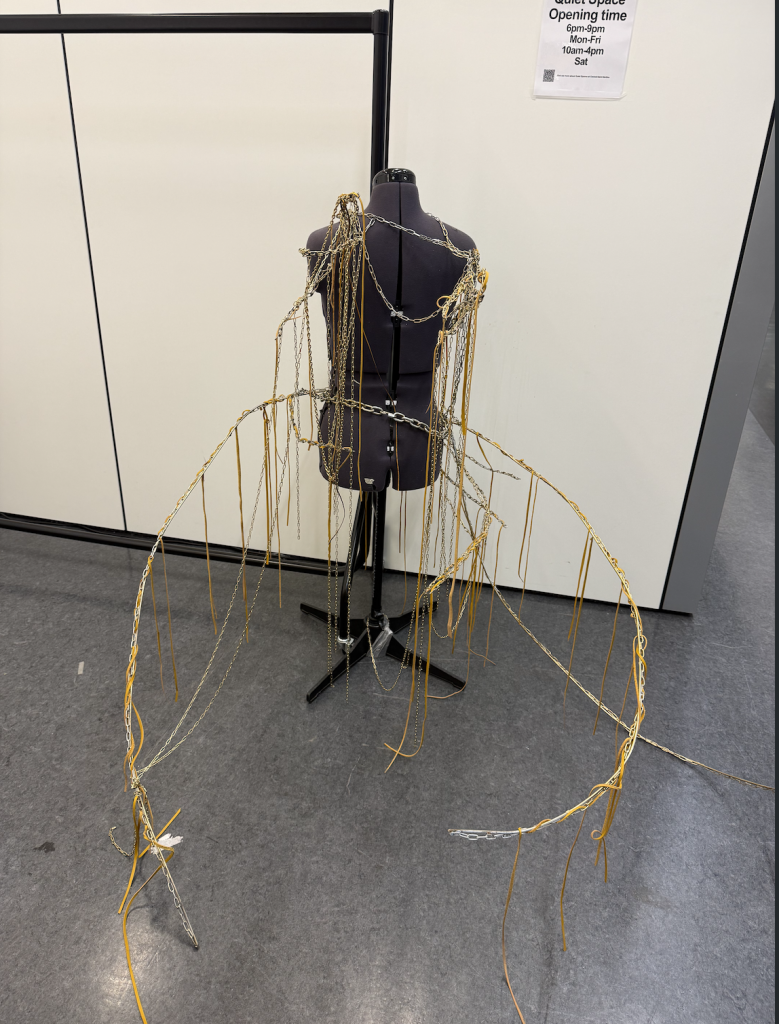
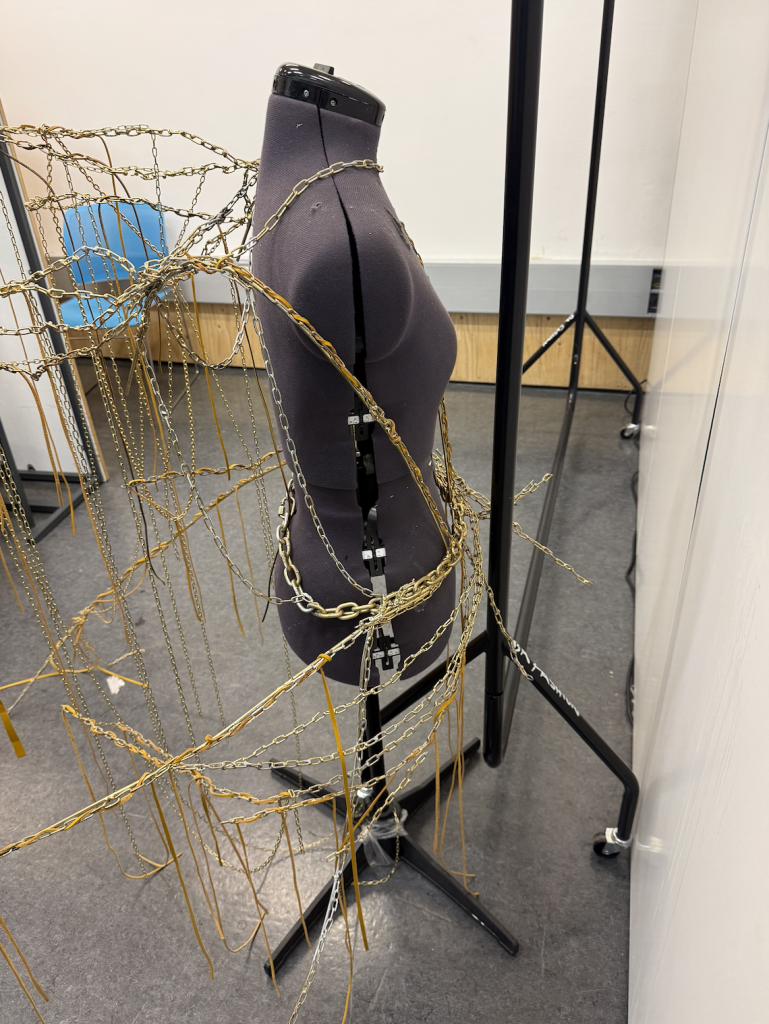
I was walking to the library at school this week and came across this piece. I thought it was very interesting because, to me, it felt as if your body is behind bars and you are trapped in your own body, since it has the figurine of the body inside. When I saw it, I thought about how there are a lot of women who feel as if they are trapped in their bodies because what they are told the standard for how they should look is very different from what actually happens with their bodies. Many people go to war with their bodies in order to feel beautiful, and if they don’t reach that standard, they have a problem with it. I just thought this was an interesting representation of that.
-
Kensington Palace Exhibit
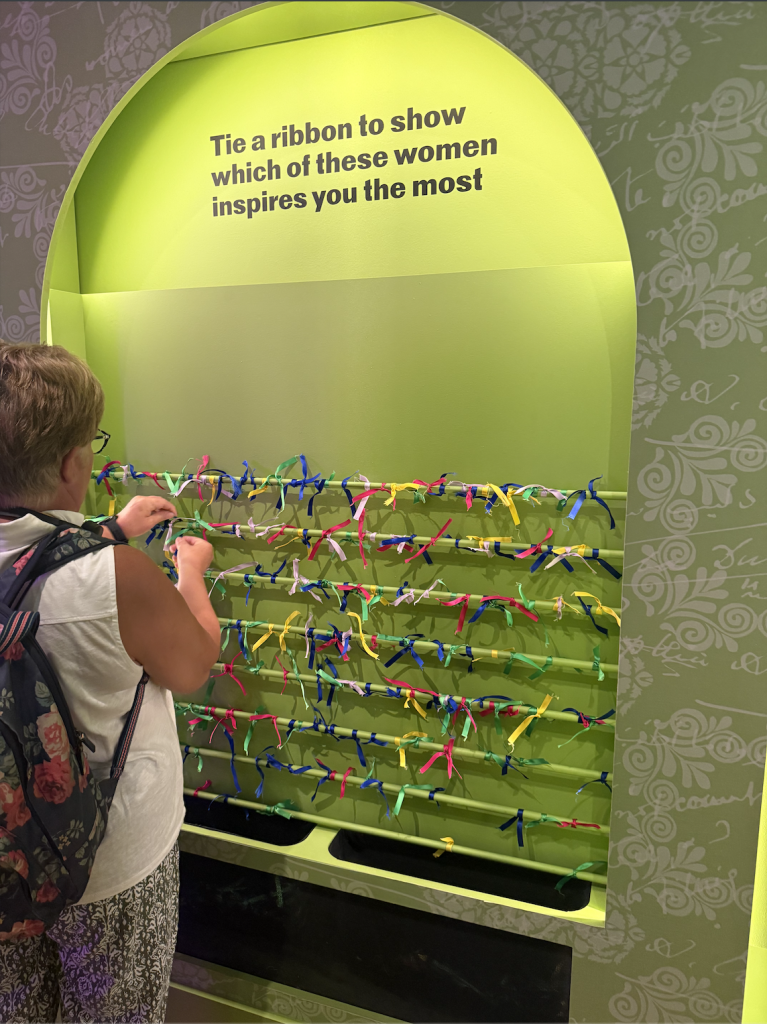
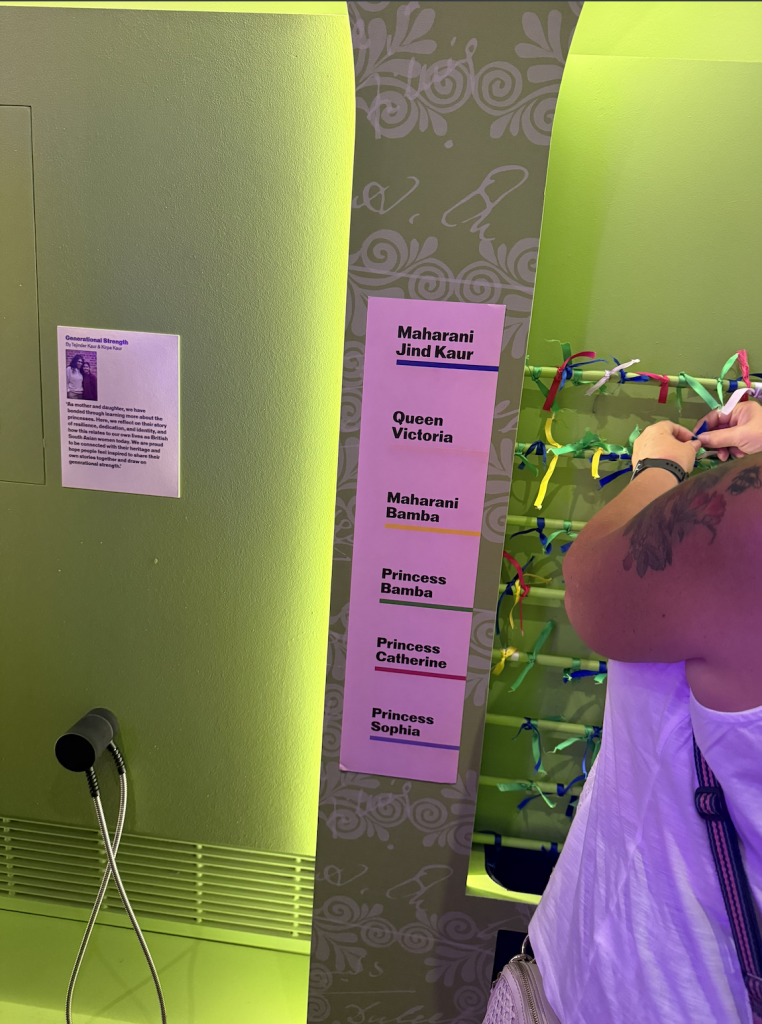
This weekend, I had the opportunity to visit Kensington Palace and see the exhibit about the last princess of Punjab, where I learned about the interconnected family between the English royal family and the royal family of Punjab. There were three last princesses of Punjab in India because none of the seven descendants had children, making them the last princesses. They were all very significant and important, with all three being female rights activists in various forms, and one of them being openly in a lesbian relationship, which was uncommon at the time. The point in all this is that at the end of the exhibit, we were asked to participate in what I can only assume is some sort of intervention, where we were asked to tie a piece of fabric around the bars in a specific color based on which of the women we learned about during the exhibit we found the most inspiring. I thought that was a very interesting way to get people to interact with and think about the exhibition, specifically these inspiring women. Since I am thinking of maybe doing something with cloth, I found it very interesting and took note of it as some sort of inspiration for a future intervention.
-
Images on Instagram
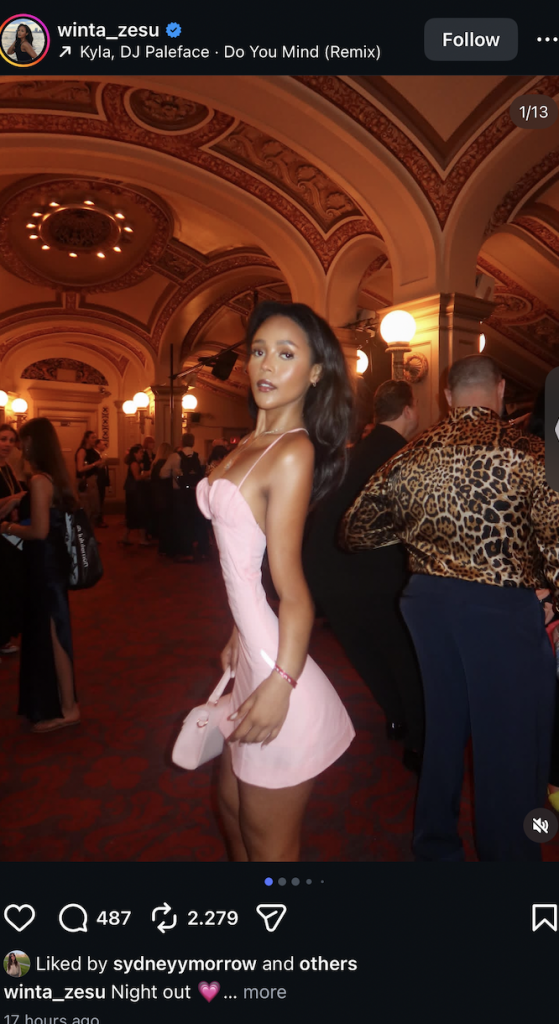
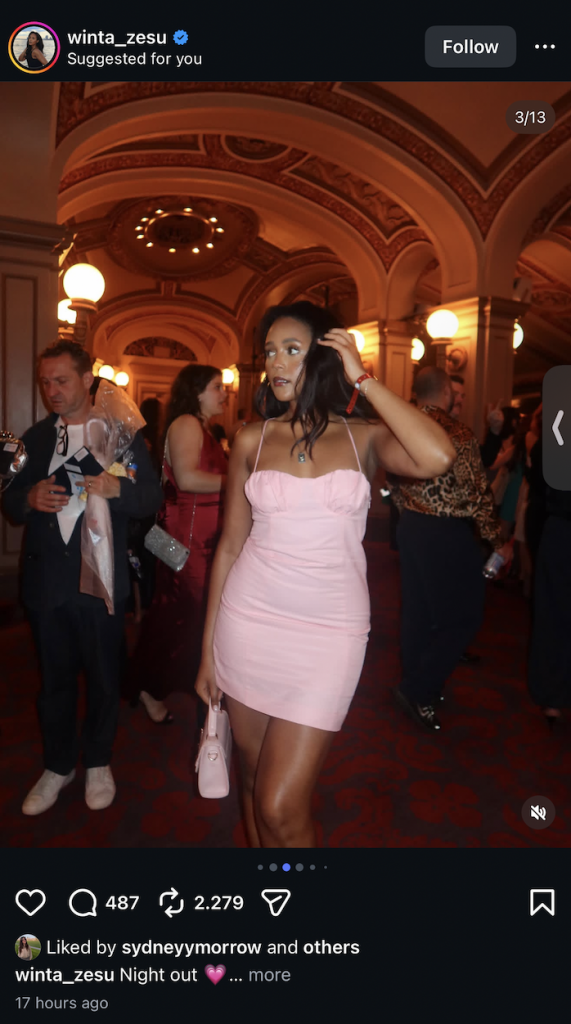
This week I was scrolling through instagram and I came across the first image shown above and I was so interested in it and the idea of shrinking your body to the most possible small version no matter the cost and then I was interested in what the other pictures she posted were and I saw the second one were she is a normal girl and I was just very curious about what the message she was trying to spread. Her name is Winita Zesu and she is an Ethiopian model and influencer and she has had several scandals when it comes to food even if it was done just in order to gain visibility, one thing that kept coming to my mind is how it made me scroll into the next page and this made me think do I need to do something this aggressive in order to get noticed during my interventions?
-
Interview Tigress Osborn
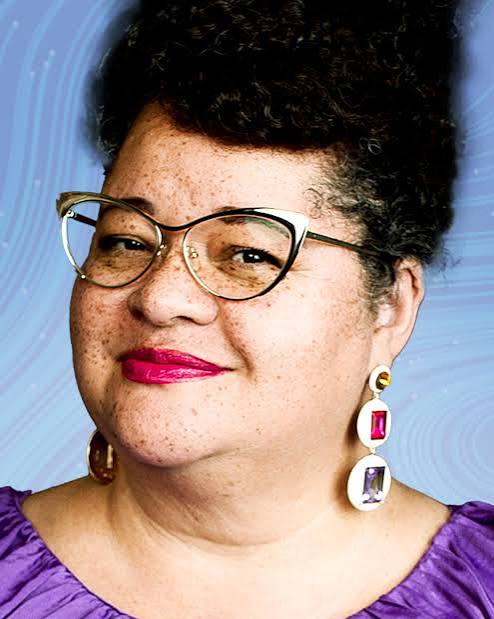
Last week I had the privilege to speak to the activist Tigress Osborn, she is the current director of NAAFA (National Association to fat acceptance) in the United States and is a known fat activist. I had a very interesting 30 minute conversation with her and got her consent to record the conversation so I was able to make much better notes after we completed our conversation.
- The Organization of NAAFA has done a lot of great things for people over the years since its founding in 1969 and the reason for its founding was because the founders wife was considered a fat women and suffer from severe criticism and her husband got so upset he decided to do something about it and his reaction was to create this organization. “It has been a comfort to people, a source of education, a source of confidence, but also a space for advocacy and political activism fighting size discrimination”.
She started to be involved in the organization when she was 18 and there were local chapters even if they are not in place today in Boston where she went to school and she took part in a workshop for fat women even though she was not fat at that point but that was her identity and her families having been a bigger teenager and looking different to what fashion magazines told her she was supposed to look like and she knew from her family history that being fat was going to be a part of her future. After this she was not involved for many years but being aware that there is an organization out there which spoke out to fat people and it made her question a lot about weight loss and diet and think about if it was okay to be fat or not. She also talked about the context of the time she was a teenager having Richard Simmons on TV and Americas biggest looser which really impacted body culture and the relationship to it.
After a while she moved to Oakland, California and she created a nighttime event which was a plus size club event and it was a hip hop party which was centered around women of color and fat women which lead to fashion events and an interesting thing about Oakland is that there is a multigenerational community of movement having to do with marginalized bodies. The way that she got involved with NAAFA was the creation of the fashion show and this is how she got her foot back in the door which lead to her becoming a member of the board and now she is the director.
One of the main questions I had for her was what the appropriate vocabulary was when talking about bodies fro her perspective since she has worked with people from different body sizes, what she recommended is that one should really follow the person one is speaking too lead or asking them directly because people have very strong opinions about the word fat but another one which I thought was more neutral but clearly I was wrong are the words overweight and obesity. There are more neutral ones but each one comes with its own issues such as plus size, higher weight and larger bodied however plus size feels very gendered to a lot of people as being a female expression and it is also a stigma because there is normal and then there is plus size another one that could be used is straight size however it is not really known and mostly used in the fashion industry and no were else. For thin people she normally just says thin or people in a normative body because even if you feel negatively about your body you might have a body with is accepted by society, however there is also the pathologizing of fat bodies and giving them all the same medical designation when talking about over weight and obese and it is not just a description of the body. Fat activists are opposing to the idea of obesity being a disease because they feel they should not be called sick if they are not really sick and then used as ana example in order to sell and prescribe things as well as having lies being spread about them.
She spoke about the fact that it is a civil organization and even if being fat causes every single problem on the world there is no reliable way of changing somebodies body and even if I have a disease I still have rights and deserve to have a safe work environment, being paid fairly, accommodation and for space to be made for them. They also question if it is a true medical condition? However there are a lot of people who were traumatized with the word fat and feel as if obesity is the first time that they are told that being fat is not their fault and why is this even a question there should not be any fault when it comes to this. What they are arguing is that fat should be used in a neutral word and just be used as a word for description such as having brown hair. Fat activist will always use the word fat because they are a part of the fat liberation movement.
there was one example she spoke about where there was an organization that wanted to collaborate with them but these people in the meeting did not feel comfortable speaking or saying the word fat and it is hard for them to understand that it is not possible to distigmatize a word that you are not even able to say, this is also a problem when it comes to journalists in the way that when they call her a fat activist they put in quotations next to it that this is how she prepares to be referred to and this is important and also interesting because why should this be explained.
Another example she spoke about was the fact that when her nephew was little she did her best to have the word be neutral and there was a Santa apron and she asked her nephew who should wear it and he said that it should be Tigress because she is fat and so is Santa and she stayed calm and choose to accept that and then find a way to explain to him that other people might feel bad from him sayin that because there is trauma around the word and at times it is almost like a type of slur.
I also asked her about the relationship between fat phobia and eating disorders and she explained that there is a tremendous connection and we have to understand that eating disorders are very complicated and they should not be looked at as it only there being eating disorders because we live in a world that is anti fat, what is really interesting is the fact that when someone is overweight if they have behaviors that would be considered eating disorders in people who were thin and they are told that they can figure it out later when they have lost the weight.
She gave me the advice that I really need tomato sure that I analyze and think about the assumption I might have when speaking to people as well as assessing what their assumptions might be trying to look at some blind spots and look at areas of study from different perspectives.
-
Tutorial June 19th
In this tutorial, we presented to our tutor Diana on a Friday instead of a Monday due to a scheduling change. It was an interesting tutorial, and I learned a lot and started applying it further in my work. I was able to see how I need to really get better at creating more visual presentations to whoever we might be presenting to, because I had a lot of text in my presentation, and that is more difficult for people to engage with, and this is relevant not just in the course but in life as a whole. I also realized that even though I have been working on my question and trying to evolve it there is still a lot more work to do and I will continue doing that especially during this time in independent study, I also need to start being much more prepared and bring in new ideas to every tutorial as well as having something to show for the work that I have been doing and not just talking about it as I did in this past tutorial but actually start doing a better job at losing it because it makes it look more organized and as if there are more possibilities all throughout. I also have a lot of different ideas I had not even realized, but now see as potential for my project.
- One of the first things Diana mentioned that stood out to her about one of my possible questions “How can the art of dressing and fashion help people suffereing through body image struggles feel safe expressing themselves in this form?” even though this cannot be my final question something that stood out was the word security and and the way it could be about the self not just self security but a sense of self, this is not a strong academic question however if I keep working on it I think it will develop into something interesting.
- Also when it comes to the description of the question it must be done in a more concise way because I gave a lot of information that maybe was not necessary and I should not include the methodology or how I am going to make it happen and also looking at the fact that my description was still very broad but in the last week I have been working on refining it and look at it in a different way.
- I really have to decide who I am doing this for and who I think needs the awareness, because I am still looking at it from a very broad perspective. I really need to decide, because this will completely change my research and the way I approach this project.
- One thing that was really reinforced in the tutorial is the fact that I need to trust myself and go through the process it is okay to feel unsure and feel fear because I am not aware of what the outcome is going to be however I am learning how to allow myself to make mistakes and grow from this process because it is normal and even though I have a hard time assimilating it it is also a part of the reason why I am doing this course.