Question: How can I collaborate with creatives and people who have lived body image struggles to create an artifact or event that raises awareness of body image pressure?
What does it mean: This study aims to create a collaboration between creatives and people with lived body image struggles to produce an artifact, an event, or a mix of both that raises awareness of the roots of body image struggles and the pressures that drive them.
Focus on the investigation: The investigation focuses on raising awareness of often-overlooked body image struggles and understanding their history. What kind of culture are we creating in different societies that leads more people to suffer from these struggles? Especially considering the effects of social media growth and the post-pandemic period.
What you are investigating: I am investigating the lack of education around body image struggles and where they come from, as well as how different times have shaped beauty ideals and created pressure to change. I am investigating how to get creatives and people who have struggled with body image to work together.
Why are you investigating it: I am investigating it because it started as just eating disorders, and it started because I myself had gone through a hard journey. Still, the further I investigated, the fact is that Anorexia is the deadliest mental illness. However, I am really investigating the different pressures that lead to it and how we can raise awareness to catch it sooner and know how to act. Much of this pressure comes from family and social circles because people sometimes don’t realize the effect their words have on others. (For example, the new trend of being skinny is the outfit) Why are people posting this? I want to see how I might help disrupt this culture.
What aspect of the subject I am focused on: I am more focused on the cultural aspect and why there is so much pressure around your body, as well as the body diversity that is often disrespected in the world today. I am also focused on collaborating with different artists and fashion brands in Colombia to learn from them and further develop collaboration.
gap, issue, or problem my project is responding to:
- Lack of sizing inclusivity when it comes to clothing in Colombian stores and brands (this was further suggested when I went to the mall and spoke to several people)
- Inherited standards lack education towards older generations to make sure that they are doing their best not to traumatize younger generations who can later on develop problems with their self-esteem and body image. (This is something that I saw as mixed because some people who I spoke to in my first intervention had a very healthy relationship with their bodies and their parents helped with that however when I was speaking to other people specifically in one on one interviews as well as with my second intervention there was a lot of talk about how parents are always criticising and want you to fit in so you don’t suffer this is not something they are doing in a bad way but because of lack of education on how to look at this different situations)
- Eating Disorders and Body image Struggles sometimes being mixed: I think I might have been trying to look at both of them as a whole but when I was doing my research specifically in the padlet some people were very specific about having to distinguish both of them, however when I am looking at it further I want to be looking at what causes the pressures in the first place that lead to seeing the body in a derogatory way.
- Lack of information on what to look out for: a lot of times, specifically from what I have heard in my conversations, people think about fixing the problem when it has already gotten to an extreme; for example, parents have a hard time accepting that their child has a problem, so they don’t get help right away. They wait until there is a very deep deterioration in their health before looking for help. Also, if people don’t look sick, and what I mean by this is extreme thinness, then they are not considered sick; for example, binge eating disorder is considered a lack of control. Bulimia is looked at as just wanting instant gratification. (There are a lot of stereotypes surrounding eating disorders in Colombia).
- It is a researched subject in Latin America; however, it is very rarely talked about around a dinner table, and people rarely share their experiences. I have only been able to find around 3 people in Colombia who have campaigned around this and are willing to speak about it. This is rarely expressed through fashion and art, though there is some representation in the media.
- Exclusion in Fashion: A lot of fashion brands are focused on who they are selling to, and this is their job, but at times, because of their barriers of entry, they do not allow or have not made the work to make sure that bigger people have the opportunity to participate in their brand because they don’t have the sizing available to them. (For example one of the responses I got from my last intervention was that women of larger bodies want to be able to be included and wear things that are elegant and in trends but a lot of times they don’t have that opportunity) – My hypothesis around this is the fact that maybe it is assumption the brand makes itself because of the pretences we have about body image in Latin America for example we create a narrative in their own brain and I have heard it a lot from several people here in Colombia that larger people should not be wearing certain clothes until they feel fully comfortable in their own body or lose weight so this might be why some people choose not to have more inclusive sizing in their brands because maybe they believe that they won’t sell and people will not buy them however this might be an assumption I am creating from what I have heard, for example a woman who has a very recognized fashion blog in Colombia called Laura Echeveri and her blog is fashion lesson talks about when she had a brand and how she had to change the sizing because people would not buy an extra large, she also speaks about how sometimes we are married to a size and we give so much impotence to out clothing size instead of buying because of how we feel we buy it because of the number.
- The collaboration between these two subjects is a gap in itself, there are very few artists that address this subject themselves from their own work or own lived experiences with eating disorders but there are even less that are asked to participate in such collaboration with the people with their own experiences specifically and also when it comes to fashion, fashion is such an integral part of our world because no matter what you do you have to get dressed everyday. Hence, it is important to look at the relationship between them, and if there are very few conversations about this with people who struggle with body image, how will we know how to help and how we can help make this relationship better? (There are some small brands that, for example, do not include the size of the clothing in the tags.) This is something interesting to look more into. (People are hired to be ghostwriters; why can there not be some ghost artists? Or designer?)
- This could also be something I do in a sort of event fundraiser because one of the people I had a conversation with talked to me about how there could be a dance festival because this person was a dancer and has the funds go into research or foundations that focus on research because there are still very few centers and resources, and this is also something that could be an option.
Interventions and testing:
INTERVENTION 1: Instagram, in all honesty, this has been the bane of my existence because in Colombia or Latin America, when someone is doing something different and controversial, it is very common to receive a lot of criticism and comments around it which has honestly created a lot of fear for me because of my own issues with self acceptance but I am still trying to go through this. However, I need to be more consistent with the posting. I have had times when I have had a lot of problems posting on my personal account, where I have more followers and more people, but when I posted my first post on my personal account. There were a lot of people who asked me what it was and told me it was weird in their comments towards the story which really made me feel self conscious about posting because since I am aware I live in a place where no one talks about what is not perfect it is hard to accomplish anything which leads to other struggles more with myself because why do I care so much what other think this is a challenge I am going to have to get over at some point.
INTERVENTION 2: Round Table parents. When I was first thinking of interventions I could make, I decided that I would start with a group I was comfortable with, which were some family members as well as some close family friends. I decided to make it a round-table experience and see how different people reacted to 3 questions I asked. The questions I asked were: (as a parent to girls, how do you feel your own relationship with your bodies affects them, and how do you feel you could improve this?, What tools have you used or started using to help your daughters build a good relationship with their bodies? What do you think is the biggest problem that girls have when it comes to their relationship with their bodies? With your experience, not just your daughter, how do you see it around you?) Most participants took it well and thought it was an important point to make; however, the older participants, or what others would call the aunties, were clearly more reluctant. From their answers, they didn’t give much detail, which I honestly expected. Still, an older man participated. He did take it very seriously and afterward had a conversation with me and allowed me to put it in my notes that one of the main issues was the fame of plastic surgery and how doctors are making a fortune out of making young girls insecure and trying to make them accomplish a body type that is not the same.
INTERVENTION 3: Attempted round table meetings/ Padlet. After seeing that I had some success on that specific intervention with the round table and that I got a lot of participants, I could try to find other focus groups, for example, people who had actively posted online about the subject. I could create a focus group or round table with them; however, when I started to try to get them together, some did not feel comfortable and told me I could send them some questions. They could answer, so it was a good plan; however, it might be interesting if they fed off each other. Some people told me they were going to make it to circles and then canceled at the last minute or never showed up. So it ended up being one-on-one, which doesn’t make it an intervention. Still, I learned a lot of valuable information, but it was frustrating because I had a plan and it changed. Still, I got a lot of valuable answers in the Padlet, as well as through the one-on-one interview questions I prepared. However, I learned a lot, especially about trying something new, the different parts of the process, and how sometimes situations will be frustrating.
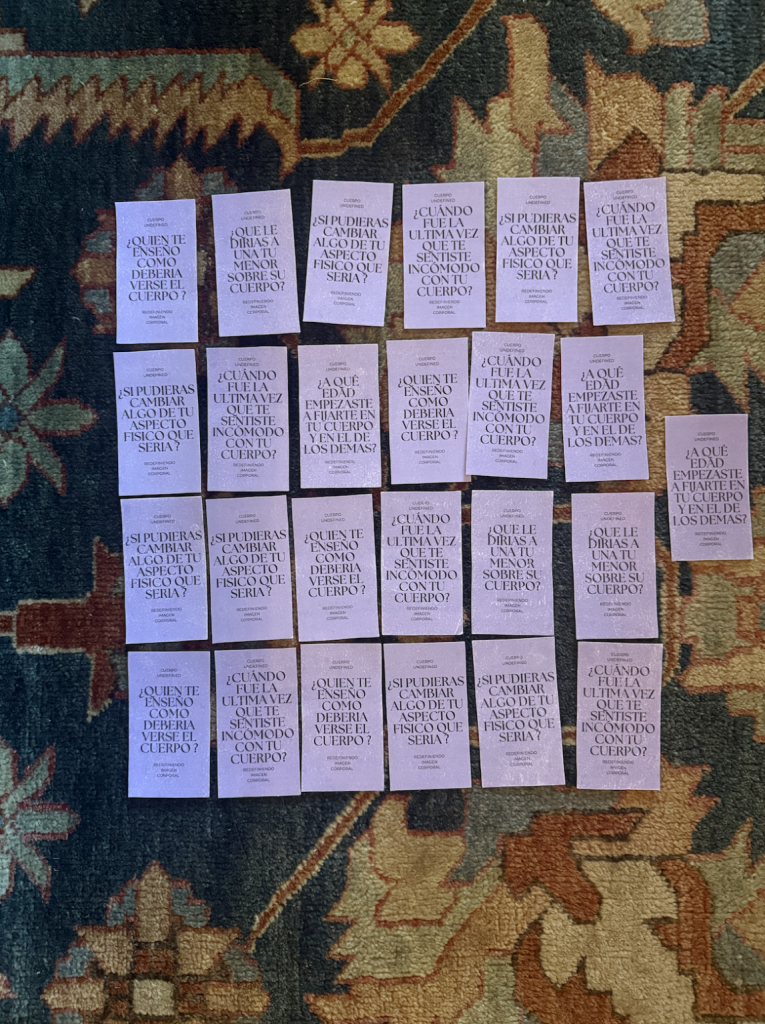
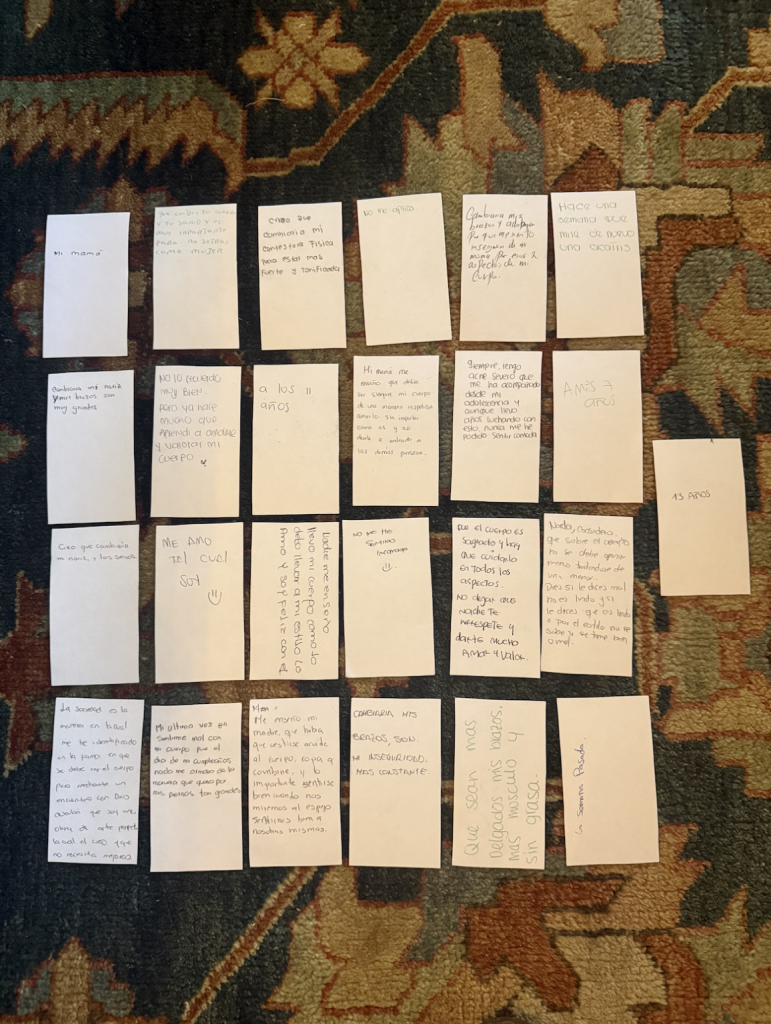
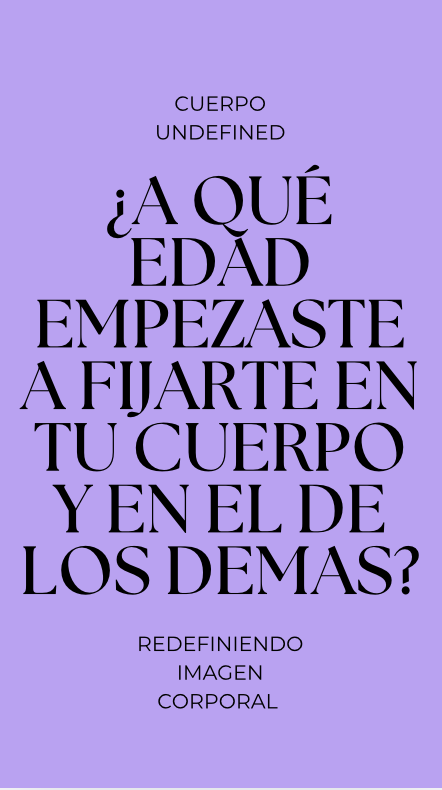
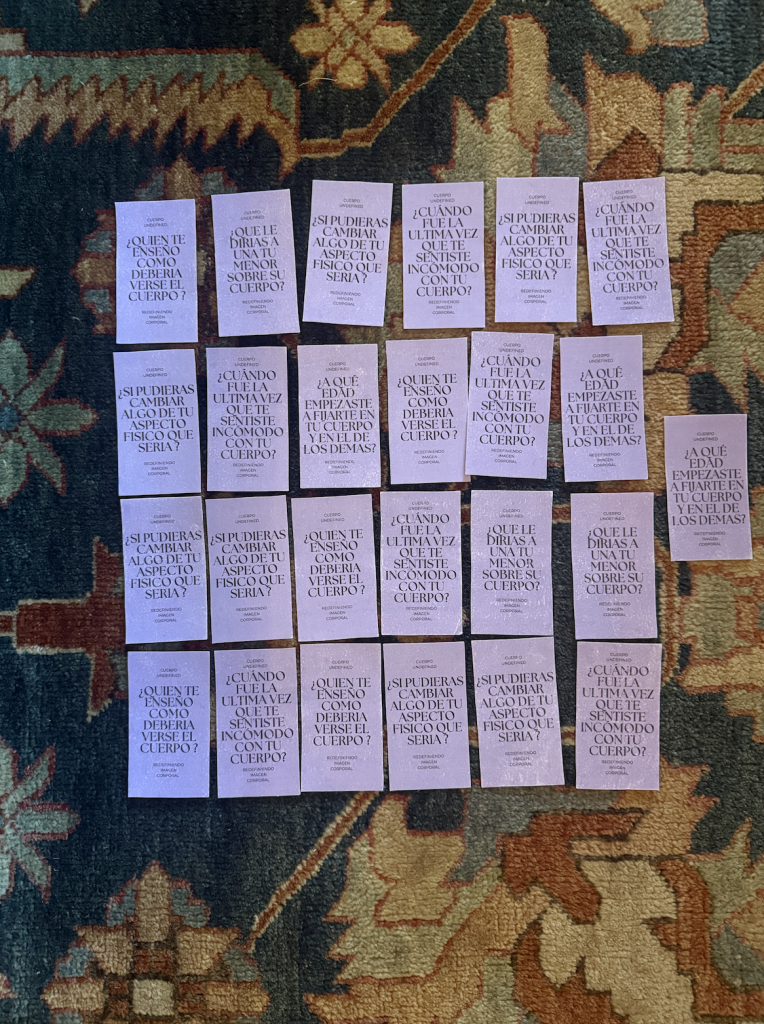
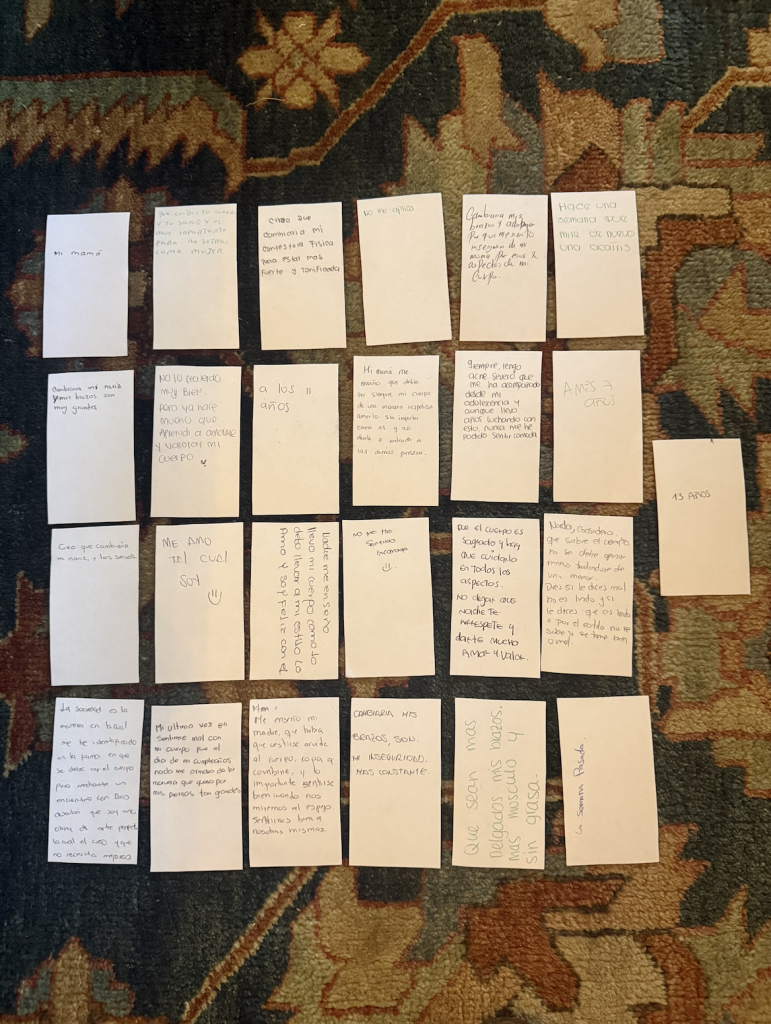
INTERVENTION 4: Questions in the note cards at malls. This intervention was interesting to me because it had people interact with a material, starting with the color itself. I wanted the note cards to be periwinkle because that is the color used for ED awareness. Still, in reality, no one actually asked about this; they just answered the question, and at times they were confused and didn’t know what to answer. I had to explain to them that it was how they felt; they did not have to write an entire paragraph to answer, and if they felt that the question did not apply to them at all, they could say that as well because that would show me that I was not asking the right questions or maybe that I was asking them from my own assumptions. This was interesting because, of the 30 people I asked to participate, 26 said yes. The others were closed off to participating, which is also valid. Still, it made me challenge myself because at the beginning I was nervous I would run into people I know or get other people’s reactions. Still, it was important because that was part of the process, and I can learn from it because people were actually very kind in this work.
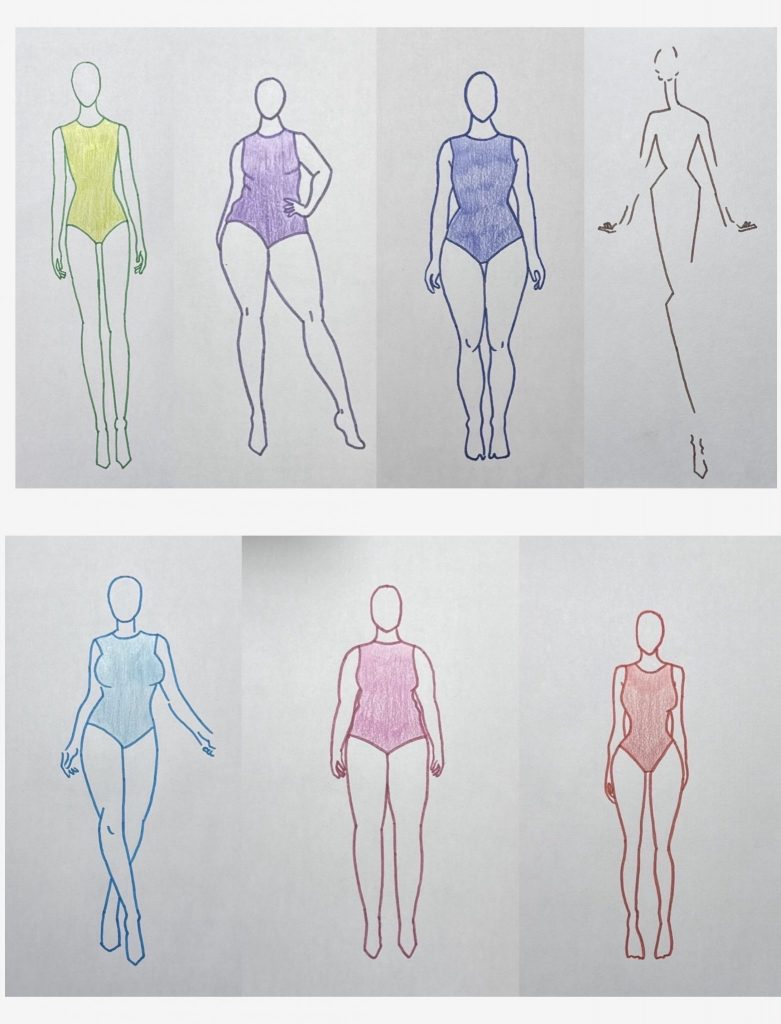
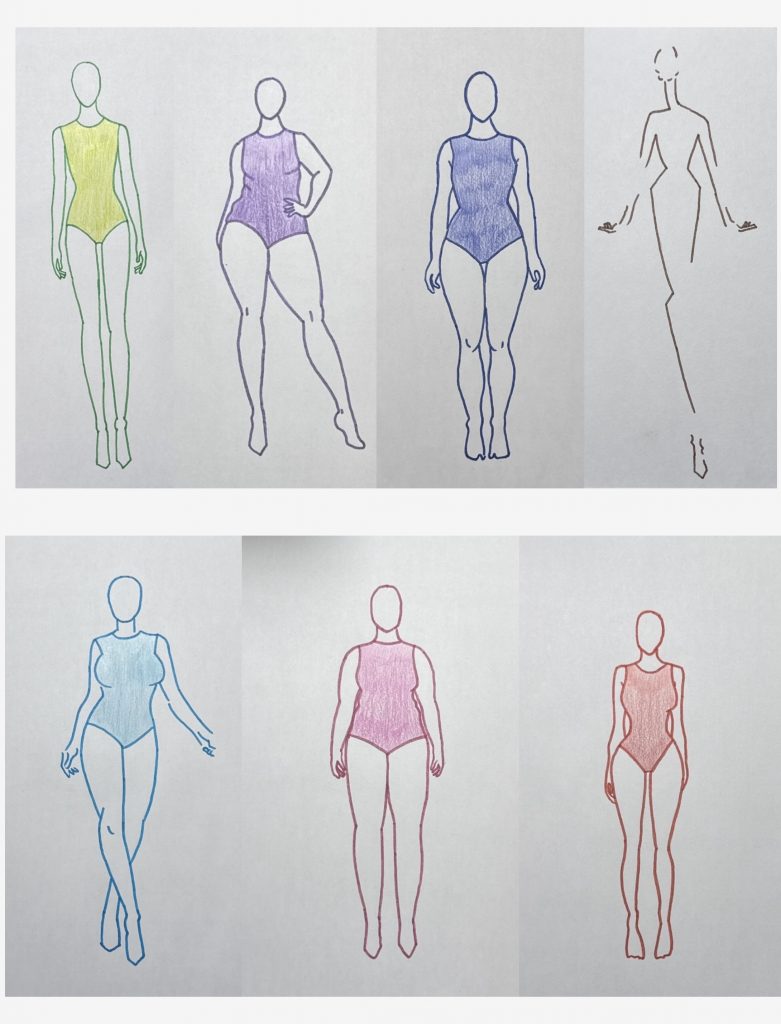
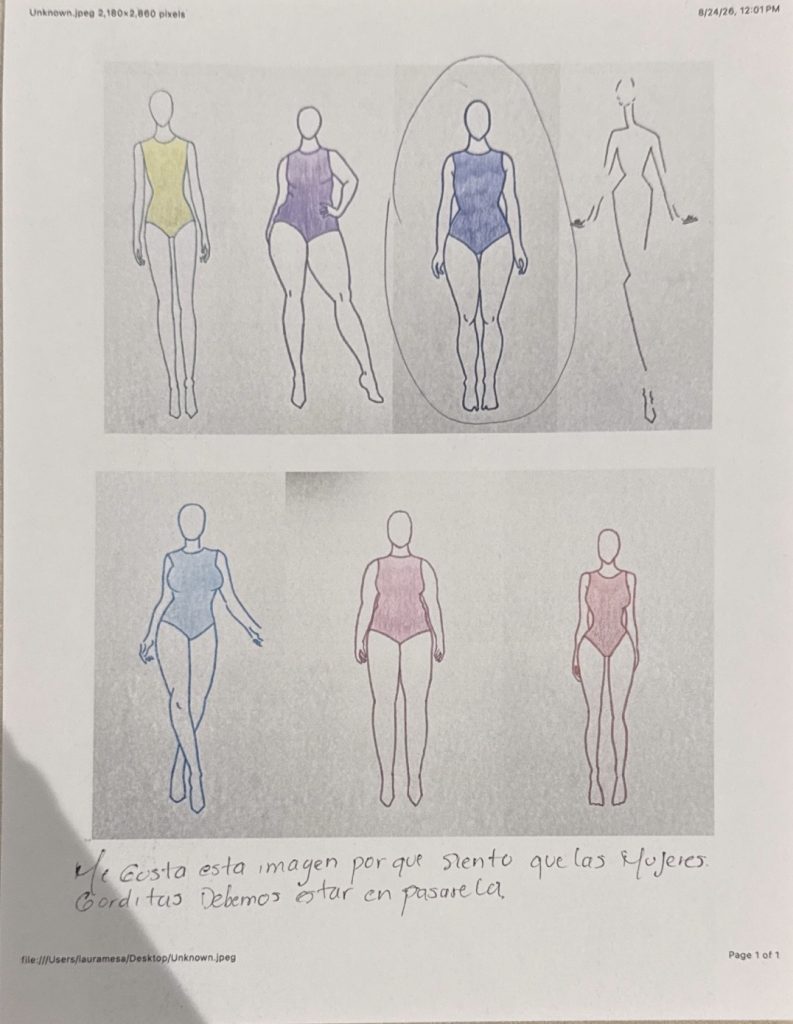
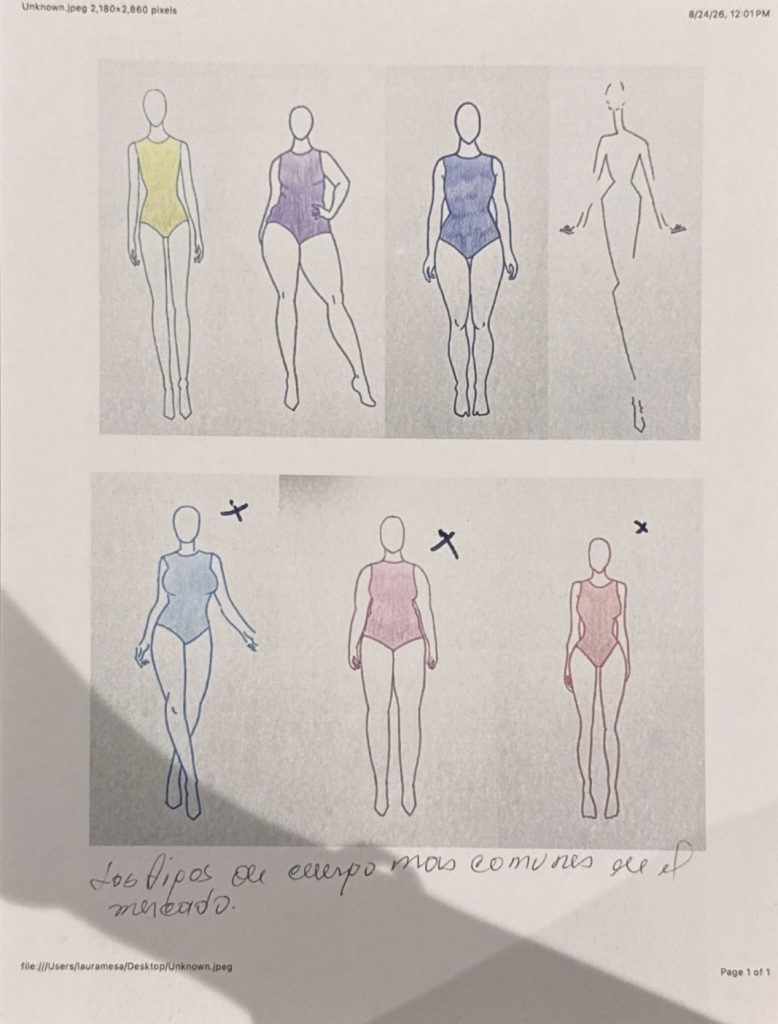
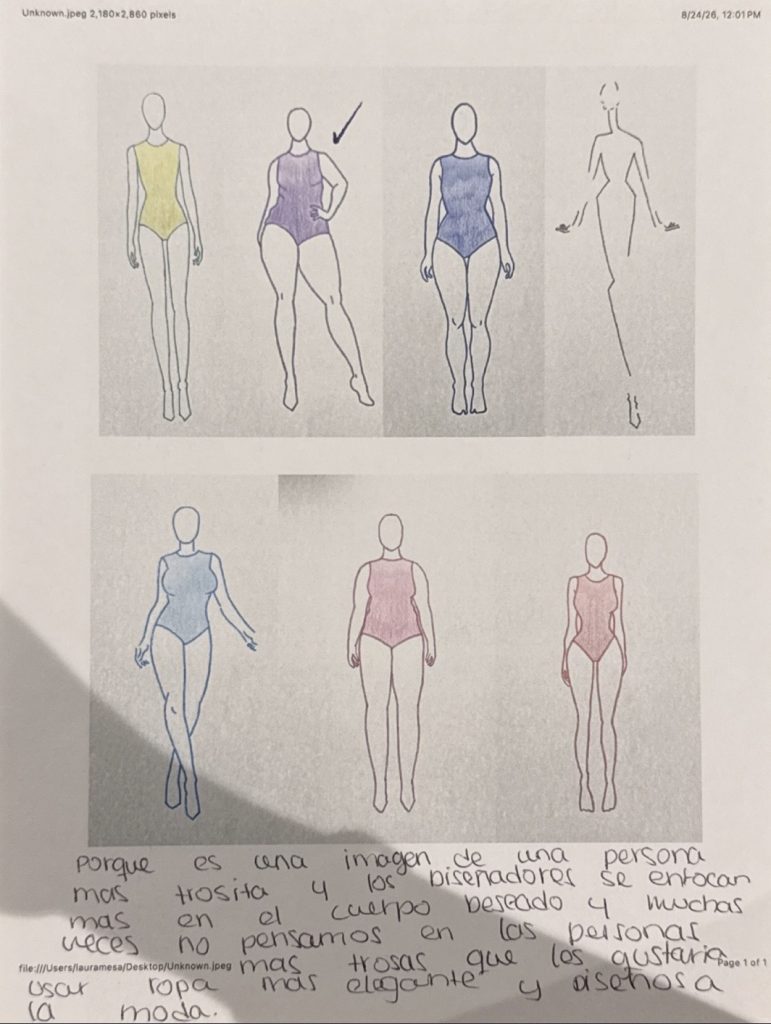
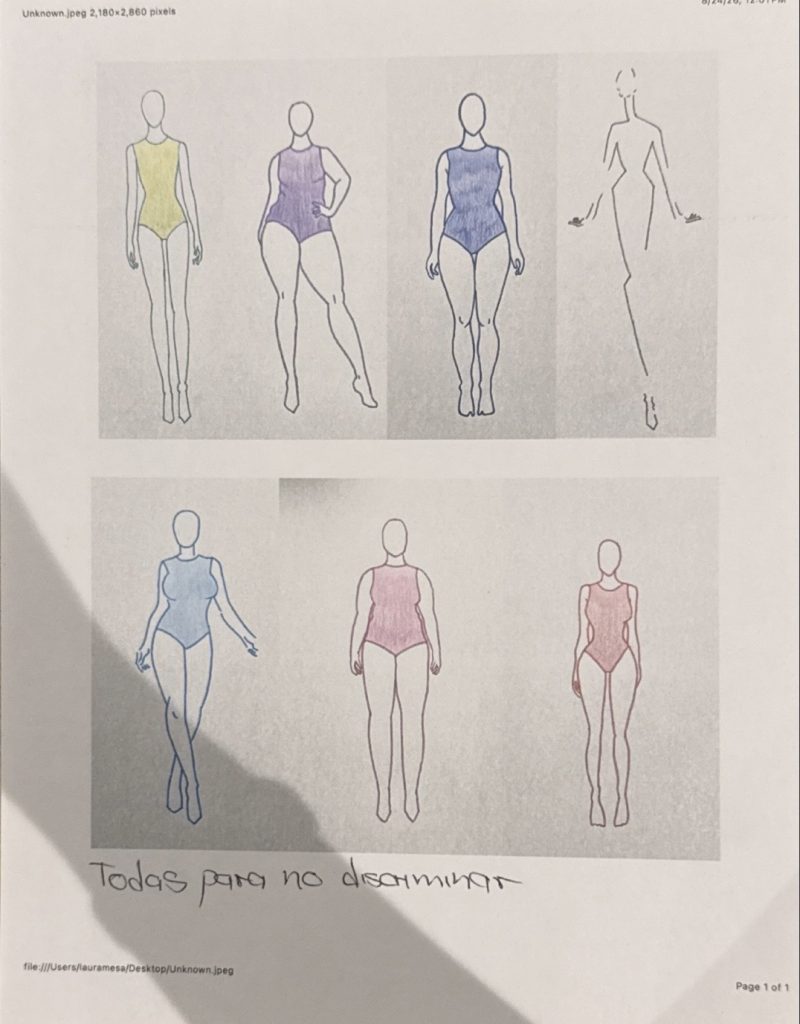
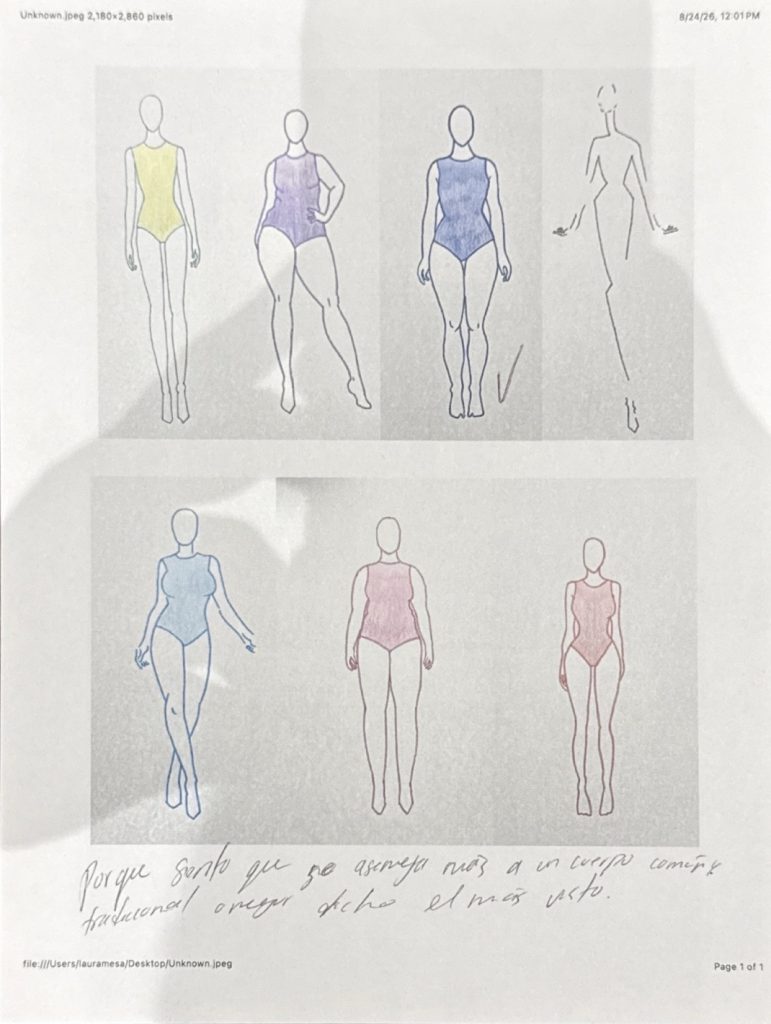
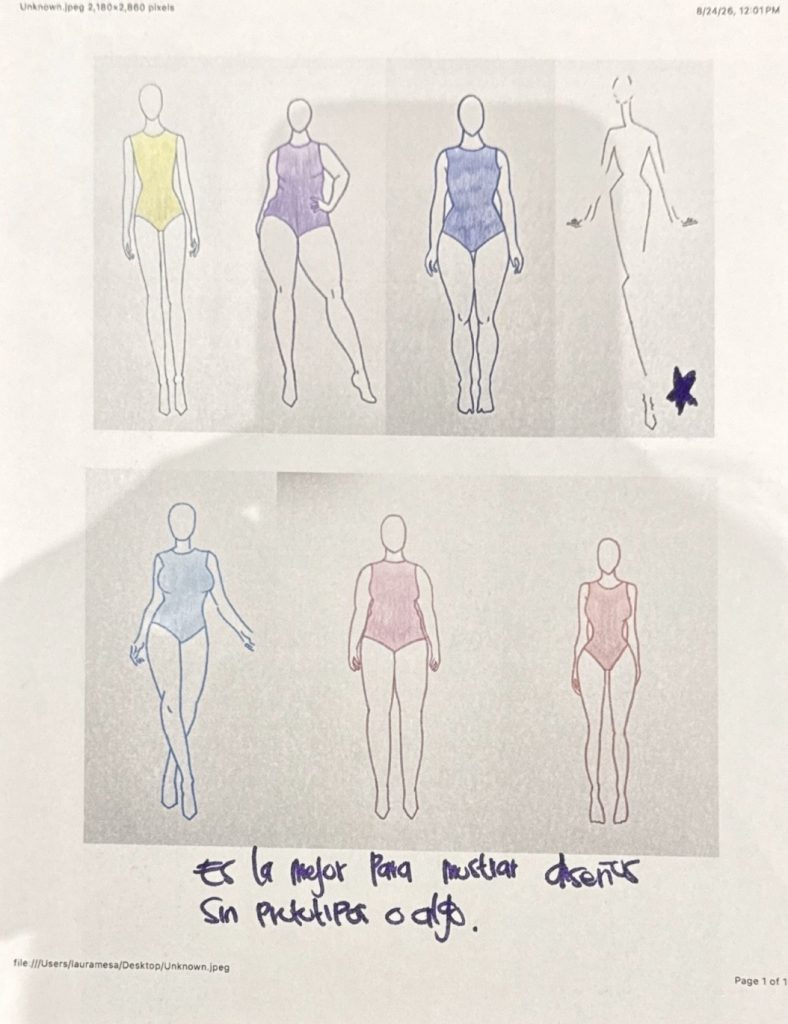
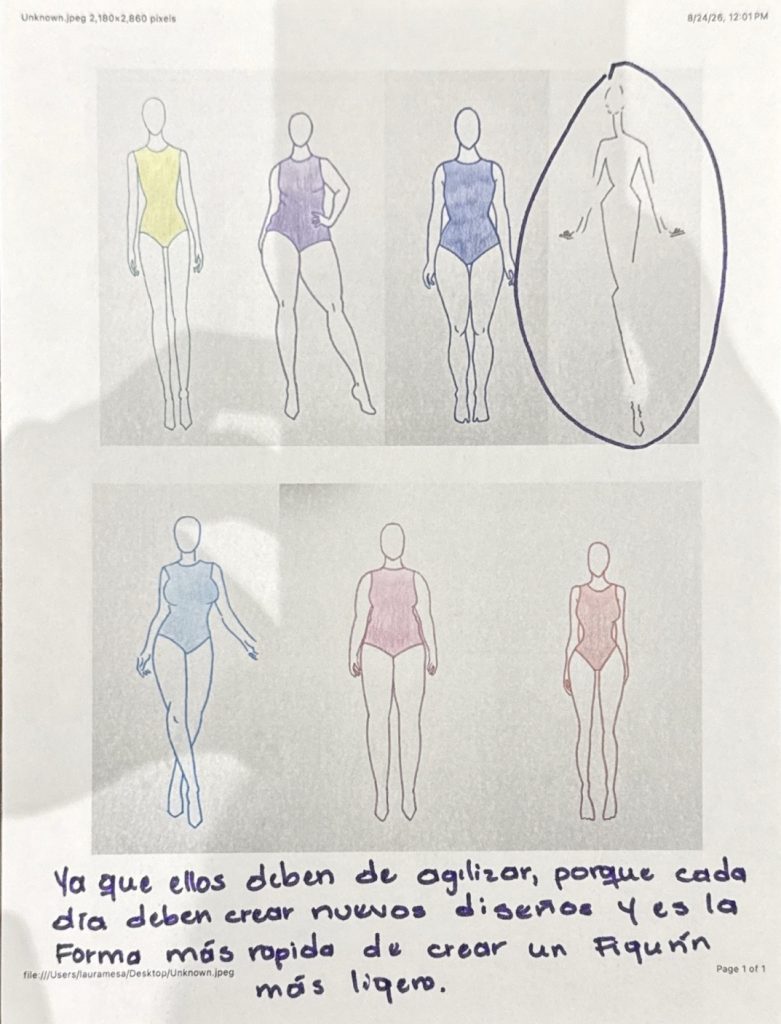
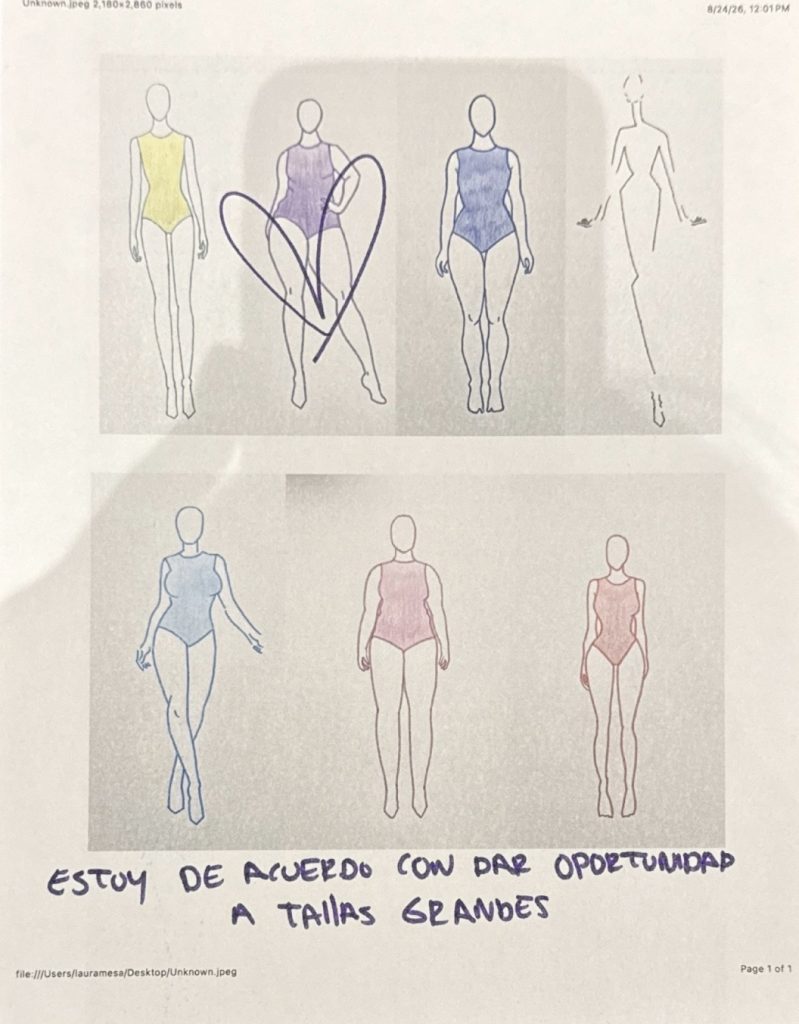
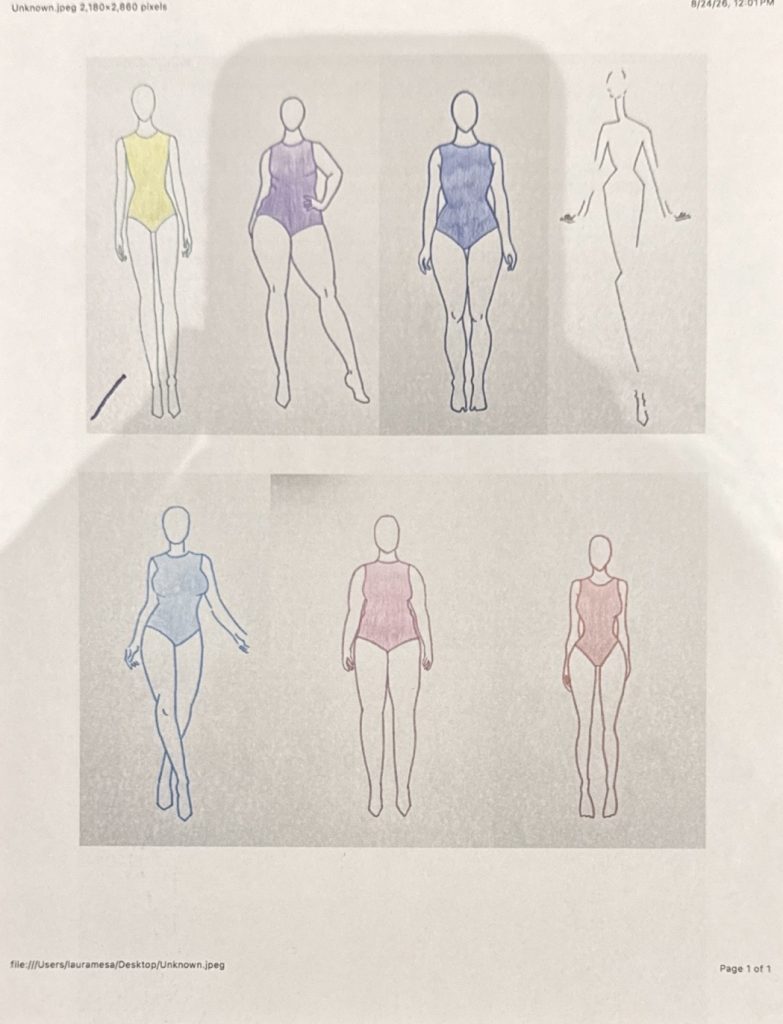
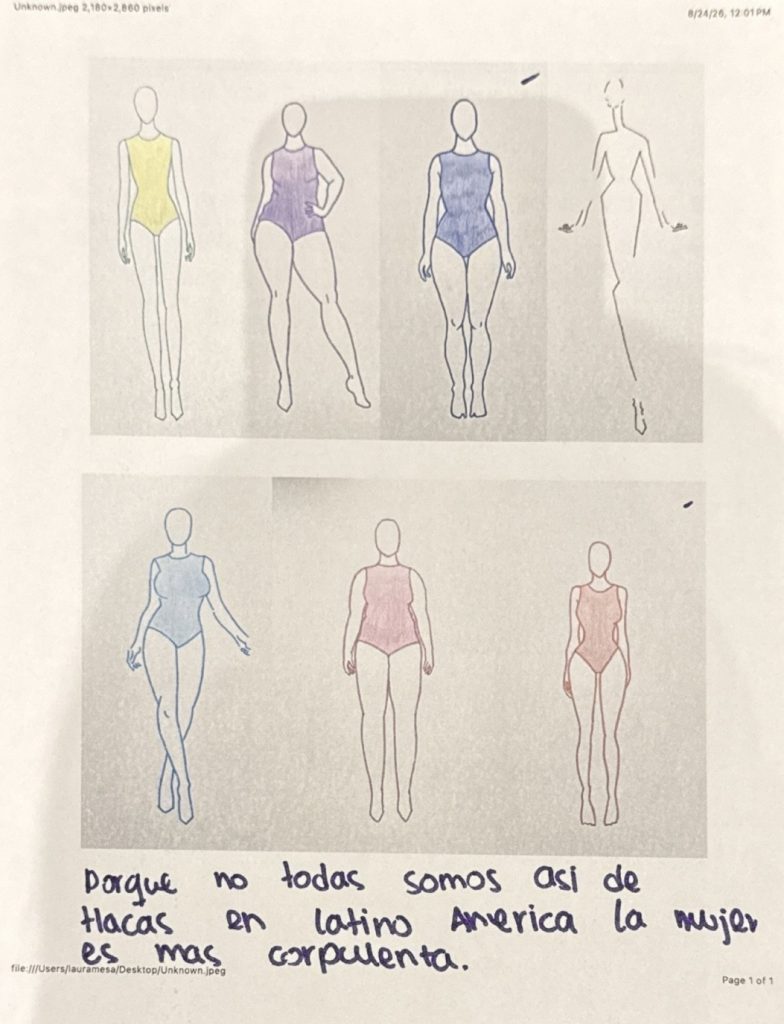
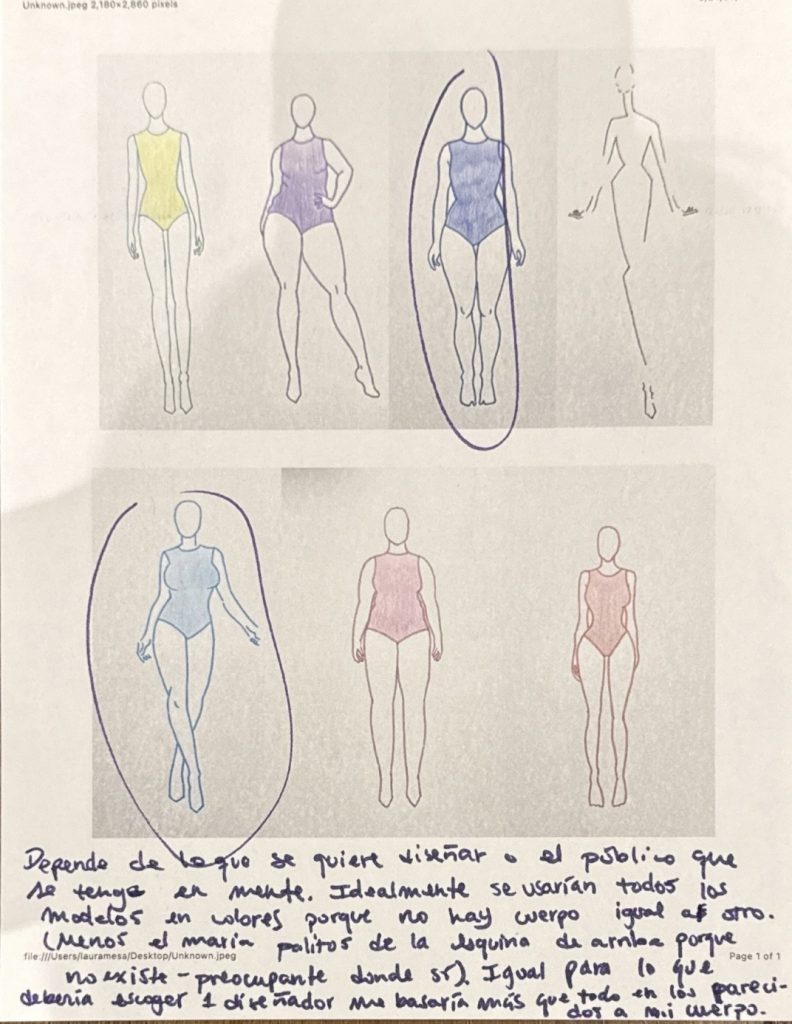
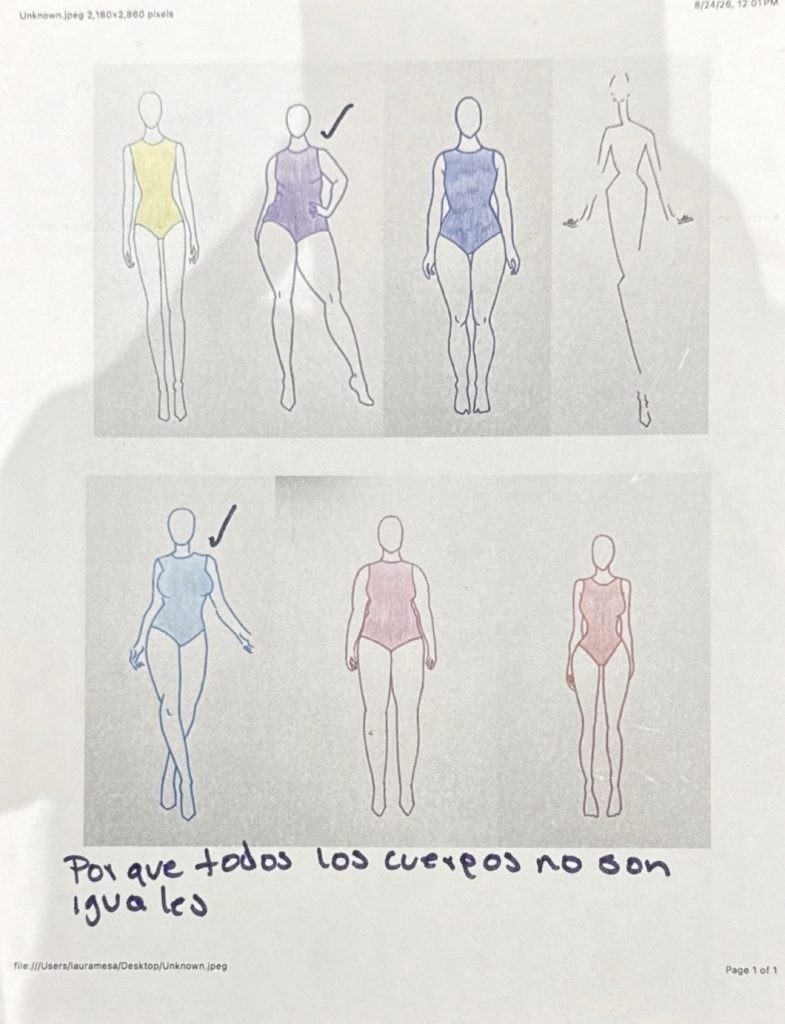
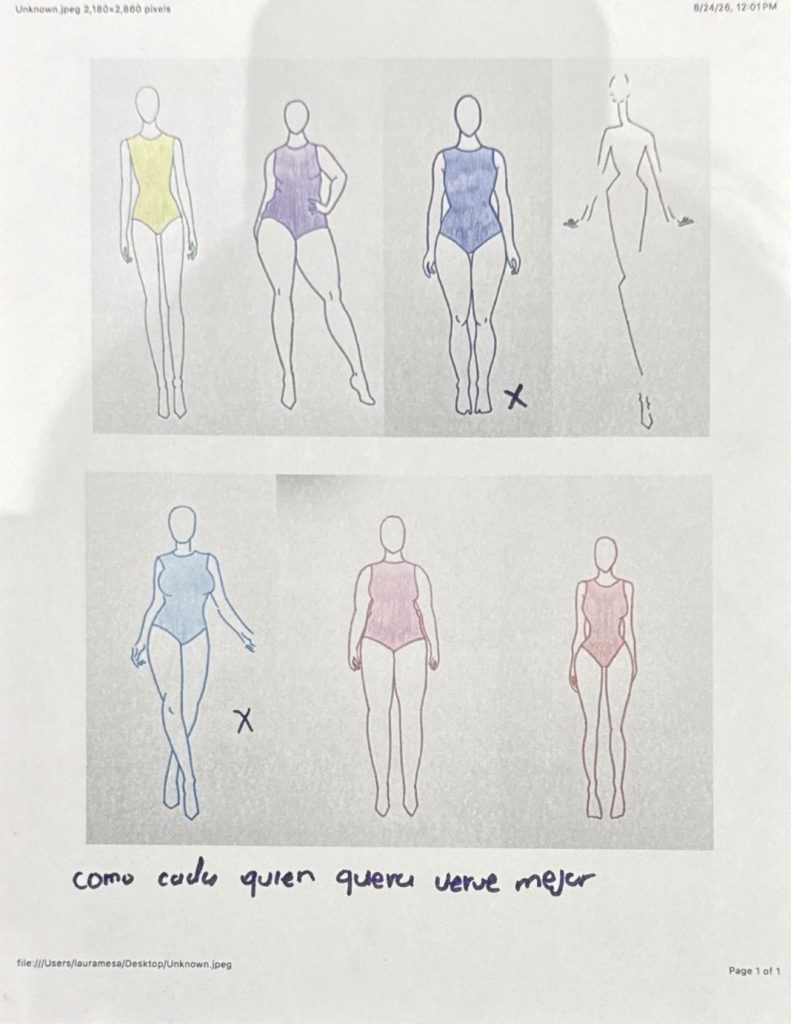
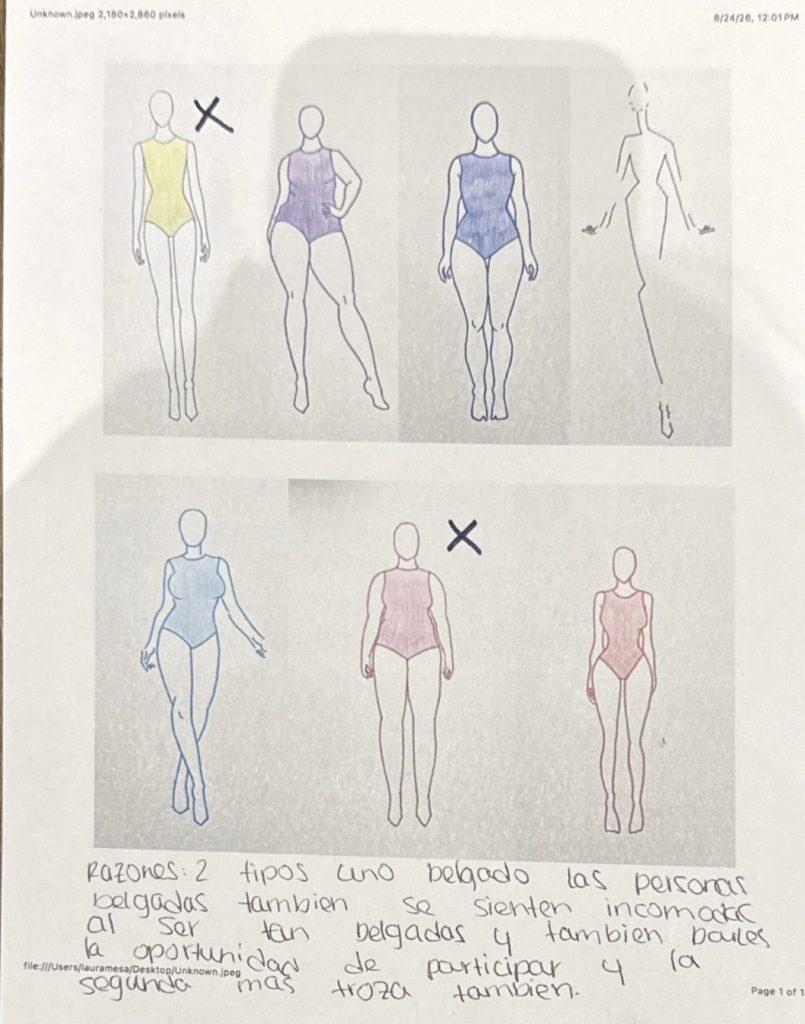
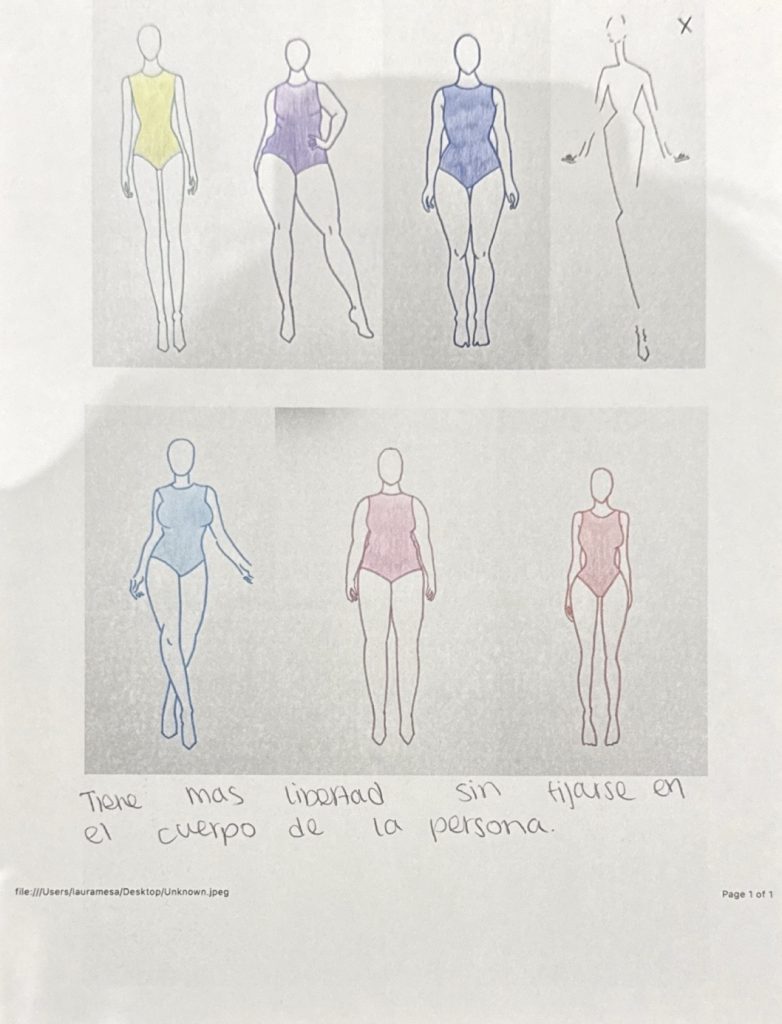
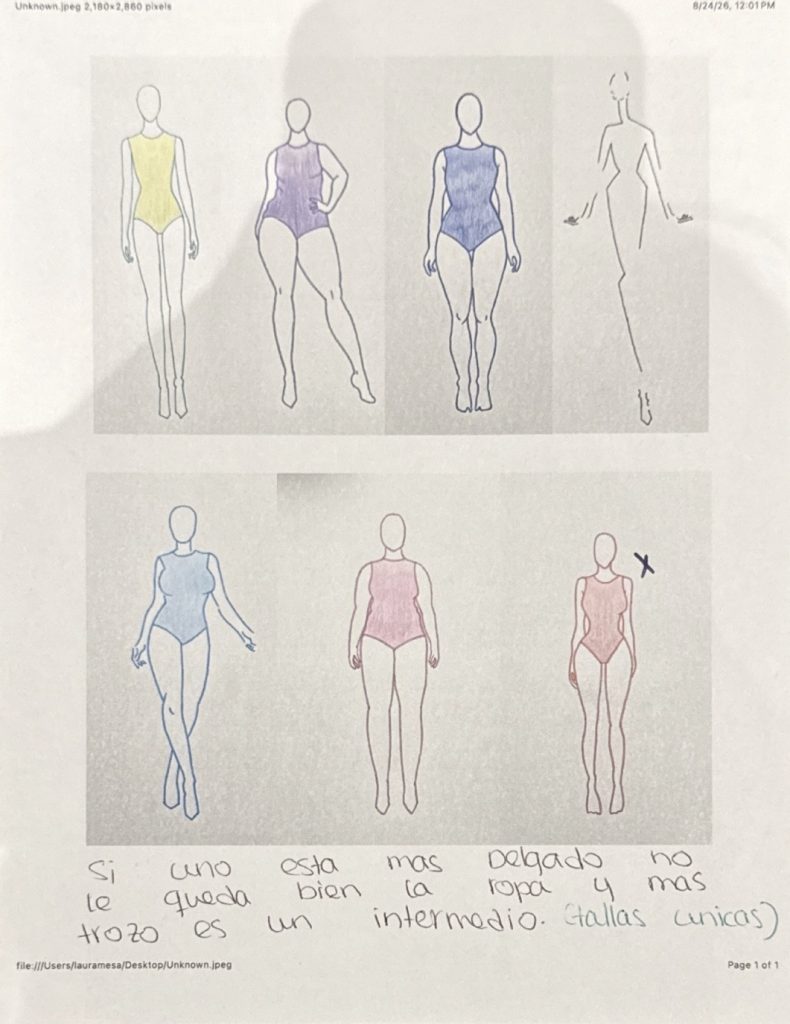
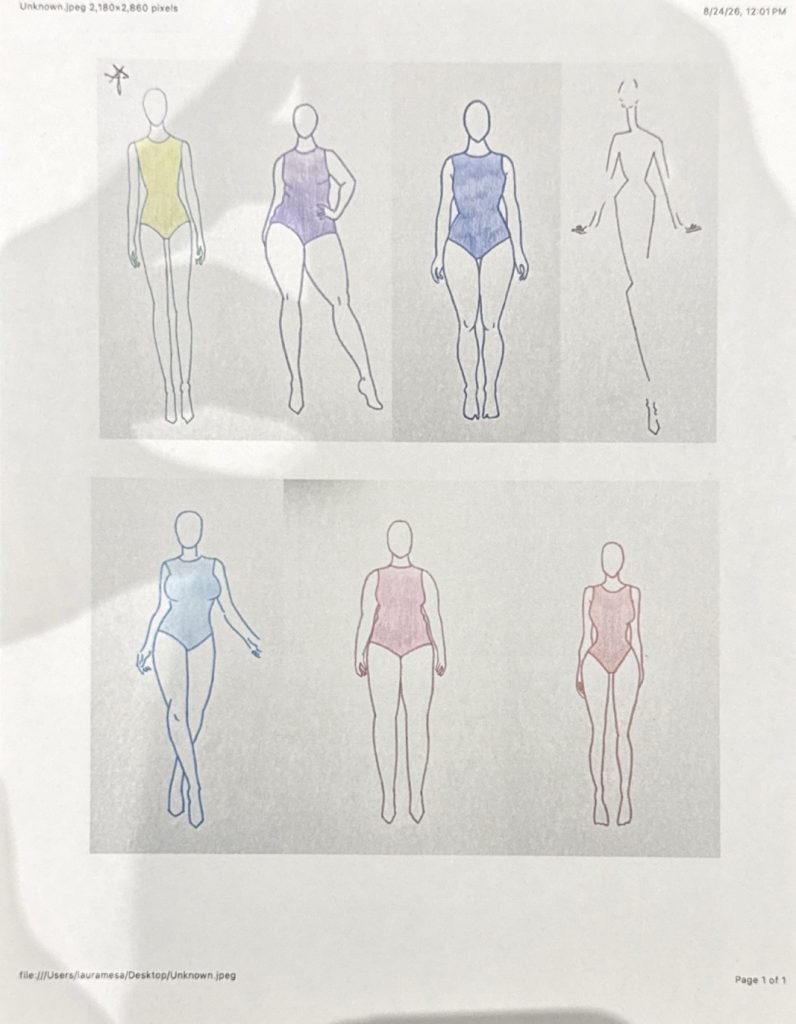
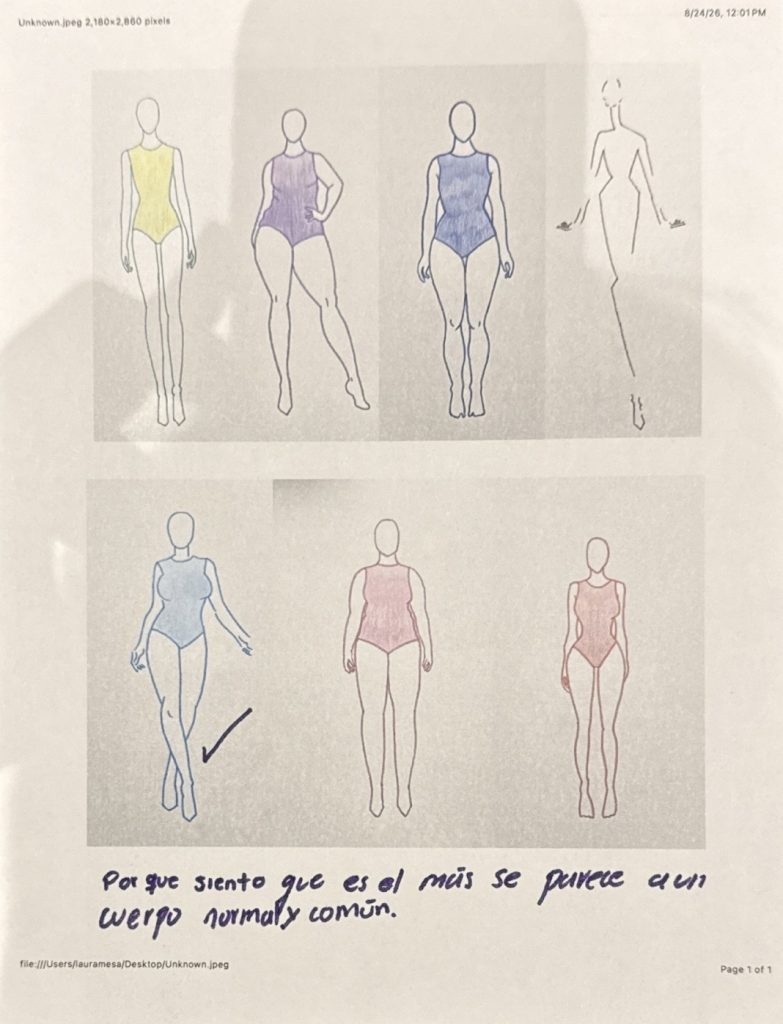
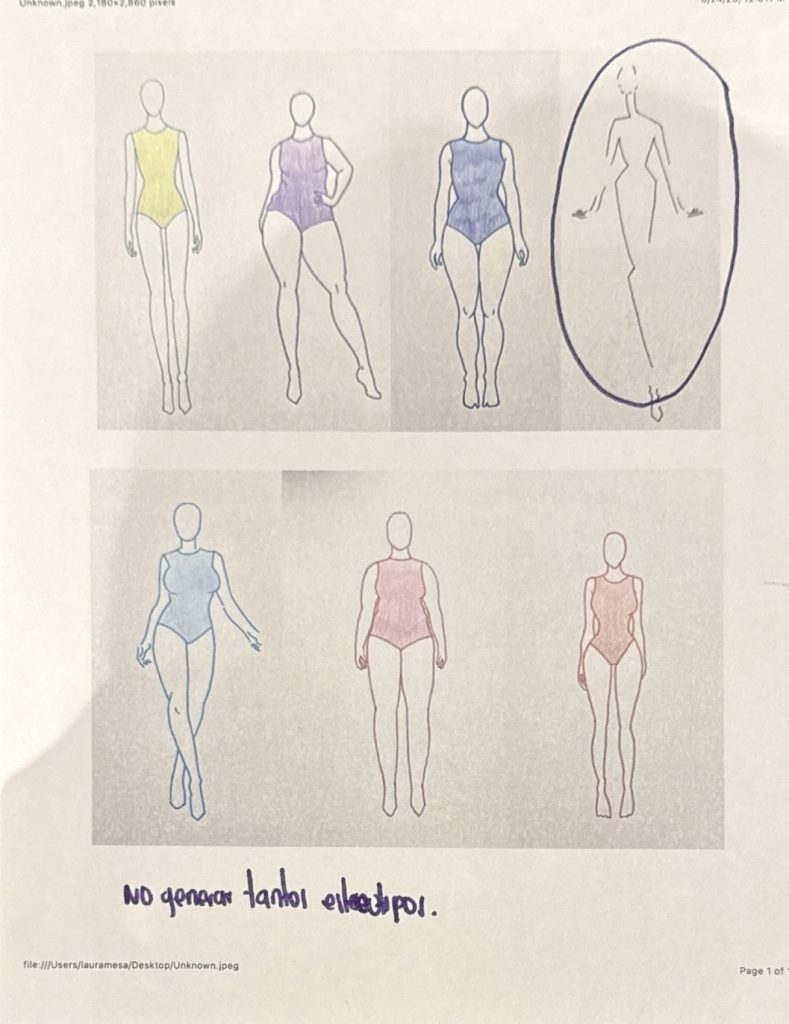
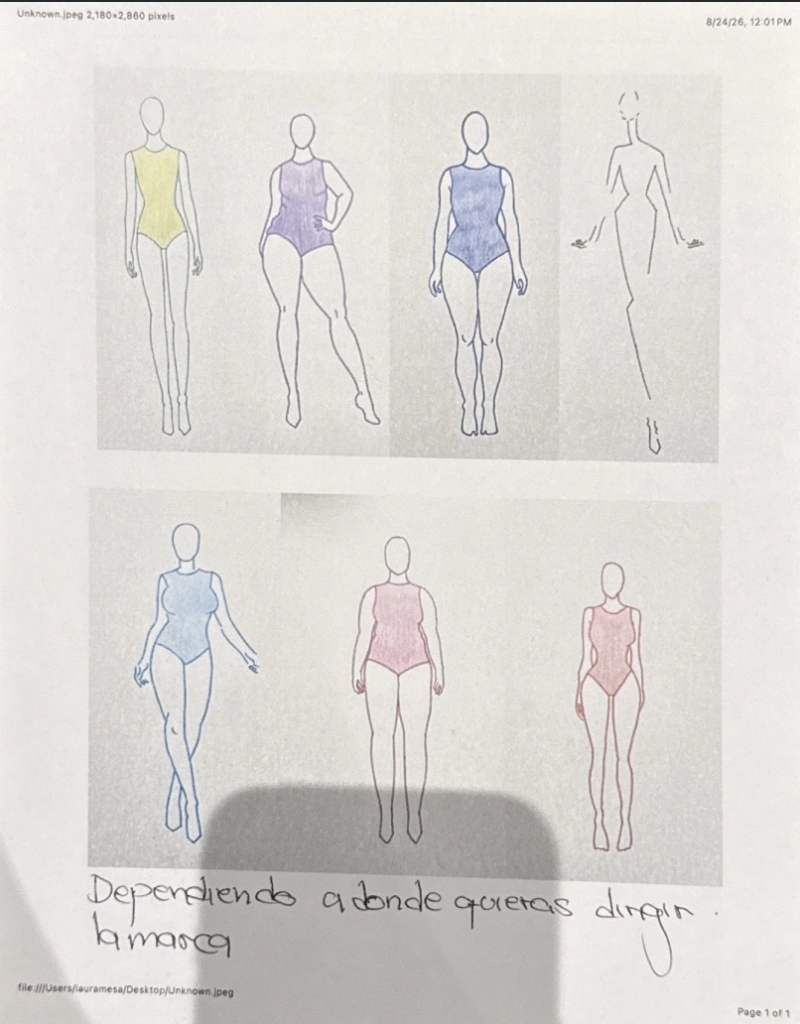
INTERVENTION 5: Artifact of different silhouettes fashion designers use and which they would think is the most appropriate and the reasoning behind it. This was really interesting to me because I felt people were very receptive, even if some of them did not answer the why they thought it should be used for the designers; some of them did, and this was very interesting to look at because it shows that people are actually interested in participating in some field research like this, even if it is unanimous. I learned a lot because many conversations started among the participants, which was a byproduct. After all, since I did this work in a shopping mall, there were times when groups of people did it at the same time and started discussing. (One other observation I can add to this is from my own experience from designing because when I was younger I used to do illustrations on regular bodies or bodies that actually looked real and when I was applying to college for art I started to work with different tutors and they would tell me that they preferred it when i would do the illustrations on thinner bodies and that it could help me make them more professional and this is something I have been thinking about during this entire process because it makes me think about how even I at the beginning would consider that fed into this stereotypes even for myself). Also, there were a lot of people who told me that they really wanted bigger women to be more represented and that it was important to see it from this perspective because if we are saying that it is easier to design for someone slimmer, then we inherently are saying that it is easier to dress someone thinner. In these specific interventions, I spoke to around 20 people, and no one said they were not interested. They all participated, which I found interesting because in other interventions I had heard more reservations about participation, for example in the focus groups.
What did your research tell you?
- My research showed me that people facing different struggles, as well as healthcare professionals in this field, feel it is important to discuss this subject and to acknowledge that it shouldn’t be glamorized.
- While writing some of the information above, I thought about how society and culture create this problem. On the other hand, we sometimes see it as a problem of the person suffering through it, which is completely incorrect. Still, when I was speaking with a Nutritionist from Denmark, she told me that, at times, from the stereotypes we have created, people think that all people suffering through eating disorders are the same. They should all be getting the same treatment; however, this is not the case because people who are suffering through these disorders are living them in different ways, which is also very important to look at specifically when I am looking at the perspective of education. This distinction is important to make extremely clear.
- One thing I noticed in my research is that a lot is talked about on both ends of the spectrum because there is so much information out there. Still, there is a lot of information about how to lose weight and diets that you should be doing if you want to look a certain way; a perfect example can be the influencer (Liv Schmidt, who is an influencer who speaks of extreme thinness and how to sustain it). Several accounts speak about the culture of body positivity and inclusion of all bodies. For example, there are accounts on social media such as (Fat Art History, Baby Panpan, Nalgona Pride, Historical Fat People, etc.)
- When I was out talking to people in the malls, many of them told me this is an important topic to discuss because they still see it as a problem. Even though there has been growth, stores still didn’t offer a wide range of sizes, especially when they were exclusively Colombian brands. They were very responsive; however, one thing that really shocked me was that after they participated, they asked me if they chose the right one, when that wasn’t the point, and it is important to understand that in some cases there is no right or wrong answer.
- I learned that most people view their relationship with their body through the lens of how their parents saw themselves and how they were spoken to when they were younger, because many received criticism that they had to lose weight.
- I have also spoken to several athletes. They speak about how there was a lot of pressure that came from their coaches and the people they looked up to which is very concerning because the people who are older and who are supposed to be taking care of you are putting pressure on you and telling you you will be a good athlete when you reach a specific body instead on focusing on technique and being strong but putting an emphasis on the size in a sort of thinness.
- Also, from several conversations I had with psychologists and researchers, one subject kept coming up. It was the one Sabrina Springs speaks about: the book and investigation about “fearing the black body.” When I talked to different people, they all talked about the Eurocentric form of body image; however, when I look at this, one thing keeps coming back. It’s that there are far more specialized treatment centers in Europe than in Latin America. Hence, it feels as if we adopted the stigma, and after adopting it and seeing the effect it has had on different groups of people, there is little we have done about it.
What insight did you take from it?
- One specific insight I found was the fact that even in environments such as malls there was a lot of emphasis on the fact that a lot of people thought that having a slimmer model would give the designers an easier shot at doing more designs in a day and this was an assumption I saw as well as them thinking that there would be less prejudice and more body inclusion if the designer or sketches were done on bodies that could not even exist which is an interesting point to look at because what make it so much harder why do people think this is a reality.
- I also took on the insight that when people are doing this kind of work anonymously there are a lot more people who are receptive and are open to it because it was a question I got asked a lot however when people see it is me doing it and I talk about it people get very confused and do not understand why it is that I am doing this which is also a struggle because there are a lot of people questioning my reasoning behind it and some of my family is even ashamed and sais that it is something that should not be talked about in different spaces for example we were at a restaurant and I was talking about what I had done that day with my family the day I took my intervention to the mall to get people to react to it and I heard some laughter by some of my family members and my younger sister was embarrassed and did not want me to continue working on it she said it was embarrassing but honestly it makes me think even more about the stigma we have around the subject and how it is something that should not even be talked about.
- I learned that people were more willing to participate in this subject than I expected, especially when they were told their names wouldn’t be included.
- What did you create/do/change as a result?
- One of the first changes was that I started the Instagram Cuerpo undefined, and we went through names and different logos because I started getting outside feedback and decided to take it. They told me the logo was hard to understand, so I made another one. Still, people around me thought that it looked sad, which led to a change, and a publicist who is a family member of mine helped me create a new logo, which she thought would be better; however, I received some criticism or feedback on that one as well, but decided that at some point people were going to have opinions. Still, I had to guide myself and decide what I wanted to do, not base it only on all the feedback, because that is part of the issue. (I think that people are always commenting on your appearance, specifically your family, because there are always people saying how if you changed your makeup, clothing, body, you could look better, but it is up to you to decide what you take and what you don’t).
- Then I did the silhouette artifact which I think that I could really expand upon this because it is important to look at it and how people had different ways of reacting to this artifact I love how one of them actually included a heart and spoke so positively about larger bodies, I also was very impressed by the conversations that the people participating started having which I found very interesting and a lot of them gave opinions on how there is a lot of discrimination and the way that there are only a couple of stores that have so much of a size range.
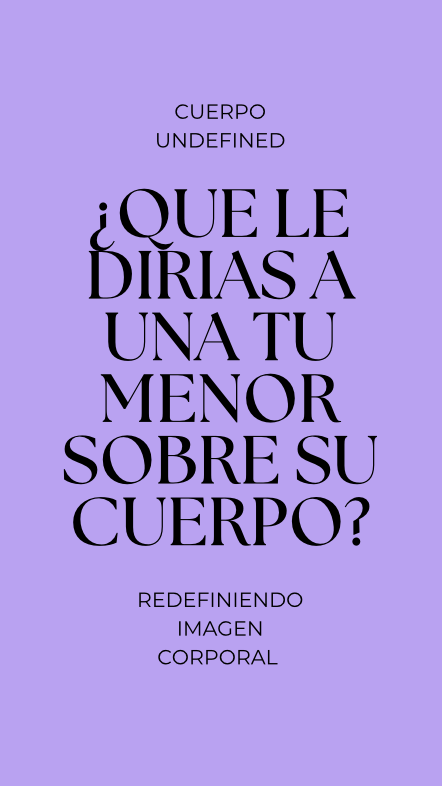
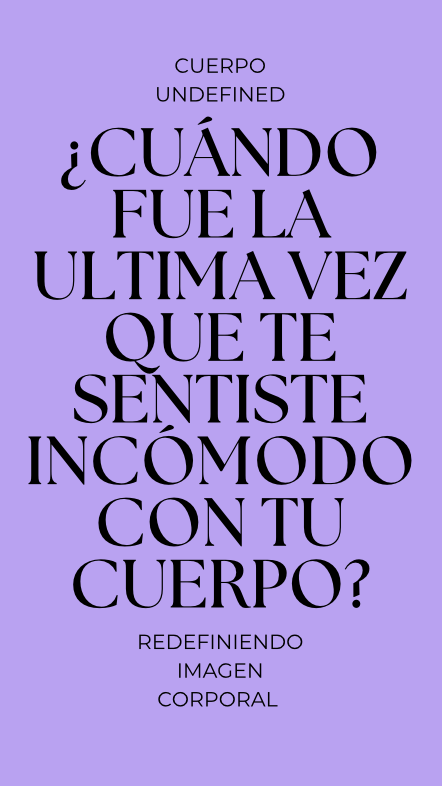
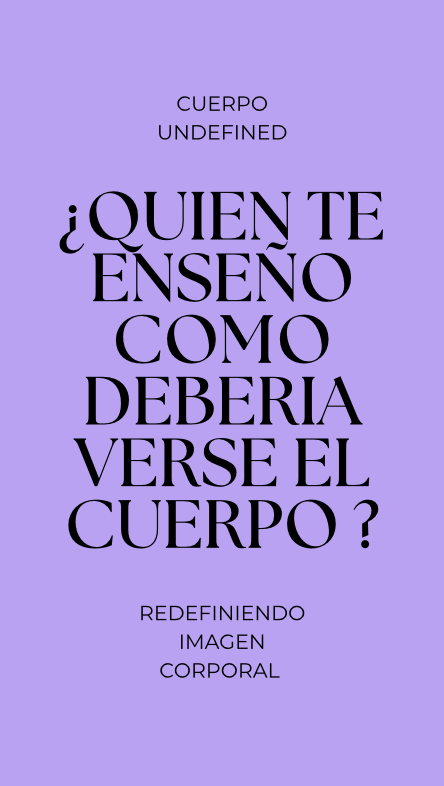
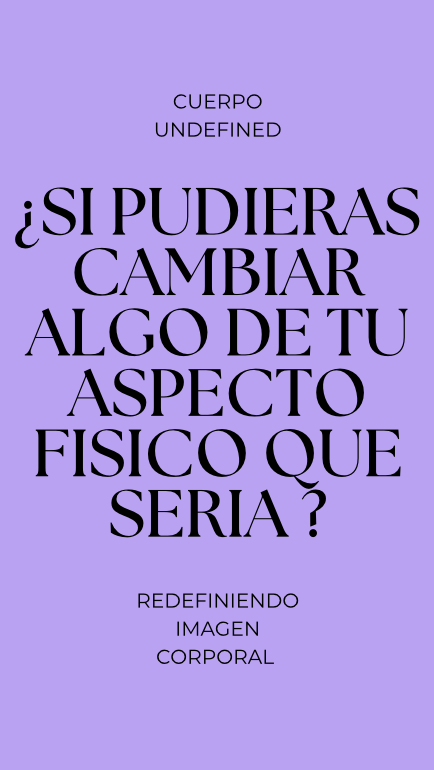
- I also created a sort of intervention with the periwinkle note cards, which was a color I chose because of its significance, but I also looked at the questions I was asking, which were (What would you tell a younger you about their body?, When was the last time you felt uncomfortable with your body?, Who taught you what your body should look like?, If there was something you could change about your physical appearance, what would it be?, At what age did you start noticing your own body and everyone around you?) I cut these out and had people write their answers on note cards so they could interact with the papers and the questions. This was a good test, and I did something similar but with a more put-together artifact.
- I created a Padlet so people could participate and answer questions anonymously, without issues around feeling seen or exposed.
- The last change may have nothing to do with the project and more to do with myself, because I discovered and started feeling more comfortable being uncomfortable. What I mean is that I was okay with being told no and being turned away. Still, I also started to reach higher the more comfortable I got; for example, there is this group or page which I really admire, which is the account “el cuerpo que somos,” and from seeing them I actually gathered up the courage to contact them even if they were from my environment in Medellin, which at times intimidates me. I was actually able to get a meeting with them on Wednesday, which I really appreciate and am very excited for, but this came from a change in my own perspective, which is a change from doing all of these different interventions, whether I realize it or not.
How did you test the intervention?
- I tested different groups; I wanted to go to the mall twice. I wanted to change it to soup, which is why I tested one intervention at one mall and the other at another. I decided to change it to soup because I realized that one of the malls was bigger and had a larger population. It also serves as a metro station, which means there are more people there at all times, which is why I decided to do my second intervention there; however, this was through learning. I was grateful I could do my intervention either way.
- I also had private meetings, which were an attempt to get groups together, but they didn’t work out; however, the people who participated in the one-on-ones agreed to collaborate further down the line if I needed help, which I really appreciated and which could lead to something greater.
- When people were not willing to participate in meetings or did not have time, I gave them the option to participate in a Padlet, and I honestly got a lot of different responses and was able to further analyze different things going on through this, including how some people view their disorder differently.
What happened and what did you learn?
- From the entire process, I started to realize it was a lot easier for me, or I had more people participating, when it was one-on-one because I wasn’t constantly worried. I don’t know why I’m shyer and more concerned about being judged by people I actually know, so I learned that about myself.
- I learned there are a lot more people willing to participate than I was ready for. People actually appreciate what it is I am doing which I learned from call backs getting people together and the reactions I gathered however I also understand that this is a very hard subject to deal with and a lot of people do not feel comfortable being so open which leads to cancellations and changes but this is part of the process as they say in our masters we need to embrace uncertainty so when I have meetings I am always ready for one person to join or everyone or no body so far I have not had everybody who says is going to show up actually make it however it is something I am starting to live with.
- One of the main things I learned is that when it is anonymous, more people are willing to participate.
What will you change or test next?
- There are a couple of changes I need to make in my next test: I am starting to reach out to a wider variety of people because so far I have spoken to medical professionals as well as people who are in recovery or recovered. I need to broaden this even more to include creatives and designers. Still, I already have a meeting with one of them tomorrow that I found online; however, I have been reaching out to Colombian brands and hope to create something soon. I also need to do more testing so maybe next time I will actually include a sketch of a dress or a garment in different body sizes and see which one people are more drawn to I also want to start getting more people to participate creatively maybe even with drawing something but this is still something I have to further think about, I also need to work further on my instagram because I have been focusing more on the other interventions but need to look at this one with more detail. I need to keep moving forward no matter the roadblocks because I have had a lot, and there are times when I have felt discouraged, but I have kept going, so I need to keep going with that impulse. I was also given some feedback that maybe I might want to try a podcast without a face or make some of my blog post outward facing I still need to look at this but something very important to me is that I need to continue working with my tutors and especially listening to the blind spots I might have and how I can continue forward for example the idea of contacting Colombian brands was Zuelinka and I need to keep moving forward because I can’t just stay waiting and doing the same things and expecting different results for example if I had just stayed with focus groups instep of going out and trying something different.